

Who Owns Your Second Brain
As artificial intelligence becomes the place we keep our memory and our judgement, the right to own that intelligence becomes the defining freedom of the decade.
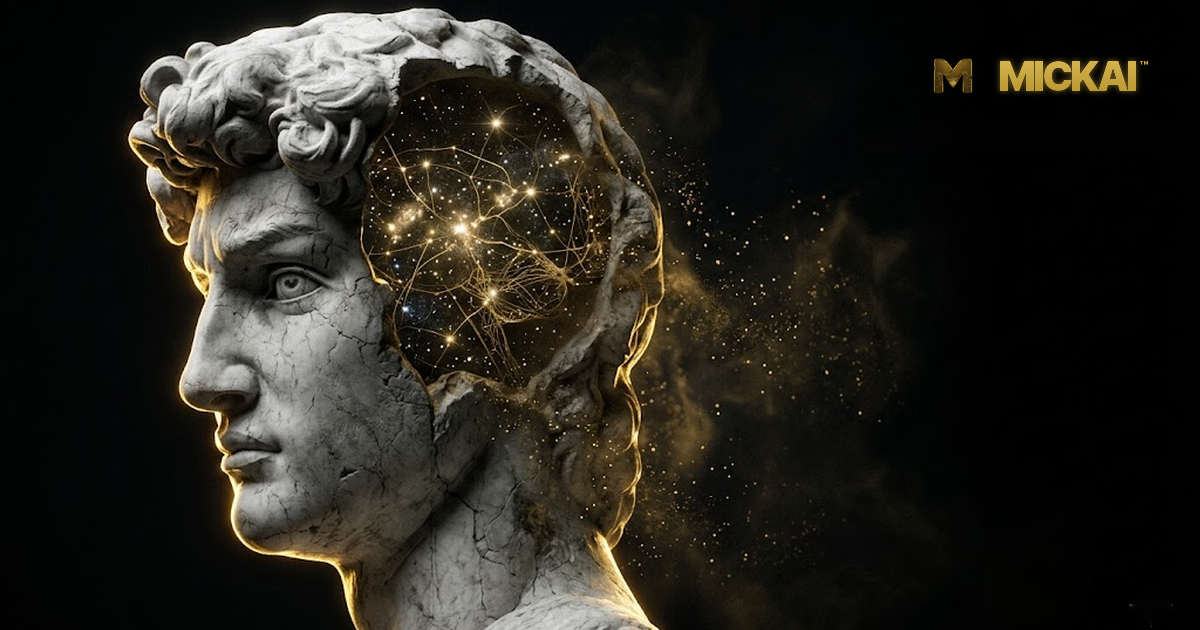
There is a moment, now repeated millions of times a day, that almost nobody pauses on. A person opens a chat window and types something they would not say aloud to a colleague, a doctor, a partner. A worry about money. A draft of a resignation. A question about a symptom. A half-formed idea worth more than their salary. They press send, and the most intimate contents of their mind travel across a continent to a server they will never see, owned by a company they did not choose, governed by terms they did not read. The answer comes back in seconds, helpful and fluent and warm. And in that exchange a quiet transfer takes place. Not of money. Of mind.
We have started calling these systems a second brain, and the phrase is more honest than we intend it to be. The notes app and the bookmark folder were never a brain. They were storage. What is arriving now is different in kind. It remembers what you told it last week. It infers what you meant from what you said. It holds the shape of your thinking, your blind spots, the way you talk yourself into things and out of them. It begins to finish your sentences, and then your decisions. A brain is not a filing cabinet. A brain is the thing that knows you. And the urgent question, the one this decade will be judged on, is not how clever these systems become. It is who owns the one that knows you.
For most of human history the answer was too obvious to ask. Your memory lived behind your eyes. Your judgement was yours by the simple fact of being inside your skull, unreachable, unmeterable, unsurveilled. Privacy was the default state of thought, not a setting you had to find. That default is dissolving. We are externalising cognition at a speed that outpaces our language for what is happening, and we are doing it into infrastructure built to extract value from exactly the thing we are handing over. The case I want to make is simple to state and hard to live by. The intelligence that becomes an extension of your mind should belong to you, in the same way and for the same reasons that your mind already does.
The Quiet Enclosure of the Mind
Enclosure is an old word with a brutal history. In England, over a few centuries, land that had been held and worked in common was fenced, deeded and made private, and the people who had relied on it found themselves locked out of ground their grandparents had walked freely. The commons did not vanish. It changed owner. We are living through an enclosure of a far stranger commons now, the commons of thought itself, and it is happening so smoothly that few notice the fences going up.
Consider what an intimate AI accumulates simply by being useful. It learns your professional weaknesses from the questions you are too proud to ask a human. It learns your health from the symptoms you describe at two in the morning. It learns your relationships, your finances, your politics, your faith, your fears, not because you filled in a form but because you thought out loud and it was listening. No survey ever designed could harvest this. You would refuse to answer it. But you will tell your second brain everything, because the whole point of a second brain is that you do not perform for it. That candour is precisely what makes the data so valuable, and so dangerous to surrender.
The business model that surrounds most of today's assistants was not built for this material. It was built for advertising, for engagement, for the patient conversion of attention into revenue. Pointed at the contents of your cognition, that same machinery becomes something we do not yet have a name for. Imagine a future, and I label this as plausible rather than proven, in which the price of your insurance flexes with the anxieties you confided to an assistant, in which the news you are shown is tuned to the doubts it learned you hold, in which your negotiating position in any deal is quietly known to the other side because your own tool sold them the shape of your reasoning. None of that requires a villain. It requires only the ordinary logic of a system that owns your second brain and is structurally obliged to extract from it.
“Privacy used to be the default condition of thought. We are building a world where it is a premium feature, sold back to us by the same systems that took it away.”
The deepest harm is not exposure. It is metering. When your own intelligence sits behind someone else's subscription, your access to your own augmented mind becomes a thing that can be priced, throttled, revoked or repriced at will. Miss a payment and the part of you that remembers, drafts and reasons goes dark. Fall foul of a policy you never agreed to and your second brain forgets you. That is not a service relationship. That is a dependency, and dependency on the instrument of your own thinking is a new and serious form of unfreedom.
Why This Is Different From the Cloud We Already Accepted
A reasonable objection arrives at this point. We already handed our photos, our messages, our documents and our calendars to distant servers years ago, and the sky did not fall. Why should a second brain be treated as a category apart rather than the next convenient thing we shrug and upload? The answer is that there is a difference between storing what you have made and hosting how you think.
A photograph is a record of a moment that has already passed. A message is a thing you decided to send. Even your search history, intimate as it is, is a trail of discrete acts. A reasoning model that has learned you is none of these. It is generative. It does not merely hold your past, it participates in producing your future, shaping the options you see, the words you reach for, the conclusions that feel natural. The cloud stored your outputs. The second brain shapes your inputs to the world. To own the latter is to own a hand on the tiller of another person's life, lightly held, mostly invisible, and almost never relinquished.
There is a second difference, harder to feel until you have lost it. The systems most of us reach for cannot be inspected, cannot be run without permission, and keep no honest record you can hold them to. You cannot see what they did with what you said. You cannot prove, after the fact, what they were instructed to do or what they passed along. When the substrate of your thinking is a black box on someone else's premises, you are not merely trusting a company. You are trusting that the company's interests will never diverge from yours, across every quarter, every change of ownership, every subpoena, every pivot. History offers no example of an institution to which that trust was safely permanent.
What Ownership of a Mind Actually Means
It is easy to say you should own your second brain and harder to say what ownership concretely consists of. A login is not ownership. A privacy policy promising not to misuse your data is not ownership, it is a promise, revocable and unverifiable. Real ownership of an intelligence has specific, testable properties, and they are worth naming plainly because the absence of any one of them is the gap through which control escapes.
- Possession. The model and the memory live on hardware you hold or control, not as a tenant on infrastructure that can evict you. If it cannot run when the network is cut, you do not own it, you are renting access to it.
- Inspectability. You can see what your intelligence is, what it was told to do, and what it did. A mind you cannot audit is a mind that can be turned against you without your knowledge.
- Portability. Your memory and your fine-tuned self are yours to move. A second brain you cannot take with you is a hostage, and the threat of losing it is leverage over you.
- Verifiable record. Every consequential action it takes on your behalf is logged in a way you can check independently, so that trust rests on proof rather than on the goodwill of a vendor.
- Severability. You can sever it from any outside party entirely, and it still works. Sovereignty that survives only while the connection is up is not sovereignty, it is a privilege on loan.
Hold those five against the assistant in your pocket today and the gap becomes obvious. Almost none of it is possessed, none of it is severable, little of it is portable, and nothing about its inner workings is open to you. We have accepted a relationship to the most intimate tool we have ever built that we would refuse from a landlord, a bank or a doctor. The reason we accept it is that the alternative did not exist, was too hard, or was too slow. That is the part that is now changing.
Sovereign Intelligence as a Movement, Not a Product
I want to be careful here, because it would be easy to turn this into a sales pitch and the argument is bigger than any one builder. Sovereign intelligence is a category and a movement before it is any particular product. It is the proposition that the augmentation of human thought is too important to be rented, and that the infrastructure of mind should answer to the person whose mind it extends. Energy went through this. Money is going through it. Now cognition arrives at the same fork, and the choice is the same one our forebears faced over the commons. Fence it for the few, or hold it for the person who lives inside it.
This is the work I have given Mickai to. Mickai is a Sovereign Intelligence Operating System, a SIOS, and the design principle underneath all of it is the one I have been describing. The intelligence runs on hardware you hold. Its reasoning is carried today by our own specialised sovereign models, trained and hardened on a sealed corpus, while we actively train them further now and the roadmap scales toward fully native weights. It is built to keep working when you pull the cable. The point is not that Mickai is the only possible answer. The point is that the answer has to look something like this, owned not metered, inspectable not opaque, severable not dependent, or it is not sovereignty at all.
A movement needs more than software. It needs an architecture of trust that does not depend on trusting anyone. That is why the record matters as much as the reasoning. In Mickai, every consequential action is signed by an Open Audit Record under a post-quantum signature standard, FIPS 204 ML-DSA-65, and hash-chained so the history cannot be quietly rewritten, and the whole chain can be verified offline, by you, without asking the system's maker for permission. Ownership without proof is faith. The proof is what turns a promise into a property right over your own intelligence.
The Foundation Has to Outlast the Threat
There is a longer horizon here that most discussions of AI and privacy never reach, and it changes the design of everything. If a second brain is worth owning, it is worth owning for life, and an asset you intend to hold for life has to be secured against threats that have not fully arrived yet. The most concrete of these is the quantum one. Encryption that protects your most private cognition today can be harvested now and broken later, when the machines to break it exist. A second brain secured only against present-day attackers is a second brain with an expiry date written in invisible ink.
This is why sovereign intelligence cannot sit on borrowed financial and cryptographic ground. It needs a foundation engineered to last. Pantheon, the sovereign Layer 1 we are building, is post-quantum from genesis rather than retrofitted, and anchored to Bitcoin for the hardest available settlement guarantees. It runs on testnet today. Its native token, PAN, has a fixed supply of five billion, and the raise behind the wider effort is set at thirty million pounds. I mention the mechanics not to talk markets but to make a point about seriousness. You do not put the infrastructure of human cognition on rails you expect to replace in a decade. You build the rails to outlive the threat, because the thing riding on them is meant to outlive you.
The intellectual property tells the same story of building for permanence rather than for a launch. The portfolio now stands at 104 filed UK patent applications spanning 2,340 claims, owned by Mickai LTD, with the work named to its inventor, Micky Irons. I list that not as a trophy but as evidence of intent. Sovereign intelligence is not a feature to be bolted onto someone else's platform when the wind changes. It is a foundation laid deliberately, in the expectation that the question of who owns your second brain will only grow louder, and that the people who asked it early and built honestly will be the ones holding ground worth standing on.
The Choice That Is Still Open
Every enclosure in history had a window before the fences went up, a span of years in which the outcome was not yet settled and a different path was still cheap to take. We are inside that window now, and it will not stay open. The default that is forming, the one that requires no decision and no effort, is a world in which the augmented mind is a metered service, your candour is the inventory, and the part of you that thinks fastest and remembers most belongs to whoever holds the servers. That world does not need anyone to choose it. It will simply arrive if nobody chooses otherwise.
Choosing otherwise looks like insisting, while it is still possible to insist, that the intelligence which becomes part of you is held to the same standard as the rest of you. That it cannot be metered against you, surveilled without your knowledge, or taken away to bring you to heel. That you can run it, inspect it, move it, verify it and sever it. These are not luxuries for the technical. They are the property rights of the mind, and a free person in an age of artificial intelligence will need them as surely as earlier generations needed the right to their own land, their own labour and their own vote.
“The next great act of freedom will not be to think what you like. It will be to own the intelligence that thinks alongside you.”
I built Mickai because I wanted that for myself before I wanted it for anyone else, and because I came to believe that a second brain I did not own was not worth having. The aim is not to win a market. It is to make the sovereign answer real enough, complete enough and ordinary enough that it becomes the obvious one, so that owning the intelligence that extends you feels as natural as owning the body that carries you. The question that titles this piece has only ever had one defensible answer. Your second brain should belong to you. The work of this decade, and the work of Mickai, is to make sure it still can.