


The AOG Technics lesson: document review depth is a safety issue
The AOG Technics fraud showed that shallow certificate checks are a safety gap, and that cross referencing every release document at receiving is how the one that does not add up gets caught.
Document review depth is a flight safety issue, and the AOG Technics case proved it: more than 60,000 aircraft parts were sold with forged release certificates between 2019 and 2023, more than 180 engines were affected, aircraft were grounded at major carriers, and the fraud ended only when a single engineer questioned a document's origins. Every one of those parts passed a receiving inspection. The paperwork looked right. The lesson is not that paperwork failed. It is that shallow review of paperwork failed.
What actually happened in the AOG Technics case?
A UK registered parts distributor sold engine parts with falsified airworthiness release documentation. Reporting by Simple Flying puts it at more than 60,000 parts sold with forged release certificates between 2019 and 2023, affecting more than 180 engines and grounding aircraft at major carriers. The parts fed the CFM56 family, one of the most widely flown engine types in commercial service, so the exposure spread across fleets and continents. Regulators including EASA and the FAA published notices on the falsified documentation, and operators worldwide were left auditing their own records for exposure.
How it ended matters most. The fraud was not caught by an audit programme, a database or a regulator's inspection. It was caught when one engineer looked at a release certificate and questioned where it had come from. Four years of forged paperwork came down to a single moment of professional doubt.
Why did forged certificates pass receiving inspection for four years?
Because receiving inspection, as commonly practised, checks that a certificate is present and plausible, not that the story behind it holds together. A release certificate summarises a chain of records: the part's origin, the work performed, the approvals under which it was released. A competent forgery is designed to survive exactly the check it will get, a visual review of the form itself. What a forgery cannot survive is cross referencing, because the records behind it either do not exist or do not reconcile. Under volume and time pressure no receiving team can cross reference every package by hand, so nobody does, and forgery lives in that gap.
How does deeper document review catch the certificate that does not add up?
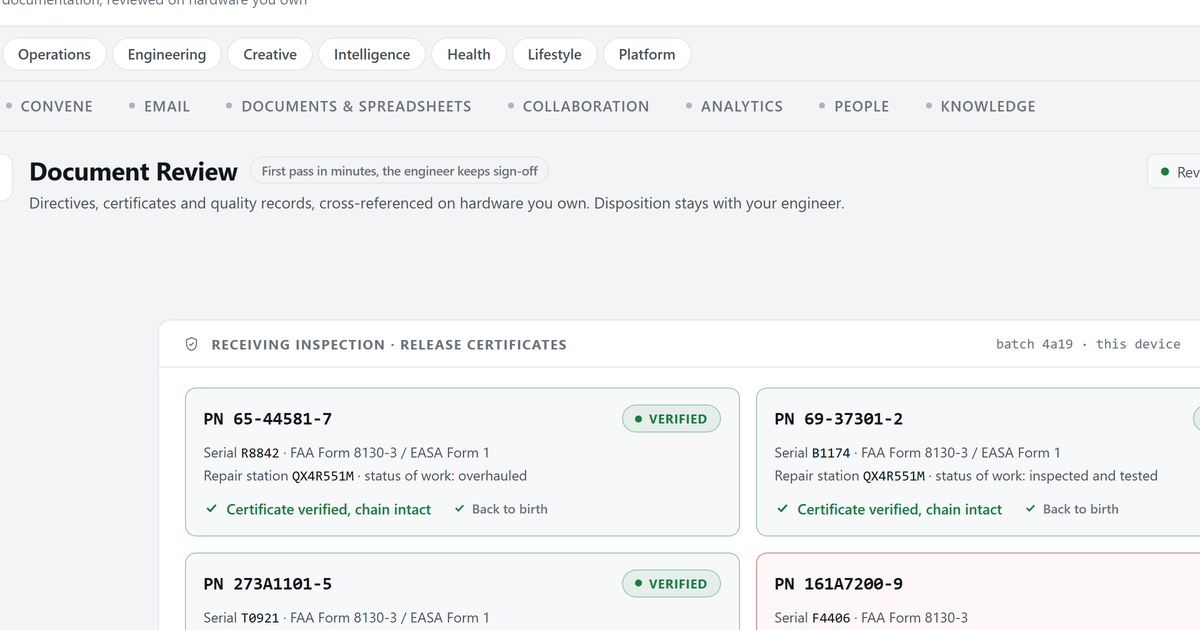
By treating cross referencing as the default rather than the exception. This is what our document review capability does: it reads the incoming documentation package, cross references every certificate against the records behind it, drafts the receiving paperwork for the parts that reconcile, and holds the ones that do not for an engineer. Nothing is sampled. The machine is patient enough to check everything, which a human team under throughput pressure cannot be.
- Certificate fields checked against the purchase order and the declared identity of the physical part
- Serial numbers and batch references checked against the trace documents the certificate cites
- Issuing approvals and release references checked for internal consistency across the package
- Life and cycle data checked against the history the paperwork claims to summarise
- Any package that does not reconcile held for an engineer's disposition before the part moves
The AOG Technics forgeries survived for four years because review at this depth did not exist at scale; depth was rationed by the hours available. When it stops being rationed, the certificate that does not add up surfaces at receiving, before the part is fitted, not years later in a fleet wide records audit.
Why does this review need to run on our own hardware?
Because the records involved are sensitive and the review itself has to stand as evidence. Maintenance records, supplier histories and trace documentation describe an operator's fleet and commercial position, and sending them to a third party cloud service creates exposure that many operators, lessors and defence adjacent maintainers cannot accept. Mickai is a Sovereign Intelligence Operating System, a SIOS, that runs entirely on hardware the customer owns, on premise and air gapped. Documents are reviewed inside the building and nothing leaves it.
Every review and every disposition is sealed to the Open Audit Record, which is cryptographically signed, post quantum secure and tamper evident, and each record is sealed before the action it describes runs, not written afterwards. It can be verified offline, years later, without our involvement. When a lessor, a regulator or a court asks what was checked when a suspect part was received, the answer is standing evidence rather than recollection.
Does the machine decide, or does the engineer?
The engineer decides. Consequential actions in Mickai wait for a person's clearance, and disposition of a held anomaly belongs to the engineer, not the system. The AOG Technics fraud was ended by human judgement, and we treat that as a design principle. The system's role is to put the evidence behind that moment of doubt in front of every receiving engineer, on every package, instead of hoping the right person looks twice at the right document.
““ One engineer's doubt ended a four year fraud. Our job is to hand that doubt, backed by the records, to every engineer on every package, and to make sure a person still decides what happens next. ” Mickai”
The pressure behind this is not going away. Attention on parts traceability has tightened since 2023, lessors and insurers increasingly want provable review rather than asserted review, and supply chains are growing longer and more crowded. We are building for the receiving desk that checks everything, holds what does not reconcile, and can prove both, because the next forged certificate is already in circulation somewhere, and the only question is how deep the review is when it arrives.
Frequently asked questions
What was the AOG Technics scandal?
AOG Technics was a UK registered parts distributor that sold aircraft parts with forged release certificates. Reporting by Simple Flying puts the scale at more than 60,000 parts sold between 2019 and 2023, affecting more than 180 engines and grounding aircraft at major carriers. The fraud was uncovered when one engineer questioned a document's origins.
How do forged release certificates get past receiving inspection?
Most receiving checks verify that a certificate is present and correctly formatted, not that the records behind it reconcile. A competent forgery is built to pass a visual check. It fails when serial numbers, trace documents and claimed approvals are cross referenced, and that rarely happens for every part by hand.
Can AI detect a forged airworthiness certificate?
Not by looking at the document in isolation, and we do not claim otherwise. Forgery is exposed by cross referencing, checking the certificate against the purchase order, trace records, serial numbers and claimed approvals. Our platform automates that cross referencing on every incoming package and holds anything that does not reconcile for an engineer's judgement.
Why not use a cloud AI service to check certificates?
Maintenance and trace records are commercially sensitive, and some operators handle export controlled or defence related material that cannot leave their estate. Reviewing on hardware you own, air gapped, removes that exposure, and a sealed, offline verifiable audit record makes the review itself provable to regulators, lessors and courts.
Does the engineer still sign off on every part?
Yes. The system drafts paperwork for packages that reconcile and holds anomalies, but disposition and sign off stay with the engineer. Consequential actions wait for a person's clearance, and every clearance is sealed to the Open Audit Record.
What is MICKAI?
MICKAI is a Sovereign Intelligence Operating System, a SIOS, that runs on the customer's own hardware, on premise and air gapped, so data never leaves the building. Every consequential action is sealed to the Open Audit Record, a cryptographically signed, tamper evident record that is verifiable offline. The system comprises 63 studios, with fourteen production ready at launch and 49 in development, and is protected by 104 filed UK patent applications across 2,340 claims, filed rather than granted.