


Airworthiness directive compliance without the paperwork mountain
The first pass of airworthiness directive compliance, reading, cross referencing and drafting, can run in minutes on your own hardware while the licensed engineer keeps sign-off.
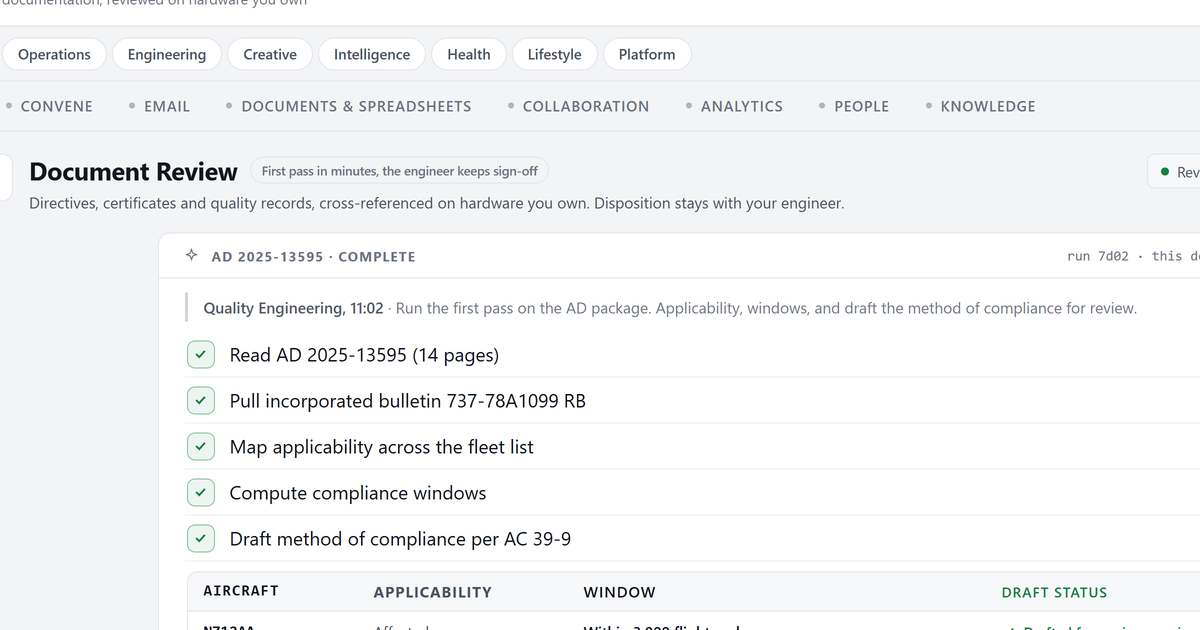
Airworthiness directive compliance does not need to bury an engineering department in paperwork, because the first pass (reading the directive, retrieving the incorporated bulletin, mapping applicability against the fleet and drafting the method of compliance records) is precisely the work a sovereign intelligence system can complete in minutes on an operator's own hardware, while the licensed engineer keeps disposition and sign-off. The directive itself is non-negotiable law. The hours spent assembling its paperwork are a choice.
An airworthiness directive is a legally enforceable rule issued under 14 CFR Part 39 to correct an unsafe condition in an aircraft, engine, propeller or appliance. Each one carries a compliance window measured in flight hours, flight cycles or calendar days from its effective date, and no affected aircraft may lawfully operate outside that window. Equivalent directive systems run under EASA and the UK Civil Aviation Authority, so the workload lands on operators and maintenance organisations everywhere.
What does an airworthiness directive actually require an operator to produce?
It requires evidence, not just work. FAA Advisory Circular 39-9, the Airworthiness Directives Management Process, describes what the regulator expects an operator's directive management to look like: a process that identifies every applicable directive, establishes a method of compliance for each affected aircraft, schedules the work inside the compliance window and records the result in a form an inspector can audit years later. The physical task on the aircraft is often the smaller part. The paperwork proving that the right task was performed, on the right serial numbers, by the right deadline, using the right revision of the right document, is where the engineering hours go.
Why does directive compliance consume so much engineering time?
Because every directive triggers the same chain of document work before a spanner moves. Federal Register document 2025-13595, published on 21 July 2025, is a final rule directive covering Boeing 737-600 through 737-900ER series aircraft. It was prompted by a report of a crack in a fuselage frame web, it requires repetitive inspections for cracking and repair of any cracks found, and it became effective on 25 August 2025. The FAA has since reviewed Boeing Alert Requirements Bulletin 737-78A1099 RB, dated 8 July 2025, on thrust reverser locking actuator indications, the kind of manufacturer bulletin whose compliance tasks the directive process routinely turns into law. An engineer working material like this must read the directive, pull the referenced bulletin at the correct revision, confirm which aircraft are affected by serial number and configuration, decide the method of compliance, write the task cards and engineering orders, and file records that survive audit. Multiply that by every directive across a mixed fleet and the mountain builds itself.
Can AI draft airworthiness directive compliance paperwork?
Yes, and the first pass is exactly where it belongs. Our document review capability reads the directive and the bulletin it incorporates, cross references applicability against the operator's own fleet records, drafts the method of compliance paperwork for an engineer to review, holds any anomaly it cannot reconcile for a person, and seals every action it takes to a tamper evident record. The first pass covers:
- Reading the directive and extracting applicability, compliance windows and required actions
- Retrieving and cross referencing the incorporated service bulletin or requirements bulletin at the correct revision
- Mapping applicability against fleet records by serial number, line number and configuration
- Drafting method of compliance paperwork, task references and record entries for engineering review
- Holding every discrepancy, ambiguity or unmatched record for a person to disposition
None of this removes the engineer. It removes the hours the engineer spends doing a machine's job before the engineering judgement starts. The compliance window does not pause for paperwork, so every hour recovered up front is schedule margin at the back.
Why should this review run on our own hardware rather than in the cloud?
Because the documents involved are among the most sensitive an operator holds. Fleet configuration data, maintenance records, reliability history and engineering orders describe exactly where an operator's aircraft are vulnerable and when. Mickai is a Sovereign Intelligence Operating System, and it runs entirely on the customer's own hardware, on-premise and air-gapped, so no directive package, no fleet record and no draft ever leaves the building. There is no third party processor to vet, no cross border transfer to paper over, and no dependence on a connection that fails on the morning an inspector arrives.
““ The directive is public. Your fleet records are not. The review has to happen where the records live, and it has to leave evidence that stands up years later. ” Mickai”
Where does the engineer stay in charge?
At every consequential step. Consequential actions wait for a person's clearance, and every review action is sealed to our Open Audit Record before it runs: cryptographically signed, post-quantum, tamper evident and verifiable offline. When an auditor asks who reviewed the applicability mapping for a directive two years ago, the answer is not a recollection. It is a sealed record that can be verified without any external service.
| Step | The system does | The engineer does |
|---|---|---|
| Directive intake | Reads the directive, extracts windows and actions | Confirms the reading |
| Bulletin cross reference | Retrieves and reconciles the incorporated bulletin | Resolves held discrepancies |
| Applicability | Maps serial numbers and configuration against fleet records | Dispositions edge cases |
| Compliance paperwork | Drafts task references and record entries | Reviews, amends and signs |
| Evidence | Seals every action to the Open Audit Record | Owns the certification decision |
Directive volume is not going to fall. Ageing fleets generate structural inspection directives, young fleets generate teething directives, and regulators on both sides of the Atlantic keep raising the evidential standard for records. The operators who cope will be the ones who stop treating the first pass as engineering work and start treating it as review work a machine can do on their own hardware, under their own control, with their own people signing. That is the shape we build for, and we believe it is the shape directive compliance takes next.
Frequently asked questions
What is an airworthiness directive?
A legally enforceable rule issued by an aviation regulator, such as the FAA under 14 CFR Part 39, to correct an unsafe condition in an aircraft, engine, propeller or appliance. Each directive sets required actions and a compliance window measured in flight hours, flight cycles or calendar days from its effective date.
Do airworthiness directives incorporate manufacturer service bulletins?
Frequently. Many directives make the compliance tasks of a manufacturer's alert service bulletin or requirements bulletin mandatory, so complying means working both documents together at the correct revision. That cross referencing is a large share of the paperwork burden and suits a patient machine first pass.
Does the AI sign off directive compliance?
No. Our platform drafts the first pass, cross references the records and holds anomalies. The licensed engineer reviews, dispositions and signs. Consequential actions wait for a person's clearance, and every step is sealed to the Open Audit Record before it runs.
Can the review run with no internet connection at all?
Yes. Mickai runs fully offline on the customer's own hardware, and the Open Audit Record is verifiable offline as well, so compliance evidence can be checked years later without depending on any external service or vendor.
What is MICKAI?
MICKAI is a Sovereign Intelligence Operating System, a SIOS, that runs on the customer's own hardware, on-premise and air-gapped. Multiple models work together on a cooperative consensus substrate, consequential actions wait for a person's clearance, and every action is sealed to the Open Audit Record, a cryptographically signed, post-quantum, tamper evident record that is verifiable offline. MICKAI spans 63 studios, with fourteen production ready at launch and 49 in development, and the estate behind it stands at 104 filed UK patent applications across 2,340 claims, filed rather than granted, owned by Mickai LTD.