


CMMC Level 2: How On Premise AI Supports Your Certification
On premise AI supports a contractor achieving CMMC Level 2 by keeping controlled unclassified information on hardware the contractor owns, shrinking the assessment boundary and generating sealed evidence continuously.
On premise AI supports a contractor achieving CMMC Level 2 because it keeps controlled unclassified information on hardware the contractor owns, which shrinks the assessment boundary, removes an entire class of third party data flows, and produces the evidence assessors ask for as a matter of architecture rather than assembly. One point of honesty first: CMMC certifies the contractor, not the software. No product makes an organisation Level 2. The useful question is narrower: does a given system make achieving and maintaining Level 2 easier or harder?
What changed on 10 November 2025 and why does it matter now?
The final acquisition rule bringing the Cybersecurity Maturity Model Certification programme into United States defence contracts took effect on 10 November 2025, and CMMC requirements now flow into new solicitations under the DFARS clause framework. Level 2 is the tier that matters for most of the defence industrial base because it covers controlled unclassified information, the technical data, drawings and programme documents that sit in nearly every supplier's systems. The rollout is phased, and third party assessments widen from November 2026, so a contractor bidding on CUI bearing work has a fixed window to get its environment in order. Level 2 is assessed against the 110 security requirements of NIST SP 800-171, and nearly every one of them asks the same question: can you prove where your CUI lives, who touched it, and what stood between it and the outside world?
Why does cloud AI complicate a CMMC Level 2 assessment?
Because every external service that stores, processes or transmits CUI pulls itself into your assessment scope, along with its own data flows, personnel and subprocessors. Send a technical drawing to a cloud AI service and your boundary now extends to infrastructure you do not control and cannot inspect. The problem compounds with AI specifically, because these tools invite staff to paste text into prompts, and a prompt containing CUI is a CUI transmission like any other. Many contractors have responded with outright bans on AI tools, which protects the boundary at the cost of the productivity the tools promised. That trade off is a consequence of where the computation happens, not a law of nature.
How does on premise AI make Level 2 easier to achieve and maintain?
By collapsing the hardest scoping questions. When the intelligence runs entirely on hardware you own, inside the same physical and logical boundary as your other covered systems, the answer to where CUI goes during AI processing is simple: nowhere. A Sovereign Intelligence Operating System deployment aligns with what Level 2 asks a contractor to demonstrate:
- CUI stays inside the assessed boundary, because the system is air gapped and fully offline, with no external calls to document or defend.
- Access is controlled and attributable, with voice biometric gating tying consequential actions to a cleared, present person.
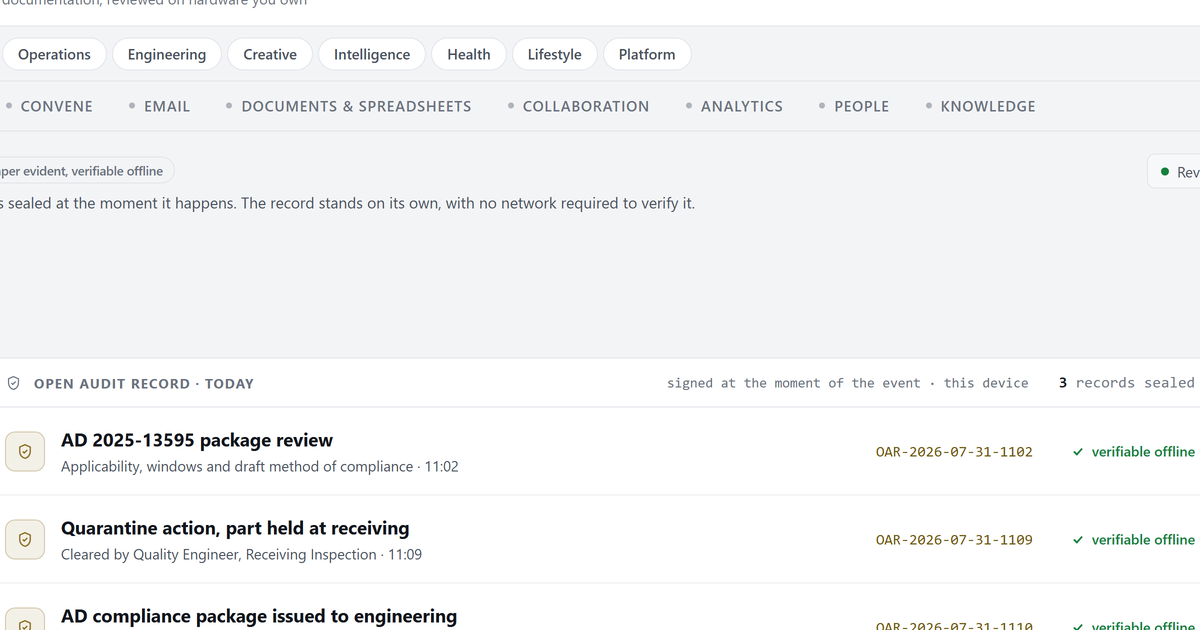
- Every review and action is sealed to the Open Audit Record before it runs, cryptographically signed, tamper evident and post quantum secure.
- Evidence is verifiable offline, so an assessor can check the record on the machine itself without connectivity or vendor involvement.
- Trust is anchored in a hardware held root of trust on the premises, not in a certificate living in someone else's cloud.
None of this certifies anything on its own. What it does is remove the exposures that make assessments long and remediation expensive, and it generates the evidence continuously instead of in a scramble the month before an assessor arrives.
““ CMMC certifies the contractor, not the software. Our job is to make sure that when the assessor asks where the CUI went and who cleared each action, the answer is already sealed in the record. ” Mickai”
What should a contractor ask any vendor who mentions CMMC?
Ask the vendor to state, in one sentence, what its product does to your certification status, and walk away from any answer stronger than supports. Software cannot hold a CMMC certification; the certification attaches to the contractor and the assessed environment. A vendor can legitimately claim that its architecture narrows scope, strengthens access control and produces assessment ready evidence. It cannot claim that buying its product confers a level. Our own position is plain: Mickai supports a contractor achieving and maintaining Level 2, and the restraint in that sentence is deliberate, because a compliance posture built on vendor overclaim fails precisely when it is tested.
How does sovereign document review fit inside a CMMC boundary?
Naturally, because the documents in question are often CUI themselves. The defence supply chain runs on paperwork: incoming certificates, technical data packages, supplier declarations, quality records. Our document review capability reads those packages on the contractor's own hardware, cross references certificates against the records behind them, drafts the compliance paperwork that engineers currently produce by hand, and holds anomalies for a person to disposition. Nothing leaves the building, no prompt reaches a third party, and every action is sealed to the Open Audit Record before it runs. Consequential actions wait for a person's clearance. The result is modern AI applied to your most sensitive documents, inside a boundary an assessor can walk in an afternoon.
The direction of travel is set. Third party assessment widens from November 2026, and the contractors who thrive will be those whose systems generate compliance evidence as a by product of doing the work rather than as a quarterly assembly exercise. We expect sovereign, on premise deployment to become the default posture for AI across the defence industrial base, because it is the architecture in which the scoping questions have short answers. We would rather be the vendor whose claims survive an assessment than the one whose marketing made promises the audit could not honour.
Frequently asked questions
Does deploying Mickai make a contractor CMMC Level 2 certified?
No. CMMC certifies the contractor and its assessed environment, never a piece of software. Mickai supports a contractor achieving Level 2 by keeping controlled unclassified information on hardware the contractor owns, enforcing attributable access and sealing a tamper evident record of every action.
What is CMMC Level 2 and who needs it?
Level 2 is the tier of the Cybersecurity Maturity Model Certification programme that applies to contractors handling controlled unclassified information. It is assessed against the 110 security requirements of NIST SP 800-171 and entered defence contracting when the final acquisition rule took effect on 10 November 2025.
When do third party CMMC assessments begin to apply?
The programme phases in from 10 November 2025, and third party assessments widen from November 2026 under the DFARS clause framework. Contractors handling CUI should plan against the earlier horizon.
Can an assessor verify an air gapped AI system?
Yes. The Open Audit Record is designed to be verified offline, so an assessor can confirm the integrity and completeness of the record on the machine itself. That suits an air gapped environment far better than logs held in a vendor's cloud.
Why does the audit record matter so much at Level 2?
Because Level 2 is ultimately an evidence exercise. The requirements of NIST SP 800-171 ask a contractor to demonstrate control, not merely assert it. A record that is sealed before each action runs, signed and tamper evident, turns that demonstration from a reconstruction into a lookup.
What is MICKAI?
MICKAI is a Sovereign Intelligence Operating System, a SIOS that runs entirely on the customer's own hardware, on premise and air gapped. It coordinates multiple models over a cooperative consensus substrate and seals every consequential action to the Open Audit Record, a cryptographically signed, post quantum, tamper evident record sealed before an action runs and verifiable offline. It comprises 63 studios, fourteen of them production ready at launch and 49 in development, and it is protected by 104 filed UK patent applications across 2,340 claims, filed rather than granted.