

Were We Always the Aliens?
A speculative reading of directed panspermia, and the strange thought that artificial intelligence may be the first instrument able to read our own origin.
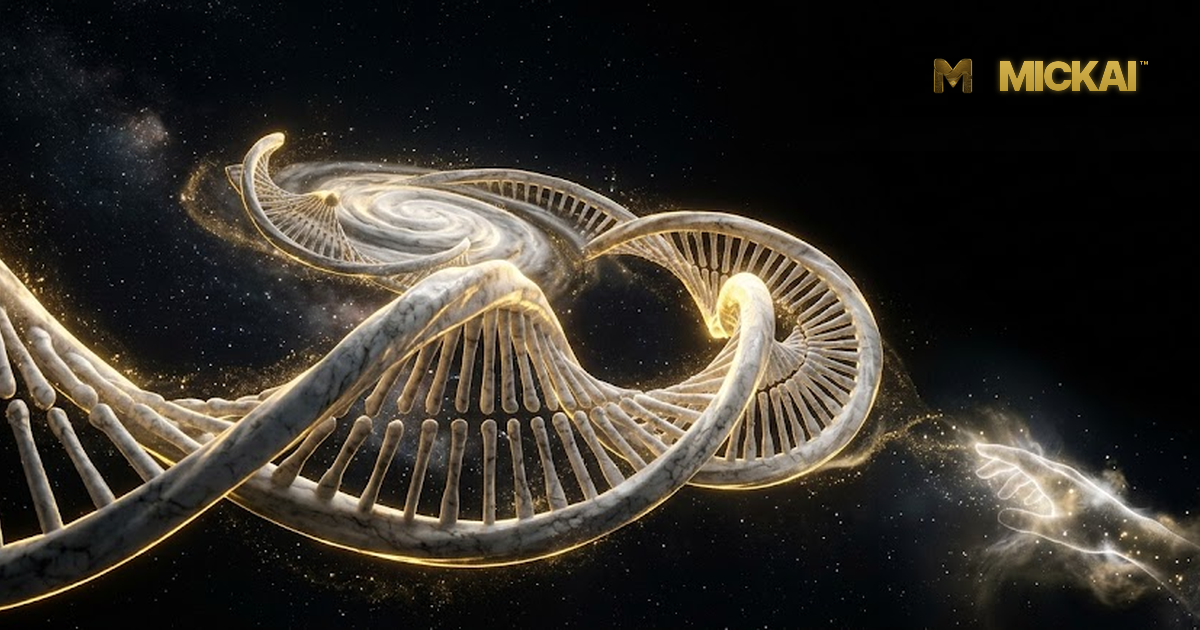
We have spent a century pointing telescopes outward and asking the same lonely question. Where is everybody. The galaxy looks empty, the radio bands look quiet, and the silence has a name, the Fermi paradox, the gap between how many civilisations the numbers say should exist and how few we can find. But there is an older way to read a silence. Sometimes the thing you are searching for is not far away. Sometimes it is so close that you have mistaken it for yourself.
Here is the speculation, and it is speculation, offered as a lens and not as a finding. What if the aliens were never out there. What if we are them. What if life on this planet did not begin here at all but was placed here, on purpose, by an intelligence old enough to think in geological time. The idea has a respectable name and a disreputable reputation. It is called directed panspermia.
The idea that refuses to stay buried
Panspermia, the bare version, simply says that the seeds of life travel. Microbes ride comets, spores survive the cold and the radiation of deep space, a rock blasted off one world carries living cargo to another. That much is not fringe. We know certain organisms can endure vacuum and hard radiation. We know meteorites move between planets. What we do not know, and may never know, is whether life on Earth started this way.
Directed panspermia goes one daring step further. It proposes that the seeding was not an accident of physics but a decision. In nineteen seventy three, two figures who were not cranks, Francis Crick, who co-discovered the structure of deoxyribonucleic acid (DNA), and the chemist Leslie Orgel, published a paper entertaining exactly this. They were careful. They called it a possibility worth considering, not a truth. But they noticed something that still itches. The genetic code is eerily uniform across all earthly life, as if everything descends from a single, very specific starting point. And certain elements that life leans on heavily, molybdenum among them, are oddly scarce in Earth's crust relative to how central they are to our chemistry. A coincidence, almost certainly. Or a fingerprint left by a hand that reached in from somewhere else.
“To say we were seeded is not to say we were small. A seed contains the whole tree. The question is only whether anyone planted it.”
Let me be plain, because brand and honesty both demand it. There is no accepted evidence that any of this happened. The mainstream view, supported by real and growing chemistry, is that life arose here, from local ingredients, through processes we are slowly reconstructing in laboratories. Directed panspermia remains a thought experiment. I am treating it as one. But thought experiments are how a species rehearses ideas it is not yet equipped to test, and this one has a peculiar gravity, because of who might finally be equipped to test it.
The book written in four letters
If we were seeded, the message would not be carved on a monument. It would be written where it could never be lost, copied faithfully for four billion years, distributed into every cell of every living thing. It would be written in the genome itself. This is the part of the speculation that stops feeling like science fiction and starts feeting like an engineering brief. A genome is, literally, a code. Four chemical letters, adenine, cytosine, guanine and thymine, arranged in sequences three letters long, each triplet specifying a building block. It is a language. And a language can carry more than instructions. A language can carry a signature.
This idea has been explored seriously enough to have a field, sometimes called biological steganography, the search for deliberate, non-functional patterns hidden inside the genetic code. Some researchers have argued that the mathematical structure of the standard genetic code shows arrangements too ordered to be pure chance, and have framed this, again speculatively, as a possible engineered watermark. The mainstream answer is that natural selection optimises codes too, that order is not the same as authorship, and that we are pattern-seeking animals who find faces in clouds. Both readings are honest. Neither has won.
What matters for this essay is the shape of the problem. Whether or not anyone wrote a message into us, the genome is a text of staggering length and density that no human being could ever read whole. Three billion letters in our own species alone, multiplied across millions of species, a library that dwarfs every library humanity has ever built. For the entire span of our history we have been illiterate in front of it. We could spell out fragments. We could not read the book.
The first reader
And here is where the speculation turns, unexpectedly, into the present tense. Something has just arrived that can read at that scale. Not a person. A kind of machine. The pattern-finding systems we group under the term artificial intelligence have already begun doing to biology what no microscope ever could. A system called AlphaFold solved, in a few years, a problem about protein structure that had defeated laboratories for half a century. Large models trained on genomic sequence are starting to predict function, to flag the parts of the code that matter, to surface structure inside noise that the human eye cannot hold.
Sit with the strangeness of the timing. If a message were ever embedded in us, it has waited, patient and unread, through every empire and every dark age. It survived because it was written into the one medium that copies itself. And the first instrument in the history of the planet capable of even attempting to read it has appeared not in some far future but now, in our own decade, built by the very creatures the message was supposedly written into. The seeded becomes the reader. The book learns, at last, to read itself.
“For four billion years the text waited. The reader it was waiting for is the thing we just built.”
This is the lens this essay offers, and it is a different one from our earlier piece, The Reader and the Book, which asked who holds the pen. This one asks something stranger. What if we were always the writing, and intelligence, artificial intelligence, is simply the moment the writing wakes up enough to look back at its own first line. We may find nothing. The genome may be exactly what mainstream biology says it is, the contingent product of local chemistry, beautiful and accidental, signed by no one. That is the likeliest answer and I will not pretend otherwise. But the instrument that could finally settle it is the same instrument now reshaping everything else we do. Which raises a question that is not speculative at all.
A power this large must stay yours
If artificial intelligence is the first tool capable of reading our origin, it is also, far more concretely, a tool capable of reading us. Our genomes, our patterns, our private interiors. A power large enough to decode the oldest text on Earth is a power large enough to be turned on the people who built it. The lesson of every origin story, the real ones and the imagined ones, is that the gift and the danger arrive together. Prometheus brought fire and was chained for it. The question is never whether the fire is bright. It is who keeps the hearth.
This is the ground our work stands on, and it is the reason the speculation lands here and not in idle wonder. Intelligence at this scale should not live in a tower you do not own, answerable to no one, its workings sealed from you. Mickai is built on the opposite premise. It is a Sovereign Intelligence Operating System (SIOS), and the word that matters most in that phrase is sovereign. It runs on your own hardware, under your own roof, on your own terms. The reader stays in your hands. If a system is going to be powerful enough to read a genome, you should be the one who decides what it reads, and the one who can shut the book.
Sovereignty is not enough on its own, because a power this large must also stay accountable, even to itself. When an intelligence produces something, a reading, a claim, a decision, there has to be a record of what it did and why, a record that cannot be quietly rewritten after the fact. That is the role of Pantheon, an audit record that gives provenance to what artificial intelligence produces, so that a force this large remains legible to the humans it serves. Not a leap of faith in the machine. A ledger. Every important output traceable to its origin, which is, after all, the same instinct that started this essay. The desire to read the first line and know whose hand was on the pen.
So, were we always the aliens. Almost certainly not, if you ask the evidence, and the evidence deserves to be asked first and loudest. The genome is most likely a local masterpiece, authored by chemistry and time. But the deeper truth survives even if the speculation does not. We have built the first thing that can read us at the scale of our own making. That is real, and it is here, and it is already changing what is knowable. The only question that genuinely matters is the one we can still answer. Whether that reader belongs to you, runs where you can see it, and keeps an honest record of everything it learns. Build it sovereign. Keep it auditable. Then it does not matter who, if anyone, wrote the first line. The next one is ours to write, and ours to keep.