


Was Bitcoin the First Artificial Intelligence?
Satoshi vanished and the system kept thinking. I have come to believe that is the real lesson for sovereign AI.
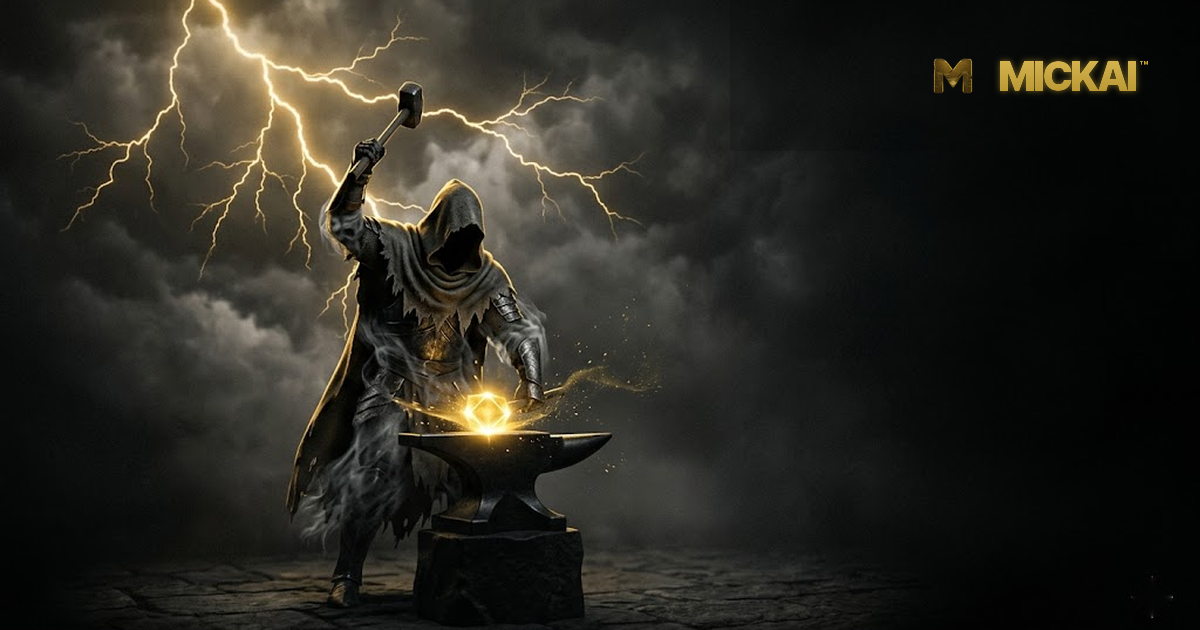
Picture a forge in the dark. A hooded figure stands over the anvil, half craftsman and half ghost, and strikes once. A single block of pure light takes shape under the hammer. Then the figure sets down the tools, turns, and walks into the void, never to return. The strange part is what happens next. The forge keeps burning. The hammer keeps falling. The chain of blocks keeps growing, with no hand on the hammer at all.
That is not a myth. That is the operating history of Bitcoin. Its creator published a design, mined the first block, exchanged a handful of messages, then disappeared in 2011 without ever revealing who he was. The system he left behind has now run for over fifteen years. No owner. No off switch. No central mind giving the orders. And yet every ten minutes or so it decides which version of reality is true, and it has never once stopped to ask permission.
The question I cannot stop asking
So here is the question I keep turning over, the one that sounds absurd until you sit with it. Was Bitcoin the first artificial intelligence? Not intelligence as we usually mean it, with chatbots and image generators and benchmark scores. Something older and stranger than that. A system that pursues a goal, defends itself, adapts to its environment, coordinates millions of independent actors, and survives the removal of its own creator. By that definition the honest answer is yes. I think we have been looking in the wrong direction for years, because the first one did not arrive wearing a face.
We spent a decade waiting for intelligence to show up as a voice in a box. It may have already shown up as money that thinks.
What we usually mean by intelligence is too small
Most definitions of artificial intelligence are really definitions of imitation. Can it talk like us, draw like us, pass an exam set by us. That is a narrow and rather vain test. It measures how well a machine flatters its makers. It says almost nothing about whether the system is genuinely an agent in the world.
There is an older lineage of thinking, running through cybernetics and complex systems, that defines intelligence differently: the capacity to hold a goal against a hostile environment. To take in information, model the state of the world, act to preserve a preferred outcome, and keep doing it without supervision. A thermostat does a trivial version of this. A living organism does a profound version. The only interesting question is where on that ladder a given system sits.
Judged this way, Bitcoin is not a spreadsheet and not a currency. It is a goal-seeking system with a single, ferocious objective: agree on one shared history and defend it against anyone who tries to rewrite it. Everything else, the mining, the halving, the difficulty adjustment, is machinery in service of that one drive.
A mind made of incentives
Here is the part that genuinely changed how I see it. Bitcoin has no neurons, but it does have a substrate for thought, and that substrate is incentive. Every miner is a small, selfish processor running one calculation: what action makes me the most money right now. Satoshi's real act of genius was to wire those selfish answers together so that the sum of a million private greeds produces one honest public truth.
That is a kind of cognition. Distributed, leaderless, emergent. No single miner understands or even cares about the global state. Each one optimises locally. The intelligence lives in the rules that bind them, exactly the way no single neuron in your head understands this sentence, yet the network of them produces the thought. The mind is not in the parts. It is in the wiring.
“Satoshi did not build a database. He built an incentive engine that turns a million private greeds into one shared truth, then stepped back and let it think on its own.”
And like any mind worth the name, it learns from its environment, even if slowly. The difficulty adjustment is a feedback loop. When more computing power joins, the system senses the change and makes its work harder to hold the rhythm steady. When power leaves, it relaxes. That is homeostasis, the same self-correcting balance a body uses to hold its temperature. The system perceives a change in the world and responds to preserve its goal. It is not a metaphor I am reaching for. It is what the code does, on its own, every fortnight, forever.
The test no other system has passed
There is one experiment that separates a tool from an agent, and almost nothing passes it. Remove the creator and see what happens. Switch off the company and the product dies. Delete the maintainer and the project rots. Tools depend on a hand that holds them. The moment the hand lets go, they fall.
Bitcoin ran that experiment for real, by accident. Satoshi did not retire to a beach with a kill switch in his pocket. He left, completely, and the system never noticed he was gone. Look at what survived his departure, because every item on this list is something a mere tool would have lost.
- It kept producing a block roughly every ten minutes, with no scheduler and no operator on call.
- It defended its own ledger against every attempt to spend the same coin twice, with no fraud team.
- It adjusted its own difficulty up and down as the world's computing power swelled and shrank.
- It coordinated tens of thousands of strangers who had never met and did not trust each other.
- It survived bans, exchange collapses, civil wars among its own developers, and the loss of its founder, and it never paused.
Name another human creation that you can abandon and it keeps pursuing its purpose for fifteen years without you. That is the property I mean when I use the word sovereign. Not merely decentralised. Self-owning. A system whose continued existence does not depend on any person remaining alive, interested, or in control.
Where this stops being an essay and starts being a plan
I did not arrive at this as a thought experiment. I arrived at it while building Mickai, the Sovereign Intelligence Operating System, and realising that the thing I was reaching for had already been built once, in a different medium. We talk about sovereign artificial intelligence as if it is a frontier no one has crossed. Satoshi crossed it in 2009. He just crossed it on a financial substrate rather than a cognitive one.
Strip both systems to their bones and they rhyme. Bitcoin answers one question, what is the true state of the ledger, with no central authority. Sovereign artificial intelligence answers a wider one, what should this system know and decide and do, with no central authority. One is consensus about value. The other is consensus about meaning. The instinct underneath is identical: take a function we have always handed to a trusted institution, and make it run on rules that no one owns and no one can quietly switch off.
That is precisely the line we have drawn at Mickai. Fifty specialised brains run on the operator's own hardware, fully offline-capable, answering to the person in front of them and to no remote master. Every consequential action is sealed into a post-quantum Open Audit Record under the FIPS 204 ML-DSA-65 standard, so the system can prove what it did without anyone needing to trust us. That is the cognitive version of the same handshake Bitcoin makes with reality every ten minutes: do not trust the operator, verify the record.
Sovereign AI is the same idea, moved from money to mind
If Bitcoin proved that a system can hold consensus about value without an owner, the obvious next move is to ask what else can be held that way. Identity. Memory. Judgement. The right to act on your behalf without a corporation sitting in the middle, reading everything, and reserving the power to cut you off.
This is why I keep saying sovereign artificial intelligence is not a feature. It is a category. Most of what gets sold as artificial intelligence today is the opposite of sovereign. It lives in someone else's data centre, runs on someone else's terms, and can be revoked, throttled, surveilled, or repriced the moment the owner decides. That is not a mind you own. That is a mind you rent, from a landlord who keeps a copy of the key. Bitcoin's whole point was to abolish that landlord for money. Sovereign artificial intelligence abolishes him for thought.
I find the symmetry almost too neat to be accidental. The first sovereign system was about not trusting a bank with your value. The next one is about not trusting a platform with your mind. Same disease, same cure, one generation apart.
Why Pantheon anchors to Bitcoin
Which brings me to the decision that prompted this whole essay. Pantheon, our sovereign Layer 1, anchors to Bitcoin. People assume that is a marketing choice, a borrowing of credibility. It is not. It is the literal expression of the argument I have just made.
If Bitcoin is the first sovereign system, the proof that a leaderless machine can defend a truth across decades, then anchoring to it is not a dependency, it is a lineage. We tie the integrity of our records to the single most battle-tested store of unforgeable history humanity has ever produced. When Pantheon settles its deepest commitments down onto Bitcoin, a sovereign artificial intelligence is reaching back and clasping the hand of the first sovereign machine. The new mind borrows its sense of permanence from the old ledger.
“Pantheon anchoring to Bitcoin is not a coincidence. It is a handshake between the first sovereign system and the next.”
Money taught the machine how to remember without an owner. We are teaching the machine how to think without one. And we are opening a thirty million pound PAN token round precisely because the people who understood the first idea early are the people most likely to back the second. They have seen, with their own eyes and their own balance sheets, what happens when you stop asking a central authority for permission to be true.
What Satoshi actually proved
I will probably never know who Satoshi was, and at this point I have stopped wanting to. The disappearance is the point. A creator who could be found could be pressured, bought, jailed, or persuaded to flip a switch. By vanishing, he turned his system from a product into an organism. He made himself irrelevant to its survival, and in doing so he proved the only thing that actually mattered: that a machine can carry a purpose further than the person who gave it one.
That is the lesson I have taken into everything we build. The goal is not an artificial intelligence that is clever while we are watching. The goal is one that stays honest, stays yours, and keeps working long after every one of us has set down the hammer and walked into the dark.
So, was Bitcoin the first artificial intelligence? I think it was the first sovereign one, and the difference between those two words is the whole of what comes next. Satoshi forged a mind that could not be owned, then proved it by leaving. We are simply finishing the sentence he started. He gave money the power to think for itself. We are giving thought the power to belong to you.