


The Ledger Is the Empire
Every civilisation that lasts learns to keep a record. The audit trail is not bureaucracy. It is a survival trait.
The First Sentence Was a Receipt
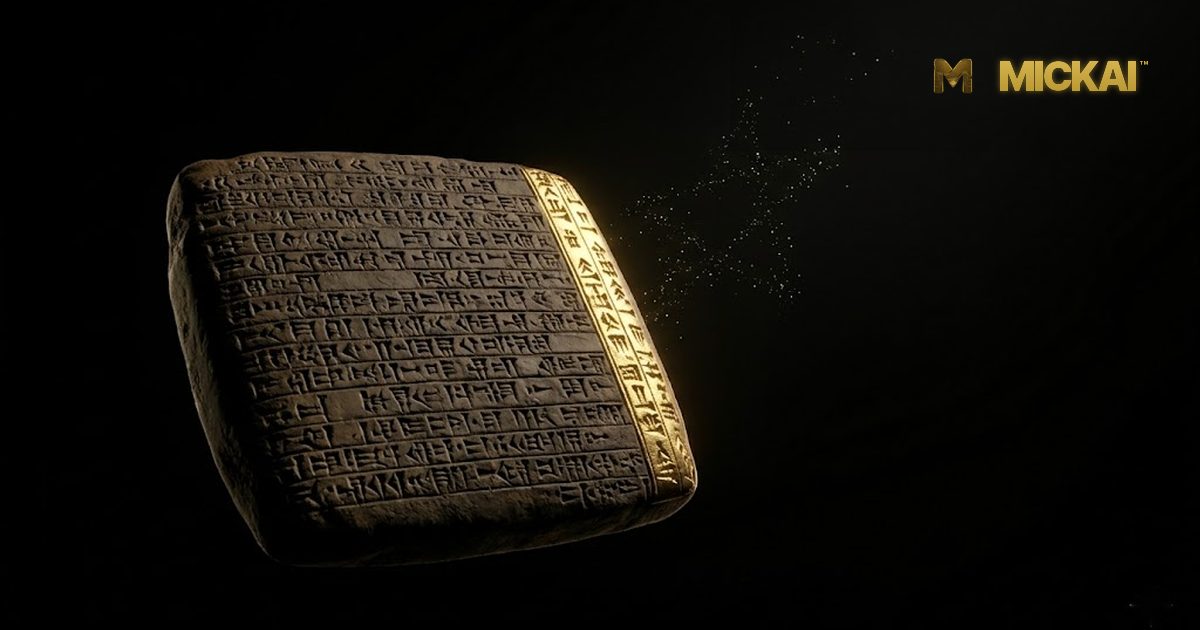
Before poetry, before law, before the gods were given names, somebody in Mesopotamia pressed a reed into wet clay to record that a quantity of grain had changed hands. Writing did not begin as art. It began as accounting. The oldest texts we can read are not hymns. They are inventories. The deep human impulse that civilisation is built on is not the urge to express. It is the urge to remember accurately, so that a claim made today can be checked tomorrow.
This is the thing we keep forgetting about memory. We treat the record as the boring part, the clerical residue left behind by the real action. We are wrong. The record is the action. A promise nobody can verify is just weather. A debt nobody recorded is just a feeling. The moment a society can prove what happened, independent of who is shouting, it has crossed a threshold that separates it from every arrangement that came before.
Look at what survives. The civilisations we still speak of, the ones that left a shape in time deep enough to organise our calendars and our courts, all share one unglamorous habit. They kept records, and they kept them in a way that let a stranger, much later, reconstruct the truth. Rome had the census, the surveyed road, the inscribed law on bronze in the open air. China ran on the granary ledger and the bureaucratic memorial, an apparatus so durable it outlasted the dynasties that built it. The medieval Church kept registers of who was born, who married, who died, and in doing so quietly built the backbone of European demography. Venice ran double-entry bookkeeping and ran the Mediterranean. The pattern is not subtle. The audit trail is a survival trait.
Provenance Is the Immune System of a Society
I want to push this further than is comfortable, because the comfortable version is just an argument for better filing.
Treat a civilisation as a living system. Every living system needs a way to tell self from non-self, true from false, friend from infection. In biology we call that an immune system. In a society, provenance is the immune system. Provenance is the chain of custody on a fact, the answer to the question "how do you know that, and who could check." A society with strong provenance can absorb shocks, because it can locate the truth and act on it. A society with weak provenance gets sick in a particular way. It loses the ability to agree on what happened, and once you cannot agree on what happened, you cannot agree on anything downstream of it.
Watch how empires actually fall. We narrate collapse as armies and weather and economics, and those matter. But underneath, again and again, you find a quieter failure. The records stop being trusted. The coinage gets debased and nobody can rely on what a coin contains. The census becomes fiction and the centre no longer knows what it governs. Tax rolls are forged, land claims become a matter of force rather than proof, and the courts fill with cases that cannot be settled because the underlying record has rotted. The empire does not only lose battles. It loses the ability to know its own state. A body that can no longer tell self from non-self is not killed by the infection. It is killed by the failure of its immune system to name the infection in time.
“Forgery is to a civilisation what an autoimmune disorder is to a body. The defences are intact, but they can no longer trust the signal, so they attack the wrong thing, or nothing at all.”
Here is the speculative leap, and I will label it plainly as speculation rather than established fact. I suspect provenance behaves less like a tool a civilisation chooses to use and more like a trait that civilisations are selected for. The ones that evolved durable, tamper-evident memory survived long enough to be remembered. The ones that did not are silent, not because they had nothing to say, but because they left no verifiable trace, and a trace nobody can verify decays into legend, and legend decays into nothing. We are, in a real sense, the descendants of good record keepers. The rest are gone. If that is right, then the audit trail is not a feature of advanced civilisation. It is closer to a precondition for being an advanced civilisation at all.
The New Author Who Cannot Be Cross-Examined
Now fold in the thing that has changed under our feet.
For all of recorded history, the entities making claims into the record were human. Slow, biased, mortal, but reachable. You could cross-examine a clerk. You could find the witness. The provenance chain, however imperfect, ran back to a person who could in principle be held to account. That assumption is now broken. We have built artificial intelligence, machines that generate text, images, decisions, and evidence at a scale and speed no scribe could approach, and increasingly we cannot tell their output from a human's, or from the truth.
This is the first time in the history of the audit trail that the most prolific authors in the system are not people. They produce volume that would have taken the entire literate population of a medieval kingdom centuries to match, and they do it before lunch. And here is the danger stated bluntly. We are pouring an ocean of machine-generated claims into the shared record of our species at exactly the moment our tools for proving where a claim came from are weakest. The immune system is being asked to process more material than ever, while losing the ability to mark each piece self or non-self, human or machine, observed or invented.
A civilisation that loses provenance over its own intelligence does not get a dramatic collapse. It gets something worse, a slow dissolving of the ground under every shared fact, until "what happened" becomes purely a function of who has the most compute and the loudest channel. That is not a future I find acceptable, and I do not think you should either.
Sovereignty First, Then the Record
So what does a serious answer look like. Not a content filter. Not a label slapped on after the fact that the next model can strip in a second. The answer has to be structural, and it has to begin with control.
The first principle is sovereignty. Intelligence this powerful should run on hardware you own, under your own roof, answerable to you and not to a meter ticking in someone else's data centre. This is the conviction behind Mickai, a Sovereign Intelligence Operating System, a SIOS, built to run on your own machines rather than rent your mind back to you by the token. Sovereignty is not a privacy nicety here. It is the load-bearing wall. You cannot have a trustworthy record of what an intelligence did if you do not control the intelligence, because whoever controls it controls the record, and a record the powerful can quietly edit is not a record at all. It is a press release.
The second principle is the trait this whole essay is about, made native to the machine. Inside the SIOS sits the Open Audit Record, a tamper-evident provenance trail for what the intelligence produces. Every meaningful output carries its lineage, what was asked, what model answered, what it drew on, sealed so that the chain can be checked later by someone who was not in the room and does not have to take anyone's word for it. This is the census and the inscribed law and the double-entry ledger, rebuilt for a new kind of author. It is the audit trail extended to cover the one entity that has never before been inside it.
Provenance at the scale of artificial intelligence needs more than a private log. It needs a public commons where a claim can be anchored and independently verified, by anyone, without trusting the party who made it. That is the role Pantheon is built to play, the audit record as shared provenance for what artificial intelligence produces, so that a power this large stays auditable by people who do not own it. Where Mickai keeps the intelligence yours, Pantheon keeps the proof everyone's. Sovereign at the edge, verifiable in the open. The clay tablet, and the public square it was meant to be read in.
None of this is built on hope. The conviction is backed by work, including 104 filed UK patent applications covering the substrate that makes a sovereign, auditable intelligence possible. But the patents are evidence, not the point. The point is older than any of us, pressed into wet clay five thousand years ago by someone who understood, perhaps without words for it, that a civilisation is only as durable as its memory is honest. We are about to hand the pen to something that is not human. The only responsible thing to do is make sure it still has to sign its name, and that we can all read the signature. The ledger was always the empire. We are simply being asked, once more, to keep it.