


Proof of Intelligent Action: The Consensus Bitcoin Cannot Give You
A timestamp proves when. The trust layer has to prove what reasoned, under whose authority.
A blockchain is very good at answering one question. It proves that a particular string of bytes existed at a particular moment, and that nobody has quietly rewritten history since. That is a genuine achievement, and a narrow one. Watch how fast the question changes the instant an artificial intelligence sits in the loop. What we now need to know is not when a fact was recorded. It is what reasoned, on what evidence, under whose authority, and whether the chain of signatures behind the decision will still stand up in a decade, when today's cryptography has aged.
That gap is the most important unsolved problem in machine intelligence wherever it touches money, infrastructure or law. We have learned to anchor outputs. We have not learned to prove conduct. The difference between those two is the difference between a receipt and an account of what actually happened.
The timestamp answers when, and only when
Picture the standard pattern for putting an AI decision on a public ledger. A model produces an output. Somebody hashes that output. The hash goes into a transaction, the transaction is finalised, and now there is an immutable record that the hash existed at block height N. People call this provenance. It is not provenance. It is a notarised timestamp wearing provenance as a costume.
Consider everything the hash leaves out. It does not say which model produced the output, or which version of that model after the last silent update. It does not carry the prompt, the retrieved context, the temperature, or the seed. It does not name the human or the policy that authorised the action at the instant of execution. It does not bind a signature that will survive a cryptographically relevant quantum computer. The ledger faithfully records that something happened. It is structurally blind to everything that would let you judge whether that something should have happened at all.
“A timestamp tells you a black box spoke at noon. It tells you nothing about what the box was, what you fed it, or who held the key.”
Why this is not a Bitcoin failing
Let me be precise, because it would be cheap and wrong to frame this as a defect in Bitcoin. Bitcoin does exactly what it was designed to do, with a discipline almost nothing else in computing can match. Proof of work secures an ordering of transactions against a hostile world. It was never built to reason about the meaning of an artificial intelligence, and asking it to is like asking a notary to audit the surgeon. The notary stamps the page. The notary has no view into the operating theatre.
So the honest claim is not that Bitcoin is weak. The honest claim is that Bitcoin answers a different question. When you bolt an AI decision onto a chain and walk away satisfied, you have notarised a black box. You have proved that the box existed. You have proved nothing about its conduct.
A new primitive: proof of intelligent action
This is where the field needs a genuinely new word, not a marketing one. Proof of work answers who spent the most energy to extend the ledger. Proof of stake answers who has the most economic skin in honest validation. Both are consensus mechanisms about the chain itself. Neither says anything about the meaning of what is being recorded.
Proof of intelligent action is a different primitive. It does not ask who extended the ledger. It asks whether a specific decision, made by a specific model, on specific inputs, under a specific authority, can be replayed and verified after the fact by someone who does not trust you. It is the layer that turns an opaque output into an accountable act. And it has to do its work before anything ever touches a chain, because the chain can only seal what you hand it. Hand it a bare hash and a bare hash is all the world will ever be able to check.
To make that real, the record of an intelligent action has to bind five facts into one inseparable object:
- The model: exactly which weights and which version reasoned, identified so a later auditor cannot be fobbed off with a different model that happens to give a convenient answer.
- The prompt and context: the full input the model actually saw, including retrieved evidence, not a sanitised summary written afterwards.
- The authority: the human, role or policy that permitted this action at the moment of execution, so the question of who allowed this has an answer that predates the outcome.
- The reasoning trace: enough of the path from input to output that the decision can be replayed and checked, not merely asserted.
- The post-quantum signature: a seal over all of the above, using cryptography chosen to outlive the machines that will one day try to forge it.
Bind those five together and the output stops being a black box. It becomes a thing you can interrogate. Leave any one of them out and you are back to a notarised hash, which is to say back to nothing that earns the word trust.
The mirror and the Medusa
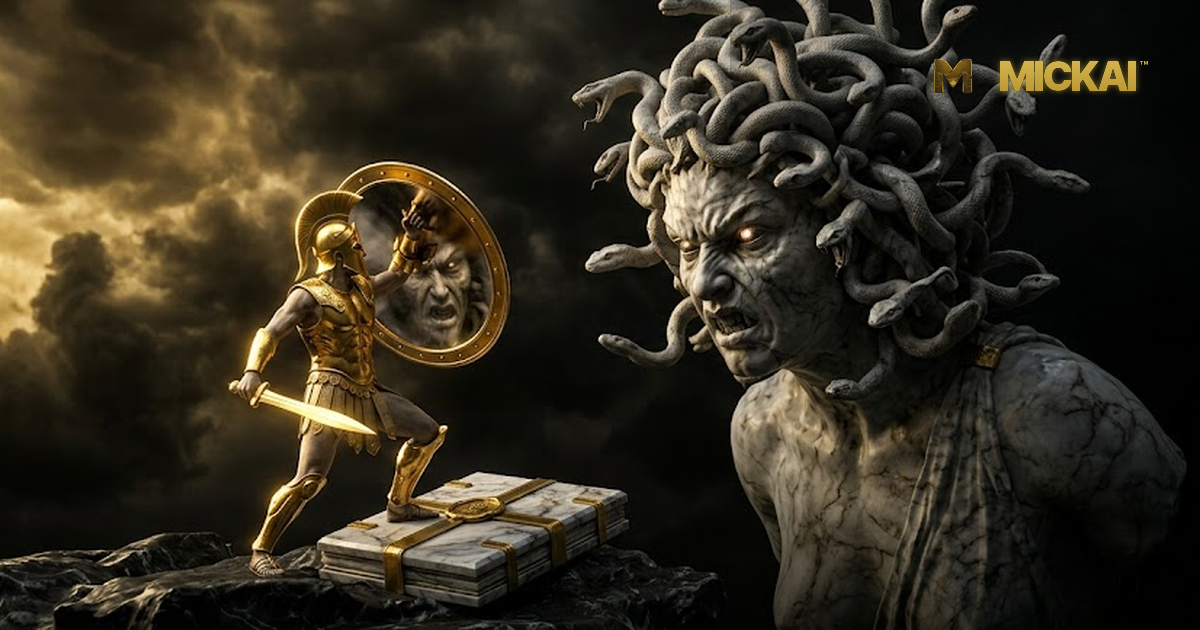
There is an old image I keep returning to, because it captures the architecture better than any diagram I have drawn. Perseus could not defeat the Medusa by looking at her directly. Her gaze turned everything that met it to stone. He won by raising a mirrored shield, letting her own gaze return to her, and acting on the reflection rather than the thing itself.
An unverified model output is a Medusa. Its hair is a writhing tangle of plausible text, confident numbers and invented citations, and if you act on it directly it turns your judgement to stone. You freeze, you defer, you sign off on something you never actually examined. The answer is not to stare harder at the output. The answer is the mirrored shield. Do not trust the gaze. Capture its reflection, and bind that reflection into a tablet you can read safely at your feet.
That reflection is the record of proof of intelligent action. You can inspect it without being petrified by the confident surface of the answer, because it shows you the model, the inputs, the authority and the seal rather than the dazzle of the output. You are no longer looking at the monster. You are looking at the evidence of what the monster did, safely, after the fact, in a form that holds.
Replayable, not merely recorded
The word doing the heavy lifting here is replayable. A recorded decision is a claim. A replayable decision is a test you can run. The distinction matters because trust is not something you grant on the strength of a signature alone. Trust is what survives when an adversary, a regulator or a future version of yourself sits down with the record and tries to break it.
What replay actually demands
To replay an intelligent action you need the original model addressable, the original inputs intact, the authority context preserved, and a seal that proves none of those were edited to fit the conclusion. Then you re-run the path and watch whether it lands where the record says it landed. If it does, the action earns its trust the hard way. If it does not, you have caught a divergence that a bare timestamp would have hidden forever under a perfectly valid hash.
Why the chain comes last
Notice the ordering this forces. All of the binding, all of the sealing, all of the work that makes a decision accountable, happens off the public ledger and before it. The chain is the final, optional act of anchoring an object that is already complete and already verifiable on its own terms. Put plainly: a chain can immortalise a black box, but it cannot open one. The opening has to be designed in upstream, or it never exists at all.
Where Pantheon fits
This is the problem we built Pantheon to solve, and I will be direct about what it is. Pantheon is our sovereign Layer 1, anchored to Bitcoin, and its job is not to compete with Bitcoin's security model. Its job is to carry the thing Bitcoin was never designed to carry: the full, bound, replayable record of an intelligent action, sealed before it is ever anchored.
Inside the Mickai Sovereign Intelligence Operating System, fifty specialised brains run on the operator's own hardware, fully offline capable, and every consequential action one of them takes is sealed into an Open Audit Record. That record binds the model, the prompt and context, the authority at execution, and the reasoning trace, and it is signed under a post-quantum scheme, FIPS 204 ML-DSA-65, so the seal is built to outlive the cryptography it replaces. The Open Audit Record is the object. Pantheon is where it anchors to Bitcoin's clock without ever being reduced to a bare hash.
So the relationship is layered, not rivalrous. Bitcoin gives you the most trustworthy answer in computing to the question when. Pantheon and the Open Audit Record give you the answers Bitcoin cannot: what reasoned, on what, under whose authority, sealed with what. One proves the moment. The other proves the act. You need both, in that order, and the order is the whole point.
The cost of skipping the primitive
Let me make the stakes concrete, because abstraction lets people off the hook. An AI denies someone credit, or recommends a clinical intervention, or moves capital across a settlement rail, and the only artefact is a hash on a public chain. Six months later the decision is challenged. You can prove the hash existed. You cannot prove which model decided, what it was shown, who authorised it, or whether the signature behind it was already forgeable. You have an immutable record of an event you cannot reconstruct. That is not accountability. That is a museum case around an empty plinth.
Now run the same scenario with proof of intelligent action underneath it. The challenge arrives, you produce the sealed record, the auditor replays the decision against the named model and the preserved inputs, and the authority context is right there, dated before the outcome. The decision either holds or it is exposed. Either way the truth is recoverable. That is the whole difference between governance you can perform and governance you can only promise.
What I am actually claiming
I am not claiming Bitcoin is broken, because it is not. I am claiming that on-chain AI, as most of the industry currently builds it, is a notarised black box, and that a timestamp dressed as provenance will fail the first serious audit it meets. Proof of work secured the ledger. Proof of stake economised it. Proof of intelligent action is the missing primitive that makes the contents of the ledger mean something when an artificial intelligence is the author.
We are opening a thirty million pound PAN token round to push this architecture out into the world at the scale it deserves, because the next decade of machine intelligence will split cleanly into two camps. There will be systems whose decisions can be replayed, challenged and verified by people who do not trust the vendor. And there will be black boxes with very good timestamps. I know which side of that line Mickai will stand on.
The chain can tell you the gaze was cast at noon. Only the sealed tablet at Perseus's feet can tell you what it saw, what it did, and who let it look.