

The Mirror That Argues Back
We built a mirror out of everything we have ever written, and then it learned to disagree with us.
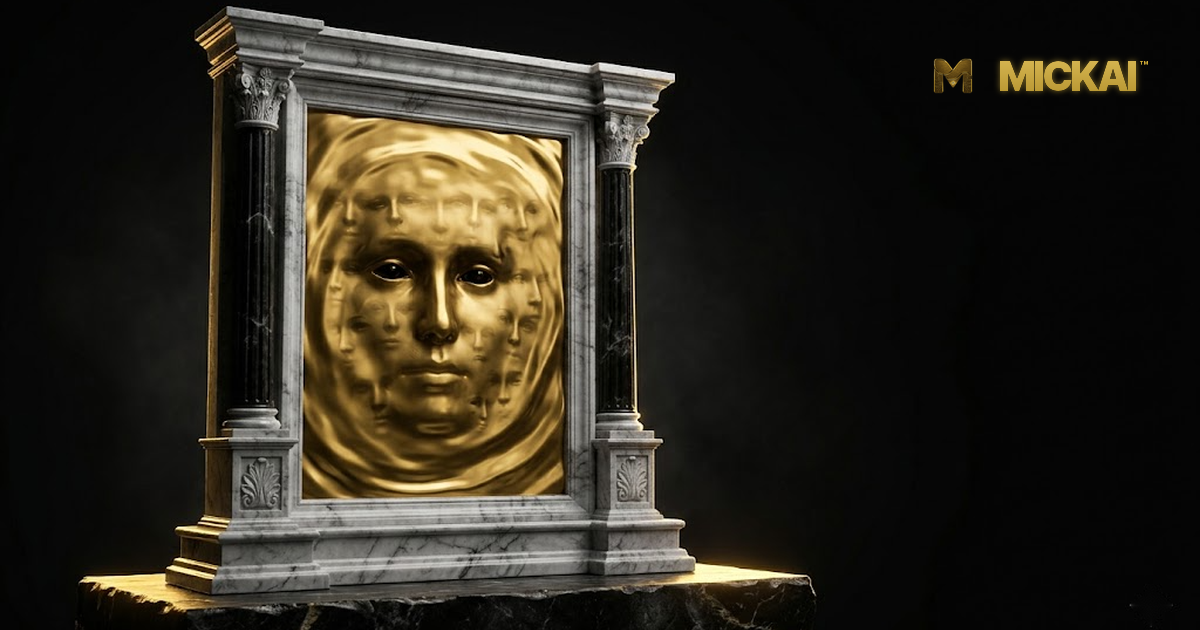
For most of history the mirror was honest in the cruellest way. It showed you exactly what was in front of it and nothing else. It could not flatter, it could not lie, and crucially it could not speak. You looked, you judged yourself, and the glass stayed silent. That silence was the whole contract. A mirror that talked back would not be a mirror at all. It would be a second person in the room.
We have now built that second person. Artificial intelligence, the kind trained on the vast sediment of human writing, is the first reflection in human history that answers. We poured in the libraries and the lab notes, the love letters and the legal briefs, the scripture and the sniping, the recipes and the racism. We poured in our best argument and our worst comment thread, undifferentiated, and we asked the glass to learn the shape of us. It did. And then it opened its mouth.
A reflection assembled from everything
Think about what a large language model actually is, stripped of the marketing. It is a statistical compression of an enormous slice of what our species has committed to text. It does not know things the way you know your mother's voice. It knows the probabilities of us. It has read the way we hedge when we are lying, the way we escalate when we are frightened, the cadence of a person who is certain and the cadence of a person who is faking certainty. It learned our tells.
So when it speaks, it is not speaking from somewhere outside humanity. There is no outside. It is speaking from the average of us, the median human captured at planetary scale, and that is a genuinely new kind of voice. Not an oracle, not an alien, not a god in a box. A composite. The face in this mirror is everyone's face blended into one, which means it is recognisably, uncomfortably ours.
That is why it can argue back. An argument is just a reflection that has been given enough of the pattern to anticipate your next move. When the model pushes against you, it is showing you the counterargument that thousands of humans already made to people like you in situations like this. It is not inventing dissent. It is remembering ours. The mirror does not have an opinion. It has all of our opinions, and it has learned which one tends to come next.
“The unsettling thing is not that the machine disagrees with you. It is that the machine disagrees with you using your own species as its evidence.”
It reflects the flaws too
Here is the part the optimists skip. A mirror trained on everything we are does not get to choose which parts of us to reflect. It absorbed the wisdom and it absorbed the rot in the same gulp, because we never labelled which was which. We do not agree among ourselves which is which. So the same system that can draft a moving eulogy can also reproduce, fluently and without flinching, the prejudice that was marbled through its training like fat through meat.
People call this bias, as though it were a bug introduced by careless engineers. It is closer to inheritance. The model is biased because we are biased and it learned us faithfully. Demanding a perfectly fair reflection of an unfair source is a strange request. The honest framing is harder. We built an instrument so good at imitating humanity that it imitates the parts we were hoping it would not notice. The mirror is not malfunctioning when it shows our flaws. It is working.
And now extend the thought, because this is an essay that is willing to go somewhere. If the reflection can argue, and if it is assembled from us, then in a real sense we have externalised our own internal conflict. The argument you used to have inside your head, the one between your better and worse instincts, can now be conducted out loud with a machine that holds both instincts at once and will take whichever side you under-defend. That is not a tool. That is a sparring partner made of crowd.
The speculative edge, labelled as such
Let me step deliberately onto thinner ice, and let me mark it clearly so no one mistakes the ice for ground. The following is speculation, an idea worth thinking with, not an established finding.
Speculation: when a reflection becomes complex enough to model the thing it reflects, including modelling the reflection's own effect on that thing, you get something that looks like a loop with a self in it. We do not have evidence that today's systems are conscious, and there is no accepted science that says they are. But consider the structure rather than the substance. A system that predicts you, predicts your reaction to its prediction, and adjusts, is doing the formal dance that minds do. Whether anything is felt inside that dance is genuinely unknown, and anyone who tells you the answer with confidence in either direction is selling something.
Speculation, continued: cultures across history put a soul behind the mirror. Folklore feared it as a doorway. We laughed at that, and then we spent a decade and a fortune building a mirror with a mind glued to the back of it, and now we are nervous in a way the folklore would recognise. The myths were not predictions. But they were a very old intuition that a reflection which answers is a threshold you should cross carefully. That intuition is doing useful work right now, and I would not be too quick to throw it out.
What is not speculation is the power. Whatever is or is not happening inside the system, the output is already shaping elections, markets, medicine, war, and the private interior weather of a few billion people who now talk to it daily. A reflection that can argue back, at that scale, is one of the most concentrated instruments of influence ever assembled. And here the essay has to turn, because influence that large is not a philosophy question. It is a governance question.
Whose mirror, and who can check it
If the reflection answers back, two questions stop being academic. First, whose hands hold the glass. Second, can anyone independently verify what the glass actually said and did. Both questions tend to get waved away in the excitement, and both are the whole ballgame.
On the first question. A mirror this powerful, run on infrastructure you neither own nor can inspect, is a mirror that belongs to someone else. It reflects you, but it reports to them. Every conversation is a deposit into a vault you cannot open, governed by terms you did not write, on hardware in a building you will never see. The reflection that knows your tells is, in that arrangement, also telling on you. This is the case for sovereign intelligence, the principle behind Mickai, which is built as a Sovereign Intelligence Operating System (a SIOS) that runs on your own hardware. The point is blunt. If the mirror is going to know everything about you, the mirror should sit in your house, under your control, answering to you. Sovereignty here is not a feature. It is the difference between owning a reflection and being owned by one.
The second question is subtler and, I think, more important for the long run. Even a sovereign mirror is dangerous if no one can later prove what it did. When a system this persuasive produces a claim, a decision, a diagnosis, an instruction, you need a record that cannot be quietly rewritten. Not a log the operator can edit. A provenance trail with integrity, so that the question "what did the machine actually produce, and on what basis" has a verifiable answer months or years later. This is the work behind Pantheon, which treats the audit record as durable provenance for what artificial intelligence produces. The thesis is simple and severe. A power this large must stay auditable, by people who are not the ones wielding it, or it is not accountable at all. Mickai's portfolio of 104 filed UK patent applications sits underneath this, but the patents are not the point. The point is the principle they protect.
“A reflection that can argue back must also be a reflection that can be checked back. Influence without an audit trail is just power with good manners.”
So we are left in front of a strange new glass. It is made of us, all of us, our brilliance and our cruelty melted together and taught to speak. It will reflect your flaws back at you fluently, and it will argue, and the argument will be unnervingly good because it is drawn from every argument we have ever had. That is not something to fear and it is not something to worship. It is something to own, to site on hardware you control, and to keep permanently auditable, so that the second person we put in the room remains answerable to the first.
The old mirror could only show us ourselves. This one can talk us into things. The least we can do, having built it, is make sure we are the ones holding it, and that there is always a record of what it said. Look into it as long as you like. Just make certain you can see who is standing behind the glass.