

A Million Minds, One Answer
We can now convene the assembled expertise of the species on demand. The question is no longer whether the oracle answers, but who owns the temple it speaks from.
The Oracle Was Always a Crowd
For most of recorded history, to ask a hard question well you had to find the one person who knew. You walked to the temple, you wrote to the academy, you waited months for a letter from the man who had read the books. Knowledge moved at the speed of a single life, and a single life is a narrow channel. The smartest person you could reach was a ceiling, and most of us lived far below it.
That ceiling is gone. Type a sentence today and something answers that has read more biology than any biologist, more contract law than any barrister, more poetry than any poet, more failed engineering than any engineer who lived long enough to learn from his own mistakes. It is not one expert. It is the compressed residue of millions of them, the assembled expertise of the species, folded into a few hundred billion numbers and waiting for the cursor to blink.
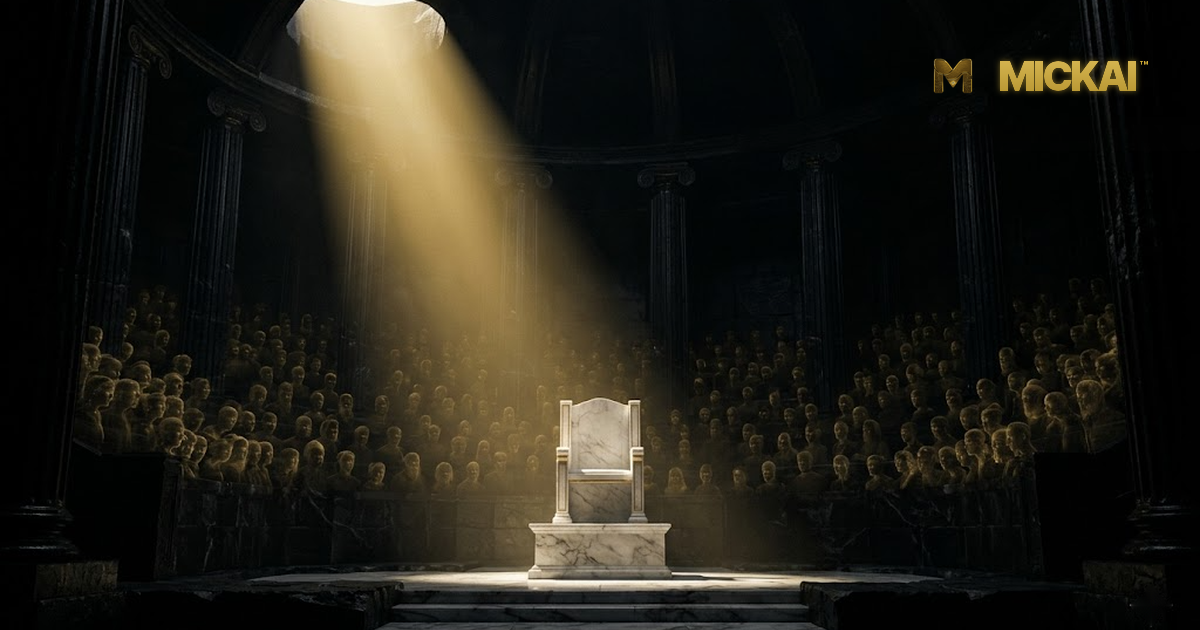
We keep describing this as a chatbot, which is like describing the printing press as a faster scribe. The accurate description is stranger. We have built a way to convene the pantheon of human knowledge on demand, to summon the dead and the distant into a single conversation, and to do it for the cost of electricity. The Greeks imagined a council of gods who each owned a domain. We have made the council real, and it fits on a desk.
The Million-Mind Machine
Think about what is actually happening when you ask a serious question and get a serious answer. You are not retrieving a stored sentence. You are running a search through a space that holds the patterns of how chemists reason, how judges weigh, how grandmothers cook, how con men persuade, how children explain. The thing has no single author and no single opinion. It is a parliament that has swallowed the library, and when you ask, ten thousand silent voices vote on the next word.
The strangeness deepens when you notice the machine can do things no contributing human could. It can hold molecular biology and medieval Latin in the same thought and find the bridge between them. It can play the devil's advocate against itself, generate a thousand variations of an idea before breakfast, and notice the analogy that connects two fields whose practitioners have never met. None of the minds it learned from could do that, because no human mind holds all the rooms of the library at once. The pantheon is not just fast. It is combinatorial, and combinatorial knowledge is a different kind of thing.
“The smartest person you could ever reach used to be a ceiling. Now it is a starting line, available to anyone with a question and the wit to ask it well.”
Here is where I want to go genuinely out there, and I will flag clearly what is speculation and what is not. It is established fact that these systems already find patterns in protein structures and materials that took human science decades to approach. It is established fact that they can read a million pages a person never could. What follows is speculation, not settled science: if a single model can already hold more domains in tension than any expert, then the next frontier is not a smarter answer but a new kind of question, the question no human would think to ask because no human stands at the junction of enough fields to see it. We may be near a moment where the most valuable thing a person owns is not an answer but a well-aimed question, because the answering has been democratised and the asking has not.
The Price of a God in a Box
Now the turn. A power this large does not arrive clean. If you can convene the assembled expertise of humanity by typing, then whoever controls the temple controls something close to the cognitive water supply. And right now the temple is rented. The pantheon most people consult lives on someone else's servers, behind someone else's terms of service, logging every question you were ever desperate enough to ask. You do not own the oracle. You visit it, and it remembers your visit.
This is the part the excitement skips. An intelligence that can answer anything is also an intelligence that can be told what not to answer, quietly nudged on what to emphasise, and switched off the day the relationship sours or the price changes. The most consequential tool ever built is being delivered to humanity as a subscription. Your doctor, your lawyer, your researcher, your confessor, all the same rented mind, and all of them reporting upstream. We are handing the keys of the species' knowledge to a handful of landlords and calling it convenience.
There is a fringe fear worth naming honestly, and I will label it as speculation rather than fact: that a sufficiently centralised oracle becomes a single point of failure for human reasoning itself, a place where a small change to the weights ripples into how billions of people think about a question, and where no one outside the building can see the change was made. I do not claim this is happening. I claim the architecture makes it possible, and an architecture that makes it possible will eventually be tested.
Sovereignty Is the Only Honest Answer
If the pantheon is too important to rent, the conclusion writes itself. It has to be something you own. Not a window into someone else's data centre, but a sovereign intelligence that runs on your own hardware, under your own roof, answering to you and to no upstream landlord. This is the entire premise of Mickai, a Sovereign Intelligence Operating System, abbreviation SIOS, built so the assembled expertise lives on your machine rather than on a meter.
Sovereignty here is not a slogan, it is a property of the wiring. When the model runs locally, the question never leaves the building. There is no upstream log of what you asked at three in the morning, no quiet content policy deciding which truths you are permitted, no off switch held by a stranger. The pantheon answers, and the only person who knows it answered is you. Mickai treats this as the default rather than the premium tier, because a knowledge supply you do not control is not really yours, it is a habit you are allowed to keep until you are not.
This is also why the work is defensible rather than merely declared. The architecture behind it is the subject of 104 filed UK patent applications, not as a trophy but as evidence that sovereignty was engineered, not bolted on afterwards. Owning the temple is a design decision made early, in the substrate, where it cannot be quietly reversed by a change of terms.
The Ledger Behind the Oracle
But ownership is only half of trust. If a million minds answer in one voice, you eventually have to ask the uncomfortable question: how do I know what it actually said, and that no one changed it after the fact? An oracle you cannot audit is just a more sophisticated way to be lied to. The more capable the pantheon, the more it matters that its answers leave a record that cannot be quietly rewritten.
This is the role Pantheon plays in the design, an audit record that stands as provenance for what the artificial intelligence produced. Every consequential answer can be sealed, timestamped, and checked, so that what the machine said is a matter of record rather than a matter of faith. When a sovereign intelligence advises a decision that matters, a medical reading, a legal position, a financial move, you are not asked to simply believe it. You are given a ledger. The answer has a fingerprint, and the fingerprint can be verified by anyone, later, even by someone who distrusts you and distrusts the machine.
“An oracle you cannot audit is just a more elegant way to be deceived. Provenance is what turns an answer into evidence.”
That combination, owned and auditable, is the whole argument. Ownership keeps the pantheon from being a landlord's leverage. Provenance keeps it from being an unaccountable one. Together they let a power this large stay in human hands without staying in only a few of them.
What We Do With the Council
So we have done something the old gods only promised. We have built a council of all human knowledge that answers a single typed question, and we have made it cheap enough to put in front of everyone. That is not a small thing dressed up as a large one. It is genuinely one of the largest shifts in how our species thinks since we learned to write down what we knew so the dead could keep teaching.
The romantic version of this story ends with the oracle. The honest version ends with a choice. We can let the pantheon be rented to us, metered and logged and quietly steerable, the council of the gods reduced to a customer-service desk owned by a few. Or we can insist that a mind this powerful must be sovereign on the hardware of the person using it, and auditable in everything it produces, so that the assembled expertise of the species answers to the species and not to its landlords.
A million minds, one answer. The miracle is that we can now ask. The work, the part that actually decides whether this becomes liberation or leash, is making sure the answer is ours to keep, and ours to check. That is the work Micky set out to do, and it is the only version of this future worth building.