


Intelligence as Infrastructure
Thinking is becoming a utility as fundamental as power and water, and the question is no longer whether we use it but who owns the layer it runs on.
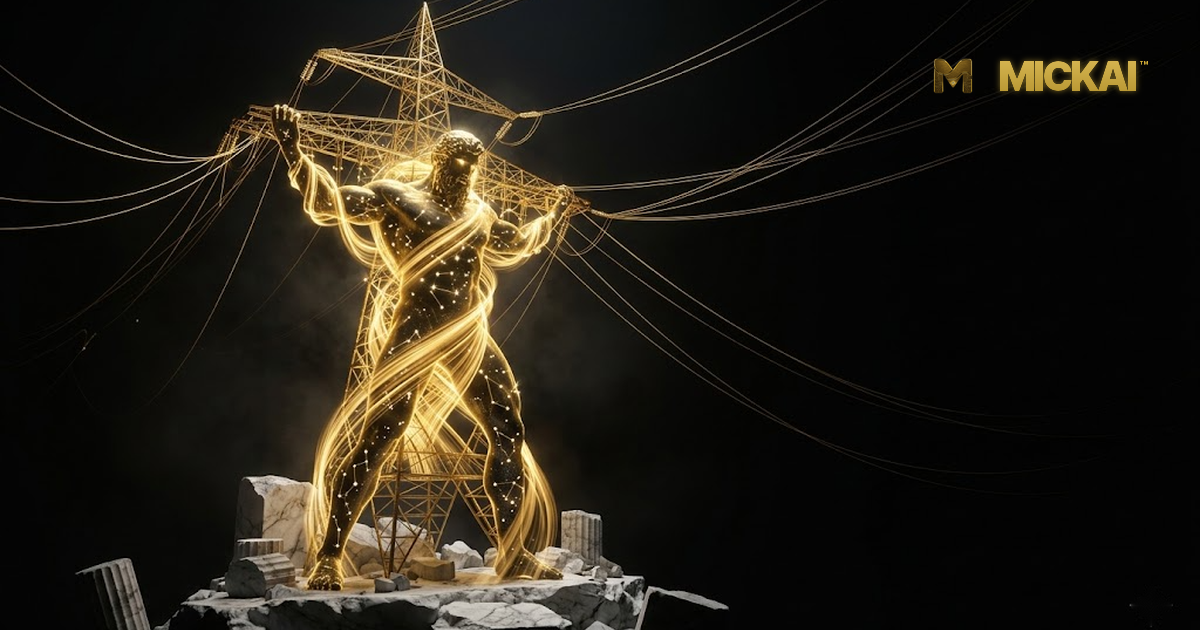
Pull the plug on a hospital and people die. Cut the water and a city empties within a week. We accept that some systems are too important to be casual about, so we build them as infrastructure: regulated, redundant, accountable, owned under terms that the public can see and challenge. Nobody seriously argues that the grid should be a black box run for the convenience of three companies in another jurisdiction. We learned that lesson with railways, with telephony, with electricity, often the hard way, and we wrote it into law.
Intelligence is about to teach us the same lesson, faster and at higher stakes. In the span of a few years, the capacity to reason over text, images, code, contracts, medical records and battlefield telemetry has moved from a research curiosity to a load-bearing input in how organisations decide things. Diagnoses are drafted by it. Loan applications are screened by it. Logistics are routed, fraud is flagged, intelligence is triaged, children's homework is marked. The moment a capability sits underneath that many decisions, it has stopped being a product. It has become infrastructure, whether or not anyone planned it that way.
And here is the uncomfortable part. We are building the most consequential infrastructure of the century as if it were a subscription. We are renting cognition by the token from a handful of towers, on terms we do not set, running on weights we cannot inspect, logging our most sensitive questions to servers we do not control. We would never accept this arrangement for our water. We are sleepwalking into it for our minds.
When a tool becomes a foundation
There is a clean test for whether something has crossed from tool to infrastructure, and it is not how clever the thing is. It is what happens when it goes away. A tool, when it fails, is an inconvenience: you reach for another. Infrastructure, when it fails, takes a slice of the world down with it. The day a payments network stutters, commerce in a country freezes. The day a cloud region falls over, a thousand businesses discover at once that they were never independent companies, only tenants who had forgotten they were renting.
By that test, frontier intelligence is already infrastructure for a great many organisations, and they have not noticed. They have woven a rented model into their underwriting, their support desk, their drafting, their code review, and they could not unwind it in a fortnight if they tried. The dependency is real, the switching cost is brutal, and the leverage sits entirely with the supplier. This is the defining condition of infrastructure capture: the customer cannot leave, and the provider knows it.
What makes intelligence different from every utility before it is the nature of what flows through the pipe. Water is water. Electricity is electricity. They carry no memory of you. But intelligence is fed by your questions, and your questions are the most revealing thing about you. To ask a model anything useful, you must tell it something true. Over a year, the pattern of what an organisation asks is a near-complete map of its strategy, its weaknesses, its pending deals, its legal exposure and its people. We have built a utility whose meter reads your thoughts, and we have handed the meter to strangers.
“Water carries no memory of you. Intelligence is fed by your questions, and your questions are the truest thing about you.”
This is why the lazy analogy to cloud computing fails. When you moved your servers to someone else's data centre, you outsourced storage and compute, commodities that are roughly the same wherever they run. When you outsource intelligence, you are outsourcing judgement, and you are doing it while feeding the judge a confession. The asymmetry is total. The provider learns the shape of your mind. You learn nothing about theirs, because the weights are sealed and the reasoning is a black box even to the people who shipped it.
The towers and their terms
The current arrangement has a structure worth naming plainly. A small number of very large providers, concentrated in one or two jurisdictions, control the foundation models that most of the world now reasons with. They set the price. They set the rate limits. They decide which uses are permitted and which are quietly refused. They change the model underneath you without notice, so the system that approved a loan on Monday may decline it on Friday for reasons no one can reconstruct. They retain the right, in practice if not always in writing, to learn from the traffic you send them.
None of this is villainy. It is simply what rational businesses do when they own a chokepoint. The problem is not the motive, it is the position. We have allowed the most strategically important capability of the age to consolidate into a posture of pure dependence, and we have done it without the safeguards we demand of every other essential service. There is no universal service obligation. There is no regulated right to inspect. There is no portability mandate, no requirement that you be able to take your reasoning layer elsewhere. There is no obligation to keep the lights on for the awkward customer, the small one, the foreign one, the one whose politics have fallen out of favour.
Consider what dependence at this depth actually exposes. The list is not hypothetical, it is a description of the present:
- Confidentiality. Every prompt is a disclosure. Sensitive strategy, patient data, source identities and legal positions are transmitted to systems you cannot audit and are governed by laws you may never see invoked.
- Continuity. A pricing change, a policy shift, a geopolitical fracture or a single deprecation notice can pull a capability you depend on out from under you, on the provider's timetable, not yours.
- Consistency. Silent model updates mean the same input can yield a different decision next quarter, with no changelog you are entitled to and no way to reproduce the verdict that affected a real person.
- Accountability. When an automated decision harms someone, you are liable, but you cannot open the box that made it. You are answerable for reasoning you are not permitted to examine.
- Sovereignty. A nation, an institution or a family that rents its core cognition from abroad has outsourced a function that, in any honest accounting, is a matter of self-determination.
Read that list as an engineer reads a single point of failure, because that is what it is. We have not just bought a service. We have surrendered a layer.
What it means to own the layer
The alternative is not to refuse the technology. That ship has sailed, and refusing it would be its own kind of poverty. The alternative is to treat intelligence the way a serious society treats any other essential service: build it as an owned, accountable utility layer, with the obligations that ownership implies. Sovereignty here does not mean isolation, and it does not mean everyone training a frontier model in a shed. It means the capability runs on infrastructure you control, under governance you can see, with the right and the ability to inspect, to reproduce, to keep running and to walk away.
Ownership of an intelligence layer is a stack of concrete properties, not a slogan. It means the model runs where you decide, on hardware you hold, so that a prompt never has to leave your walls to be answered. It means you can read the audit trail of what the system did and why, in a form that survives the disappearance of the company that built it. It means the weights are yours to fine-tune, specialise and eventually replace, rather than a sealed dependency rented by the month. It means continuity is your decision, not a line item on someone else's roadmap. None of these is exotic. Every one of them is something we already demand of the systems that carry our water and our power. We have simply not yet demanded them of the system that carries our thinking.
This is the conviction Mickai is built on. Mickai is a Sovereign Intelligence Operating System, a SIOS, designed from the foundation as infrastructure you own and operate rather than a service you rent. The model runs on your hardware. The reasoning is local. The data stays inside the layer. And the obligations of infrastructure are wired in rather than bolted on, because a utility that cannot prove what it did is not a utility, it is a liability with good marketing.
Owning brings obligations, not just rights
It would be easy, and dishonest, to present sovereignty as pure liberation. Owning your infrastructure is harder than renting it. Anyone who has run their own power, their own water, their own servers knows the bargain: you trade the comfort of someone else's problem for the responsibility of your own. The reason to take that trade is not that it is easy. It is that, for anything load-bearing, the responsibility is the point. You cannot be accountable for a decision you have fully outsourced. Accountability and ownership are the same muscle.
So the case for sovereign intelligence has to carry its duties on its face, or it is just a different sales pitch. If you operate the layer that reasons over consequential matters, you owe the people affected by it a set of things that rented intelligence has been allowed to skip:
- An honest record. Every consequential action the system takes should be signed and logged in a way that cannot be quietly altered, so that the account of what happened survives the company, the server and the convenient memory.
- Inspectability. When a decision touches a real person, that person, or someone acting for them, should be able to see how it was reached, not be told the reasoning is a trade secret.
- Durability against time. Infrastructure outlives the fashions of the moment, and that includes the fashions of cryptography. A record worth keeping must be worth keeping in ten years, against attacks that do not yet exist.
- Graceful failure. A serious utility tells you honestly when it cannot do something safely, rather than guessing past the edge of its competence and dressing the guess as authority.
- A way out. Ownership is hollow if it is a cage of a different colour. The right to leave, to export, to run elsewhere, is part of what makes the thing yours.
These are demanding. They are meant to be. The whole argument of this piece is that intelligence has become too important for anything less, and a movement that asks for sovereignty without accepting its obligations is asking for power without accountability, which is exactly the disease it claims to cure.
In Mickai, the honest-record obligation is not aspirational. Every consequential action is signed by the Open Audit Record, the OAR, under a post-quantum signature standard, FIPS 204 ML-DSA-65, and hash-chained so that the sequence cannot be silently rewritten. The chain is verifiable offline, by anyone, without trusting the vendor, which is the only kind of accountability that means anything once the marketing has faded. An audit trail you have to take on faith is not an audit trail. It is a press release.
The foundations under the foundation
If intelligence is the utility, it needs ground to stand on, and the ground has its own requirements. Two of them are easy to overlook and impossible to retrofit, which is precisely why infrastructure people obsess over them while everyone else discovers them too late.
The first is time. Anything you build as infrastructure has to assume it will be attacked by capabilities that do not exist yet. The signatures and ledgers that protect today's records were designed against today's computers. A sufficiently capable quantum machine, when it arrives, breaks much of that protection retroactively, and an adversary who is patient can harvest encrypted records now to crack later. For a system whose whole purpose is a record that endures, post-quantum security is not a feature to add in a future release. It is a precondition. This is why Mickai's sovereign Layer 1, called Pantheon, is post-quantum from genesis rather than promising to migrate one day. It is anchored to Bitcoin for the weight of an external clock, it is currently on testnet, and it carries the PAN token with a fixed supply of five billion. The fixed supply is itself a statement about infrastructure: the rules of the foundation should not be quietly inflatable by whoever runs it.
The second is the weights themselves, the actual reasoning core, and here honesty matters more than ambition. Today Mickai runs on its own specialised sovereign models, trained and hardened for the sovereign layer on a sealed corpus we control, running on hardware the owner holds rather than called over a wire. At the same time, Mickai is actively training its own models now, building toward weights that are fully native rather than borrowed. Funding scales that journey, it does not begin it. I will not pretend the destination is the present. A movement that overclaims its own maturity earns the scepticism it gets. What I will claim is the direction, and the discipline of building it in the open, layer by layer, so that the reasoning core ends up as owned as the hardware it runs on.
There is a reason to be precise about all of this rather than wave at a vision. Infrastructure is judged by what it can prove, not by what it promises. The patent position behind Mickai, one hundred and four filed UK patent applications carrying approximately two thousand two hundred and thirty four claims, owned by Mickai LTD with myself as the named inventor, exists for the same reason the audit chain exists: to make the claims checkable. Anyone can assert sovereignty. The work is in the parts that can be inspected when the talking stops.
A category, not a feature
Step back from any one product and the larger movement comes into focus. We are at the point in the life of a technology where it stops being something you buy and starts being something a society has to decide how to own. Electricity went through this. So did the telephone, the railway, the road. In each case there was an early period when the new capability was simply a marvel for sale, and a later reckoning when people realised that something everyone now depended on could not be left as a private convenience answerable to no one. The reckoning always came. It is coming for intelligence, and it is coming faster, because intelligence touches not just what we can do but what we are permitted to think with.
Sovereign intelligence is the name for getting ahead of that reckoning rather than being dragged through it. It is the position that the reasoning layer of a person, an institution or a nation is too fundamental to rent from towers that owe you nothing, and that the alternative is not paranoia or retreat but ordinary, grown-up ownership, with the books open and the obligations accepted. It is a category, not a feature, and like every category that mattered it will be defined by whoever takes the obligations most seriously, not whoever shouts loudest.
We have done this work before, for water and for power, and we know how it ends. The systems that carry the essential things get built as infrastructure, owned under terms the public can see, accountable to the people who depend on them. The only open question with intelligence is whether we do it deliberately, while there is still a real choice, or whether we wait until the dependence is total and the terms are dictated to us. I would rather we chose. Mickai is one answer to that choice, an attempt to build the intelligence layer the way we should have built it from the start, as something you own, something that can prove what it did, and something that will still be standing, and still be yours, when the towers have moved on to the next thing they intend to rent you.