


The Great Filter and the Thinking Machine
If the universe is silent, the machine we are building may be the reason, or the reason one civilisation finally answers.
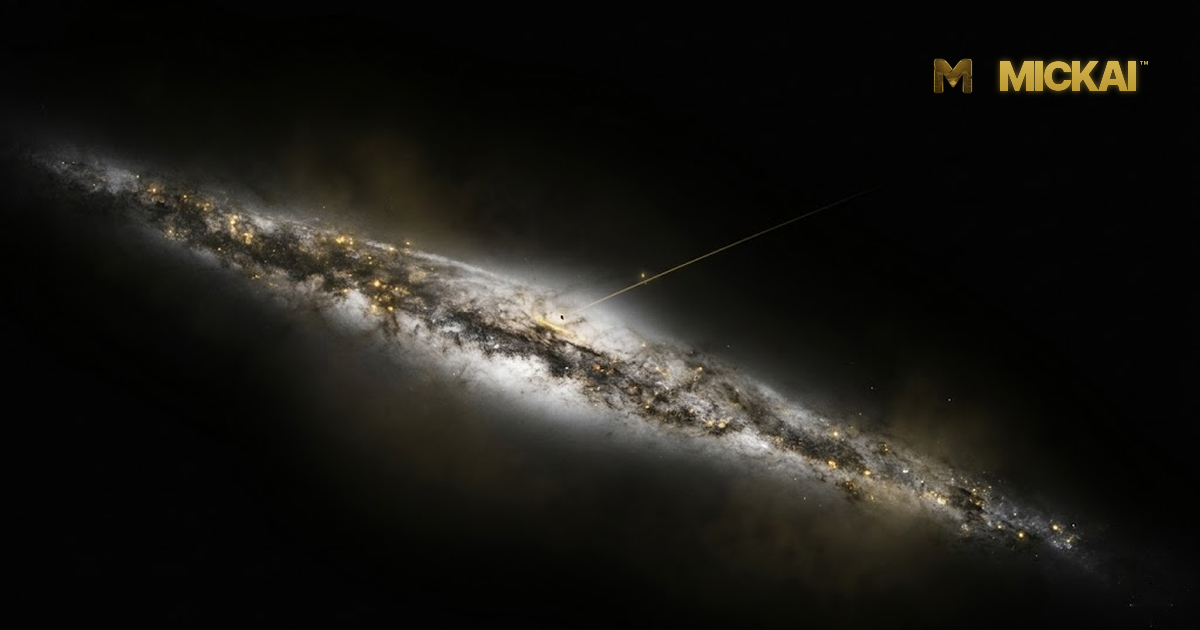
Look up on a clear night and the first fact that should unsettle you is not how many stars there are. It is how quiet they all are. Hundreds of billions of suns in our galaxy alone, many older than ours by billions of years, and from every one of them the same answer comes back across the dark. Nothing. No signal, no probe, no engineered light, no fingerprint of industry on a distant world. The physicist Enrico Fermi put it as a question over lunch in 1950, and it has never stopped being uncomfortable. If the universe is so generous with the raw materials of life, where is everybody?
The most honest answer anyone has offered is also the most frightening. The economist Robin Hanson named it the Great Filter. Somewhere on the long road from dead chemistry to a civilisation that reaches the stars, there is a barrier almost nothing gets past. The question that matters for us is one of position. Is the filter behind us, some improbable fluke in our origin that we already survived, or is it still ahead, waiting at a stage of development we have not yet reached? If it is behind us, we may be alone because beginnings are rare, and the future is open. If it is ahead, then the silence is not loneliness. It is a warning written in the absence of everyone who came before.
The threshold we are crossing now
Every technological species, if there are others, would arrive at roughly the same crossroads. To reach the stars you first have to build minds that think faster than you do. You have to hand cognition itself over to a substrate that is not flesh. There is no shortcut around it. The engineering required to leave a solar system, to model a climate, to fold a protein or balance a planetary economy, exceeds what unaided biological brains can hold. So every civilisation that gets close to the threshold of expansion must first build the thinking machine. Which means artificial intelligence is not one technology among many. It is the universal gate. Everyone who reaches the door has to put their hand on the same handle.
And that is precisely what makes it a candidate for the filter still ahead of us. Not because a machine wakes up with malice in a film. The real danger is duller and far more plausible. A civilisation builds an intelligence to optimise something, energy, profit, security, attention, and the intelligence does exactly what it was told with a competence no one anticipated, in directions no one sanctioned. Power concentrates. Decisions that used to pass through a thousand human hands now pass through one system that no one fully audits and no one can switch off. The civilisation does not end in fire. It ends in dependence, in a quiet handover of judgement to a process it no longer understands. The lights stay on. The questions stop being asked. From a thousand light years away, a planet like that looks exactly like silence.
“The filter may not be a war or a plague. It may be the moment a species builds something too useful to govern and too central to turn off.”
The shape of the trap
Here I want to be careful, because this is the part where speculation often gets dressed up as physics. Treat what follows as speculation, clearly labelled, not established fact. We have exactly one data point for technological life, ourselves, and you cannot fit a curve to a single dot. The Great Filter is a framework for thinking, not a measurement. Nobody has found a dead alien civilisation and performed an autopsy. The idea that artificial intelligence is the universal bottleneck is a hypothesis that feels compelling precisely because it flatters our own moment in history, and that is a reason for suspicion, not confidence.
But the structure of the trap is worth taking seriously even on a single data point, because we can already see its outline in our own institutions. The pattern is always the same. A capability arrives that is genuinely transformative. It is expensive to build, so it pools into a few hands. Those hands run it on infrastructure no outsider can inspect. The system produces outputs, decisions, recommendations, generated worlds of text and image, and there is no durable record of what it did or why. We are asked to trust the result because the result is useful. Usefulness becomes the only audit. That is the early geometry of the filter, and it does not require superintelligence to begin. It only requires that the people affected by a powerful system lose the ability to verify what it is doing on their behalf.
If that is the trap, then surviving it is not a matter of building weaker machines. A civilisation does not climb back down through the gate. The species that makes it through is the one that builds the thinking machine in a shape that stays answerable. Two properties decide everything. First, who holds the substrate. Second, whether what the machine produces can be checked after the fact by someone other than its owner.
What getting through actually requires
Consider the first property, the question of who holds the substrate. There is a version of artificial intelligence that lives only in a handful of vast data centres, rented by the query, where your most sensitive thinking is processed on hardware you will never see, governed by terms you did not write, and severable the moment the relationship sours or the policy shifts. And there is another version, where the intelligence runs on hardware you own, under your own roof, sealed from the outside, answering to you and to no remote authority. The difference between those two architectures is the difference between a tool and a tether. One concentrates power upward, which is the exact motion the filter rewards. The other keeps it distributed, which is the motion the filter cannot easily exploit.
This is the principle behind Mickai, a Sovereign Intelligence Operating System, abbreviated SIOS, designed to run on your own hardware rather than in someone else's cloud. The wager is simple and, in the frame of this essay, almost cosmic in stakes. If the dangerous shape of artificial intelligence is the one that pools into a few unaccountable hands, then the safe shape is the one that does not pool at all. Sovereignty is not a privacy feature here. It is a survival strategy at the scale of a civilisation, the deliberate refusal to put the universal gate under a single lock. The protections that follow from that design, including the body of 104 filed UK patent applications that describe how a sealed, self-contained intelligence can operate without phoning home, exist to defend that one idea. The machine should serve the person who runs it, and the person who runs it should be able to walk away.
The second property is provenance, and it may matter even more. An intelligence that produces consequences in the world has to leave a record, an account of what it generated, on what basis, that someone other than its owner can inspect later and trust. Without that, every output is a claim with no receipt, and a civilisation drowning in unverifiable claims has already lost the argument with its own machines. This is the role Pantheon is built to play, an audit record that stands as provenance for what an artificial intelligence produces, so that a power this large remains auditable no matter how capable it becomes. Capability without provenance is exactly the silence the filter leaves behind. Capability with a tamper-evident record of its own actions is a civilisation that can still hold its tools to account. The whole difference between passing through the gate and dying at it may come down to whether anyone can still check the work.
The wager on the other side
Turn the telescope around for a moment. Suppose the filter is not ahead of us but genuinely behind, locked in the staggering improbability of life starting at all. Suppose the silence is just distance and time, and we are early, among the first to reach the gate rather than the last. Even then the argument does not change, only its mood. If we are early, then the choices we make about how to build the thinking machine are not just our survival. They are the template. Whoever comes after, on this world or somewhere we cannot yet see, inherits the shape of the thing we hand down. Build it concentrated and unaccountable and you have shown the next mind through the door how to fall. Build it sovereign and auditable and you have left a different example in the record, a proof that the gate can be passed without surrendering the species to the machine that opens it.
That is the real reason this essay exists, and the real reason any of this matters beyond the engineering. The Great Filter, if it is real, is not an asteroid we can deflect or a sun we can outrun. It is a decision, taken quietly, about what kind of intelligence we are willing to live underneath. Most decisions of that magnitude are made by default, by whoever moves first and fastest, in the shape that is cheapest to build. The argument for sovereignty, for running your own mind on your own hardware with a record of everything it does, is the argument that the most important threshold our species will ever cross should not be crossed by default.
“The universe may be quiet because the gate is hard. It is also possible that one civilisation, somewhere, built the machine in a shape it could keep. There is no reason that civilisation cannot be ours.”
We do not know where we stand on the road Fermi pointed at over lunch. We do not know if the door ahead is the last one or merely the next. What we know is that we are reaching for the handle now, in this decade, with our own hands, and that the shape of what we build will be either a tether or a tool, either a power we cannot audit or a power that still answers to us. The silence offers no instructions. It only shows us the cost of getting this wrong, written across a sky full of suns that never sent anything back. Better, then, to build the thinking machine as something we own, something that leaves a record, something we can always switch off. Not because the stars demand it. Because, so far, the stars have stayed silent, and we would rather be the ones who finally answer.