

Fifty Minds, One Substrate
Inside the architecture of a Sovereign Intelligence Operating System: fifty cooperating specialised models, cross-model routing, an offline knowledge index, and every action sealed into a record that cannot be quietly rewritten.
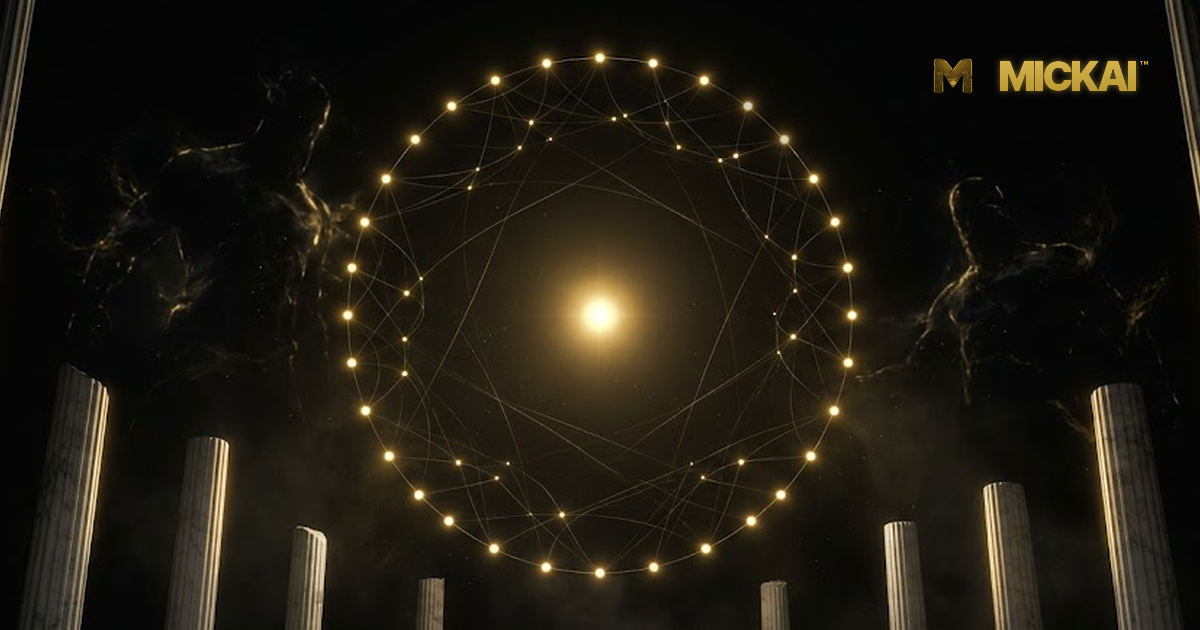
Picture a council chamber lit from a single source. Around the long table sit fifty figures, each one a specialist in something narrow and deep. One reads law. One reads cell biology. One reads the wiring diagrams of power grids. One does nothing but decide which of the others should speak next, and one does nothing but check that what was said is true before it leaves the room. None of them is a genius at everything. Together they behave as if they were. Now place that chamber not in a distant data centre owned by a company you will never meet, but in a machine humming quietly on your own desk, behind your own door, answerable to you alone. That image is not a metaphor reaching for effect. It is, as closely as language allows, a literal description of what a Sovereign Intelligence Operating System is.
For three years the public conversation about artificial intelligence has been organised around a single hidden assumption, so quiet that almost nobody states it out loud. The assumption is that intelligence must be rented. That to think with a powerful model you must send your question across the wire to someone else's silicon, accept their terms, trust their retention policy, and hope that the answer that comes back was not shaped by interests you cannot see. The whole architecture of the modern AI industry rests on that assumption. Sovereign intelligence is the argument that the assumption is wrong, and that the alternative is not only possible but already running.
Why one giant mind is the wrong shape
The instinct of the last few years has been to build ever larger single models, monoliths trained on the whole of human text, asked to be lawyer and physician and poet and engineer at once. This produces astonishing breadth and a particular kind of fragility. A single enormous model is a single enormous attack surface. It is opaque in proportion to its size. When it is wrong it is wrong with the same fluent confidence it brings to being right, and there is no second voice in the room to catch it. It must run somewhere vast, which in practice means somewhere you do not control, which in practice means your most sensitive questions become someone else's training data, telemetry, or subpoena.
Nature, when it built the most capable intelligence we know, did not build one undifferentiated mass. It built regions. Areas that specialise, that compete, that inhibit and correct one another, with structures whose entire job is arbitration between them. A brain is a federation, not a monolith. Mickai takes that lesson seriously. Rather than one model straining to be everything, a Sovereign Intelligence Operating System is composed of fifty specialised minds, twenty-five trained on domains of knowledge and twenty-five built to run the system itself. Each one is smaller, sharper, and more auditable than any monolith could be. The capability does not come from the size of any single mind. It comes from how they are made to cooperate.
“Capability is not a property of the largest model in the room. It is a property of the conversation between fifty smaller ones.”
The twenty-five domain brains cover the territory a serious operator actually works in: intelligence and defence, governance and strategy, health and humanity, science and engineering, and identity. The twenty-five operational brains are the machinery that turns a collection of models into an operating system. Among them sits the Chronus Kernel, eight components that schedule and sequence work, including the router that decides who answers and the arbiter that settles disagreements between them. Beside the kernel sit the custodians, two quiet brains whose only purpose is the health of the whole: one that keeps the system's knowledge fresh, and one that repairs the system when something breaks. The rest are specialists, fifteen of them, each owning a craft. It is, deliberately, the shape of an institution rather than the shape of a single oracle.
The art is in the routing
Anyone can assemble fifty models. The difficulty, and the value, lies in deciding which mind handles which fragment of a question, and in stitching their answers back into something coherent. This is cross-model routing, and it is the part of the architecture that most resembles thought itself. A real question is rarely the property of one discipline. Ask whether a particular medical device can lawfully be deployed across a national health network and you have, in a single sentence, asked a question of clinical safety, of procurement law, of cyber security, of supply chain logistics, and of public trust. A monolith answers such a question by averaging across everything it has ever read. A routed federation answers it the way a good chief of staff would: by sending each part of the problem to the person who actually knows, and then convening them.
The router reads the shape of the request and dispatches its parts. The relevant domain brains work in parallel. The arbiter reconciles them when they conflict, because they will conflict, and that conflict is a feature, not a fault. The custodian that watches over knowledge ensures that what each brain draws on is current rather than frozen at the moment of training. What emerges is not the loudest single voice but a reconciled position, with the disagreements visible rather than smoothed away. This is slower than firing a prompt at one model and accepting whatever returns. It is also far harder to fool, far easier to inspect, and far closer to how careful institutions reach decisions they can stand behind.
Memory you can hold, not memory you must trust
A mind with no memory is a stranger every morning. The fashionable answer to this is to let a model reach out to the open internet on demand, pulling in whatever it finds. That is convenient and it is also a quiet surrender of sovereignty. Every reach across the wire is a signal of what you are thinking about, sent to parties who log it. It binds the quality of your reasoning to the quality and the availability of someone else's network. And it makes your intelligence stop working the moment the connection does.
A Sovereign Intelligence Operating System takes the opposite path. It carries its own knowledge index, an offline corpus that lives on the operator's hardware and is searched locally. The brains consult that index rather than the open web. The index can be curated, versioned, and inspected, so the operator knows precisely what their system has read and can stand behind every source. When the network is cut, the intelligence does not degrade, because nothing it depends on was ever on the far side of the cut. This is what it means for knowledge to be something you hold rather than something you trust a stranger to hand you. It is also what makes the system usable in the places that need it most: a clinic with poor connectivity, a vessel at sea, a site under blockade, a room where the very act of querying the internet would tell an adversary too much.
The custodian brains keep this index from going stale. One refreshes knowledge on a schedule the operator controls, folding new material into the corpus deliberately rather than scraping the world in real time. The distinction matters. The difference between a curated index you own and a live feed you query is the difference between a library and a surveillance tap pointed at your own curiosity.
Every action sealed, every record honest
Here is the question that separates a serious sovereign system from a clever toy. When the system does something that matters, can you prove afterwards exactly what it did, and can anyone tamper with that proof? In most AI deployments the honest answer is no. There is a log, the log lives in a database, and whoever controls the database controls the truth. A record that can be quietly edited is not a record. It is a story the keeper of the database is willing to tell today.
Mickai's answer is the Open Audit Record, the OAR. Every consequential action the system takes is signed and chained the moment it happens. The signature uses ML-DSA-65, the post-quantum digital signature standardised under FIPS 204, chosen precisely because it is built to survive the arrival of quantum computers that will break the signatures most systems rely on today. Each record is hash-chained to the one before it, so the sequence cannot be reordered or have entries removed without breaking the chain visibly. And, crucially, the whole record can be verified offline, by anyone holding it, with no need to phone home to the company that produced it. The proof of what happened does not depend on trusting the party who has every incentive to be trusted.
- Each consequential action is signed at the moment it occurs, not reconstructed later from a mutable log.
- The signature uses ML-DSA-65, the post-quantum scheme standardised as FIPS 204, designed to outlast the cryptography most systems still depend on.
- Records are hash-chained, so removing, reordering, or altering any entry breaks the chain in a way that anyone can detect.
- Verification is offline and independent, requiring nothing from the vendor and no live connection to anyone.
- The operator, not the manufacturer, holds the evidence of what their own system did.
This is the unglamorous part of the architecture and it may be the most important. Intelligence without accountability is just confident assertion. The OAR is the mechanism that lets a sovereign system be trusted not because its maker asks to be trusted, but because its actions are sealed into a form that cannot be quietly rewritten. In a world increasingly nervous about what automated systems are doing in our names, an audit record you can verify yourself is not a feature. It is the precondition for letting these systems anywhere near decisions that matter.
On your hardware, in your name
None of this would mean very much if the whole apparatus still ran in someone else's cloud. Sovereignty is not a slogan you can paint onto a rented service. It is a property of where the computation actually happens and who holds the keys. A Sovereign Intelligence Operating System runs on the operator's own hardware. The fifty brains, the routing, the knowledge index, and the audit record all live on machines the operator owns and controls. The system is designed to detect the hardware it is running on and scale to fit it, from a single capable workstation up to a full server. Where a capability genuinely exceeds the silicon available, the system says so plainly and tells the operator what an upgrade would unlock, rather than pretending or silently failing. Honesty about limits is itself a sovereignty principle.
The models are honest about their provenance too. Today the brains are our own specialised sovereign models, trained and hardened on a sealed corpus into the specific minds the system needs. At the same time Mickai is actively training its models now, not at some funded future date, and the roadmap scales that effort toward fully native weights as resources grow. That is the honest state of the work: running sovereign models we control today, deepening native intelligence in parallel, and stating clearly where the work stands rather than dressing one stage up as another. The point of sovereignty is not to claim you invented every brick. It is to know exactly what every brick is and to own the building.
The layer beneath the minds
A sovereign system needs more than private computation. It needs a way to settle value, identity, and record without leaning on infrastructure that someone else can switch off. That is the role of Pantheon, the sovereign Layer 1 beneath the intelligence. Pantheon is post-quantum from genesis, built from its first block to resist the cryptographic threats that will render most of today's chains readable, and it is anchored to Bitcoin so that its history inherits the most battle-tested settlement guarantee in existence. It runs on testnet today. Its token, PAN, has a fixed supply of five billion, and the work to bring the network to maturity is the subject of a thirty million pound raise.
It would be easy to treat the chain as a separate product bolted on for fashion. It is not. A sovereign intelligence that can prove its own actions through the Open Audit Record, and a sovereign ledger that can settle and timestamp those proofs without permission from any gatekeeper, are two halves of the same idea. One makes the mind's conduct verifiable. The other makes the mind's record durable and independent. Together they describe a future in which an operator can run powerful intelligence, prove what it did, and anchor that proof, all without asking anyone's leave. That is the shape of genuine independence, and it is why the architecture reaches all the way down to its own foundations rather than renting them.
A category, not a product
It is tempting to read all of this as the description of one company's clever system, and to file it accordingly. That would be a mistake, and not only because it undersells the work. Sovereign intelligence is a category and, increasingly, a movement. It is the proposition that the most consequential technology of our age should not be available only as a rented utility metered by parties whose incentives we cannot inspect. It is the claim that individuals, institutions, hospitals, ships, agencies, and nations have a right to think with powerful tools without surrendering the contents of their thinking in the process. The architecture described here, fifty cooperating minds, routed and reconciled, drawing on knowledge you hold, sealing every action into a record you can verify, running on hardware you own, anchored to a ledger no gatekeeper can revoke, is simply what it takes to make that right real.
There is a great deal of work still ahead, and it should be named as such. Pantheon is on testnet, not yet a mature mainnet. The native models are in active training, not finished. The full hardware lineup the architecture is designed for stretches well beyond what most operators run today. None of that is hidden, because hiding it would betray the entire principle. What exists now is real: fifty specialised brains, cross-model routing, an offline knowledge index, the Open Audit Record signing and chaining actions under FIPS 204, the whole thing running sovereign on the operator's own machine, with a portfolio of 104 filed UK patent applications, 2,340 claims, owned by Mickai LTD, named inventor Micky Irons, marking out the ground.
The council chamber, then, is not a thought experiment. It is the room we are building, fifty minds around one table, lit from a single source, and that source is the operator. The question the next decade will put to all of us is simple and not at all comfortable. When intelligence becomes the most powerful instrument in the world, will we hold it, or will we rent it from those who do? Mickai exists to make the first answer possible. Sovereign intelligence is the movement that insists it should be the answer we choose.