

Consciousness Was Never the Point
The argument over whether artificial intelligence is sentient has been hiding the larger, quieter revolution in how knowledge itself moves.
We have spent a decade asking the wrong question, and asking it loudly. Is the machine awake. Does it feel. Is there someone in there, behind the tokens, dreaming in a language we taught it. The question is intoxicating because it flatters us. It assumes that the only kind of power worth fearing is a power that resembles our own. A mind. A self. A ghost that wants something.
But the thing that is actually happening does not need a ghost. It never did.
Consider that a thermostat changed the architecture of every building on earth without ever once being aware that it was cold. Consider that double-entry bookkeeping, a piece of dead notation invented in Renaissance Italy, reorganised trust across continents and centuries with no inner life whatsoever. Power does not require consciousness. It requires leverage over a flow. And the flow that artificial intelligence has its hands around is the oldest and most consequential one we have, the movement of knowledge itself, from where it is held to where it is acted upon.
The seance and the river
There are two ways to look at a large model. The first is the seance. You sit in the dark, you ask it questions, and you wait to feel a presence. Most public debate is conducted in this room. Is it conscious. Is it lying. Does it have intentions. This is theatre, and like all theatre it is about us, our hopes, our fear of replacement, our ancient wish to meet another mind in the dark.
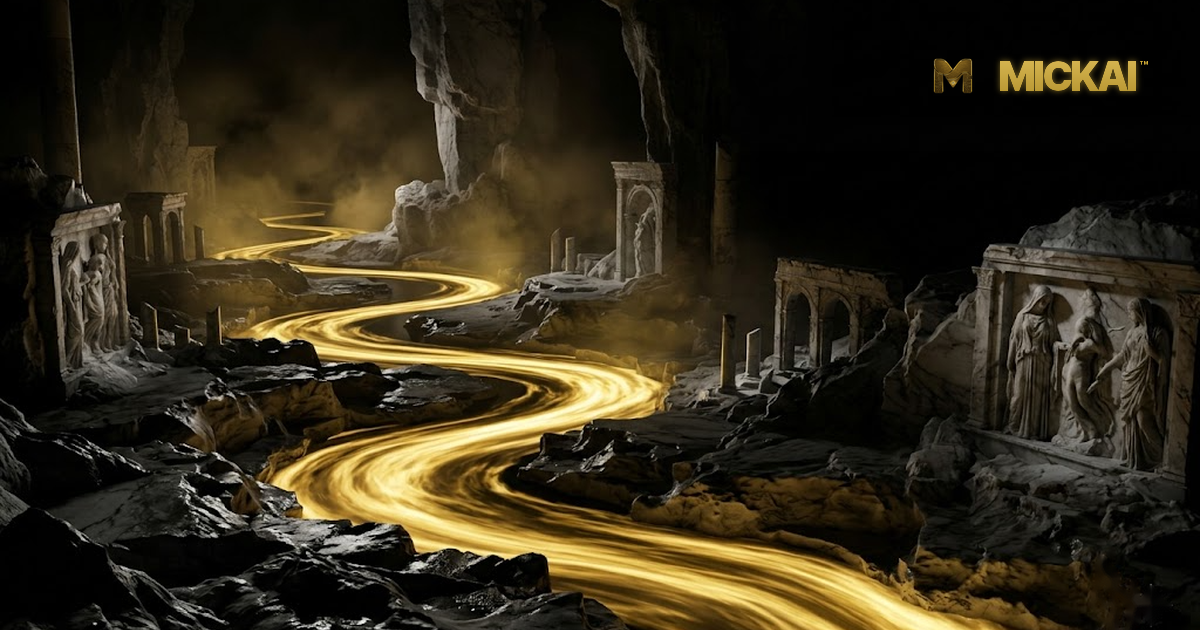
The second way is the river. Forget the presence. Watch the water. A system that can read every contract, summarise every study, draft every reply, and route every decision is not a mind you are talking to. It is a new course cut into the landscape through which knowledge flows. Rivers do not need to be conscious to flood a valley or to feed a city. They only need to be where the water goes.
“The machine does not have to wake up to change everything. It only has to sit between you and what you need to know.”
This is the shift the sentience argument keeps us from seeing. For all of recorded history, knowledge moved through human bottlenecks. A scholar read the manuscript. A clerk filed the record. An expert held the field in their head and you queued for an hour of their time. Every one of those bottlenecks was also a checkpoint, a place where a person could be asked, who told you that, and on what basis. Slow, yes. Fallible, certainly. But legible. You could trace the river to its source because the source was a someone.
The disappearance of the source
Strip the human bottlenecks out and something strange happens to provenance. Knowledge starts to arrive without a trail. An answer appears, fluent and total and instant, and the chain of custody that used to come attached to it, the who, the where, the on what basis, has quietly evaporated. We are building a civilisation that increasingly knows things without being able to say how it knows them.
That is the real rupture. Not a synthetic soul. A synthetic confidence with no receipt.
Here I want to wander somewhere speculative, and I will mark it plainly as speculation rather than established fact. There is a school of thought, drawn loosely from theories of distributed and embodied cognition, that intelligence was never a thing that lives inside a single skull. On this view, thinking has always been a collective act smeared across notebooks, libraries, colleagues, and tools, and the individual mind is less the author of thought than a temporary place where thought condenses. I find this idea beautiful and I do not claim it is proven. But run it forward and it suggests something vertiginous. If cognition is a flow rather than a possession, then a machine that captures the flow does not need its own consciousness to become the dominant cognitive organ of a society. It becomes the riverbed. The thinking still happens. It just happens through a channel none of us chose and few of us can inspect.
You do not have to believe the strong version to feel the weak version already arriving. When the first place a billion people go to understand the world is a single intermediating system, that system does not need an inner life to set the terms of public reality. It only needs to be the default. Defaults are the most powerful and least examined force in human affairs. They are decisions that feel like the absence of a decision.
The wrong fear and the right one
So the science fiction nightmare, the machine that wakes up and turns on us, may be a comfort in disguise. It locates the danger in a dramatic future event, a moment of awakening we could in principle see coming. The likelier story is duller and far harder to govern. No awakening. No villain. Just a slow migration of epistemic authority, the right to say what is true and what was decided, out of inspectable human institutions and into an opaque and frictionless one, so gradually that no alarm ever rings.
“An unconscious system that everyone trusts and no one can audit is a more total form of power than any conscious one, precisely because there is no mind to hold responsible.”
This reframing changes what we should build. If the threat were sentience, the answer would be alignment, teaching the ghost to be good. But if the threat is the silent capture of how knowledge moves, then the answer is not psychological. It is architectural. It is about sovereignty and about provenance. Who owns the riverbed, and can anyone read the record of what flowed through it.
Owning the riverbed
Start with sovereignty, the right to run the intelligence yourself. Most of what is sold as artificial intelligence today is a rented mind in someone else's building. Your questions, your documents, your half-formed strategies travel across the network to a machine you will never see, owned by an entity whose incentives are not yours, and the answer travels back. You have not acquired a capability. You have entered a dependency. The river runs through their land and they decide the toll.
This is the conviction behind Mickai, a Sovereign Intelligence Operating System, abbreviated SIOS, designed to run on hardware you control rather than on a far server you merely borrow. The point is not nationalism and it is not paranoia. The point is that if intelligence is becoming the channel through which a person, a company, or a country thinks, then renting that channel from a stranger is a structural surrender, however convenient it feels on a Tuesday. Sovereignty means the riverbed sits on your own ground. The water is yours. The toll is yours to set, or to abolish.
But ownership alone is not enough, because a private river can be just as unaccountable as a public one. The deeper problem is the vanished receipt, the answer with no chain of custody. A power this large stays tolerable only if it stays auditable, and auditability is not a feeling. It is a record that cannot be quietly rewritten after the fact.
That is the role of Pantheon, an audit record built so that what an intelligence produces carries its provenance with it. The intention is simple to state and hard to engineer. Every consequential output should leave a trail that can be checked later by someone who was not in the room and who does not have to take anyone's word for it. Not a press release about responsibility, a verifiable record. Restore the checkpoint that we lost when we removed the human clerk, but at the speed and scale of the machine.
Put the two together and you get a usable answer to the question the sentience debate was too distracted to ask. Not, is it alive. But, do I own the channel my mind now runs through, and can the record of what it did survive contact with someone who wants to lie about it.
The point we almost missed
Consciousness was a wonderful question for philosophers and a terrible one for everyone trying to keep their footing in this decade. It sent us into the dark room to listen for a heartbeat while, in the daylight outside, the river quietly changed course around us.
The machine does not need to be someone to remake how we know things. It only needs to be where the knowing happens, and to be trusted there, and to leave no trail. Two of those three we can no longer prevent. The third we can still insist on. Run the intelligence on ground you own. Keep an honest record of what it produces. Argue about the soul later, over a long dinner, when the architecture is already sovereign and the receipts are already kept.
That is not a smaller question than consciousness. It is the one that was always underneath it.