


Anchoring Is Not Spending: Why Pantheon Settles on Bitcoin
The difference between a chain that secures proof and a chain that prices gas.
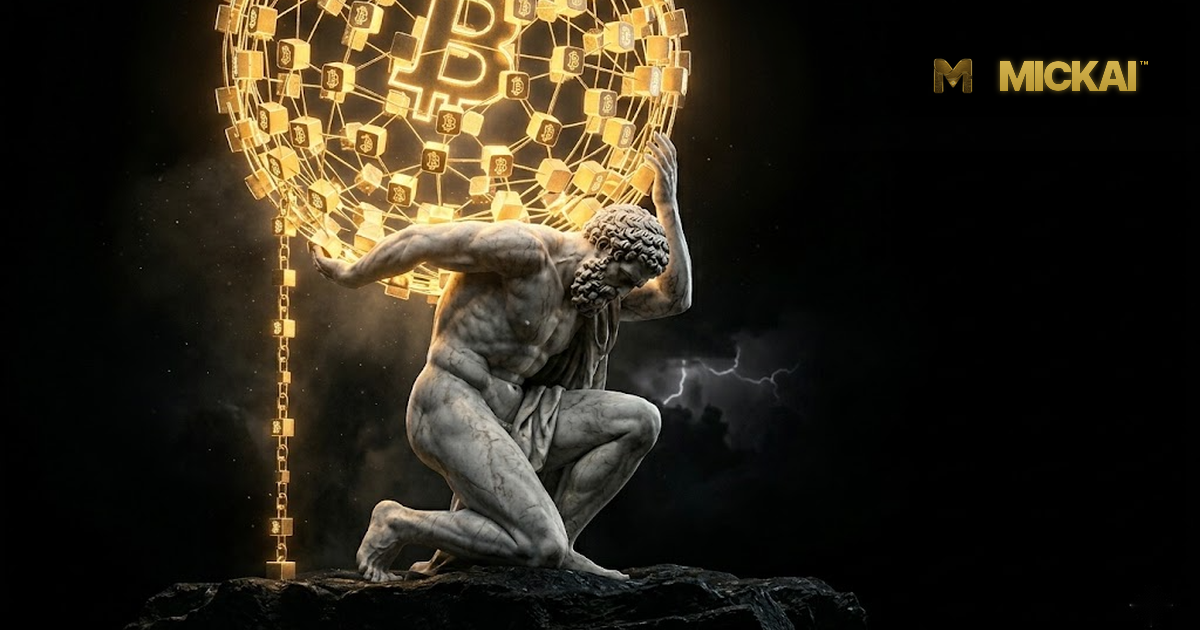
Every trust system in history has needed a clock that nobody owns. A title deed is only as good as the registry that timestamps it. A contract is only as good as the witness who can swear, under oath, that the ink was dry on a given date. The whole apparatus of property, of finance, of law, rests on one quiet question. When someone disputes what happened, whose record do we believe, and can that record be moved after the fact?
For most of the digital era the answer was a server in someone's building, a database row an administrator could edit at two in the morning with nobody watching. We spent decades treating that as acceptable. It was not, and it never was. The moment artificial intelligence began taking consequential actions on our behalf, deciding, advising, executing, the question stopped being academic. If a machine acts and the record of its acting can be quietly rewritten, the record is theatre.
The clock that cannot be moved
There is exactly one ledger on earth that has held its integrity at scale, under adversarial pressure, with real money trying to break it every single day for more than fifteen years. That is Bitcoin. I have no romance about the price. I am not here to tell you what a coin is worth this quarter. I am telling you that the Bitcoin timechain is the most expensive thing in the world to lie to, and that property, the cost of rewriting history, is the only property that matters when you are anchoring proof.
So when people ask why Pantheon, our sovereign Layer 1, reaches out and touches Bitcoin at all, the answer is narrow and deliberate. We do not transact there. We do not price our economy there. We use it as a clock. We commit a hash, and from that moment the existence of a record at a point in time is secured by the most secured ledger humanity has built. That is the whole relationship. It is a timestamp, not a transaction.
The mistake nearly everyone makes
Walk through the on-chain artificial intelligence sector and you see the same architecture repeated like a nervous tic. Mint a token. Route every action through it. Charge gas in it. Then, when the token swings forty percent in a fortnight, call the volatility a feature, dress it up as price discovery, as alignment, as skin in the game. It is none of those things. It is a design flaw wearing a marketing department.
Here is the problem stated plainly. If the cost of recording that an action happened is denominated in a volatile asset, then the affordability of truth itself fluctuates with a speculative market. On a bad day, proving what your system did becomes expensive. On a very bad day it becomes uneconomic, and people start skipping the proof. A trust layer that gets switched off when the market turns is not a trust layer. It is a fair-weather promise.
“Anchoring a hash is categorically different from paying for compute. One secures that something happened. The other rents the machine that made it happen. Confuse the two and you have built a courthouse that closes when the gas price spikes.”
Anchoring versus spending, the distinction that runs everything
Let me draw the line sharply, because everything I believe about durable infrastructure sits on it. Spending is consumption. You pay, the resource is gone, the meter resets, you pay again. Gas is spending. Compute is spending. Inference is spending. These are real costs and we honour them inside our own economy, on our own chain, in our own units.
Anchoring is not consumption. When Pantheon commits a hash to Bitcoin, it is not buying a service that gets used up. It is borrowing, permanently, the accumulated proof-of-work of an entire global network, and binding our record to it. The cost is trivial and bounded. The security is enormous and inherited. We are not customers of Bitcoin's economy. We are beneficiaries of its irreversibility. That asymmetry is the entire point, and it is why the relationship has to stay thin.
- Spending is recurring and scales with usage. Anchoring is occasional and scales with nothing but the passage of time you choose to checkpoint.
- Spending exposes you to the price of the thing you spend. Anchoring exposes you only to the survival of the chain you anchor to.
- Spending can be repriced against you by a market. Anchoring inherits security you never have to re-buy.
- Spending lives inside the application. Anchoring lives underneath every application, indifferent to all of them.
What actually gets sealed
Inside the Mickai Sovereign Intelligence Operating System, every consequential action a brain takes is written into an Open Audit Record. Not a log line an administrator can amend. A sealed, signed record. We sign it with post-quantum cryptography, FIPS 204 ML-DSA-65, because a record meant to outlive market cycles had better also outlive the cryptography of the present decade. A signature a quantum machine can forge in fifteen years is not a signature. It is a countdown.
So the lifecycle is precise. The action happens on the operator's own hardware, fully offline-capable, across fifty specialised brains that never need to phone home. The Open Audit Record is generated and signed. Its hash flows into Pantheon. And periodically, Pantheon's state is committed to Bitcoin. The result is a bitcoin anchored audit record whose existence at a moment in time is as durable as the most secured ledger on earth, while not a single byte of the operator's private activity ever leaves their machine. We anchor the fingerprint, never the body.
Why the economy must run somewhere else
If Bitcoin is the clock, something still has to be the engine. Validators must be paid. Storage, ordering, consensus, the work of running a living chain has a cost and a reward, and that loop has to close in a unit we control. That is Pantheon, and that is the PAN token. The economy of the network runs on the sovereign Layer 1, deliberately separated from the anchoring layer, so a swing in our token never touches the affordability of proof, and a swing in Bitcoin never touches the running of our validators.
This separation is not an accident of engineering. It is the thesis. Two jobs, two layers, two failure domains that do not contaminate each other. The validator economy can grow, contract, reprice, evolve, and through all of it the proof of what happened sits anchored and untouched. You can argue about the value of PAN all day long, as people will, and the integrity of a bitcoin anchored audit record committed last year stays utterly indifferent to the conversation.
The thirty million pound round, and what it does not buy
We are opening a thirty million pound PAN token round. I want to be exact about what that capital is for, because the whole essay collapses if I am sloppy here. It funds the validator economy, the build-out of the sovereign Layer 1, the hardware path, the brains, the substrate. It is venture in the engine. It is not, and can never be, a toll on truth. The price you pay to participate in Pantheon's economy and the cost of anchoring a record are different things by design, and we keep them different on purpose.
Trust infrastructure has to outlive the cycle
I have lived through enough market cycles to hold one conviction without flinching. The things that survive are the things that were never priced for the bull market in the first place. Infrastructure that only makes sense when sentiment is high is not infrastructure. It is a position. And a trust layer, of all things, is the one component you cannot afford to build as a position.
Think about what we are actually asking these records to do. A decision an artificial intelligence made on your behalf today might be examined in a dispute five years from now, by a regulator, a counterparty, a court, a future version of you. The question in that room will not be what the token was worth. It will be this. Did this happen, exactly as recorded, and can anyone prove it was not altered. The answer must be yes regardless of what the market did in between. That is only possible if proving it never depended on the market in the first place.
“Build your courthouse on bedrock, not on the tide. The verdict has to read the same whether the room you deliver it in is a boom or a crash.”
The objection I take seriously
The fair challenge to all of this is reliance. If Bitcoin is the anchor, are you not simply dependent on Bitcoin? Yes, and I will defend that dependency without hedging. We depend on it the way a surveyor depends on bedrock, not the way a gambler depends on a number. We are not exposed to its price. We are exposed only to its continued existence as the most secured ledger on earth, and if that assumption ever fails, the failure will be the least of anyone's problems, because it will mean the most battle-tested system in the history of computing has fallen.
There is a deeper point underneath the objection. Sovereignty is not the absence of all dependency. That is autarky, and autarky is brittle. Sovereignty is choosing your dependencies deliberately, keeping them thin, and ensuring none of them can quietly seize the thing that matters. We depend on Bitcoin for one job, irreversibility, and for nothing else. We depend on no one for the operator's data, the brains, the keys, or the running of the chain. That is a sovereign posture, and it is the opposite of the everything-on-one-token designs that dominate the field.
What durability feels like in practice
Strip away the architecture and here is the human experience we are building toward. An operator runs their Sovereign Intelligence Operating System on their own machine. The brains work, offline, on their hardware. Things happen, decisions, actions, consequences. Each one leaves a sealed record. None of it leaves the building. And somewhere, quietly, a fingerprint of all of it has been committed to a ledger that no government, no company, no administrator, and no market can rewrite.
Years later, when it matters, that operator can prove what happened. Not assert it. Prove it. And the proof costs them nothing to hold and nothing to verify, because anchoring was a one-time bounded act, not a meter that has been running against them the whole time. That is the difference between a system designed to be paid for and a system designed to be trusted. We chose trusted, and we built the economy somewhere it could never contaminate the proof.
Settling, not spending
So when I say Pantheon settles on Bitcoin, hear the precision in the word. We settle there the way history settles, by leaving an immovable mark and walking away. We do not live there. We do not price our world there. We borrow its permanence for a single purpose and return everything else to ground we control.
Most of this industry minted a token and called the volatility a feature. We anchored a hash and called it the truth. One of those choices ages into a footnote. The other ages into bedrock. The proof of what your machines did should be as durable as the most secured ledger on earth, or it should not be called proof at all. Anchoring is not spending. It never was. I know which one I am building on.