

The Alien We Made of Ourselves
We built a mind from every human word, and it came back speaking in a voice none of us has ever owned.
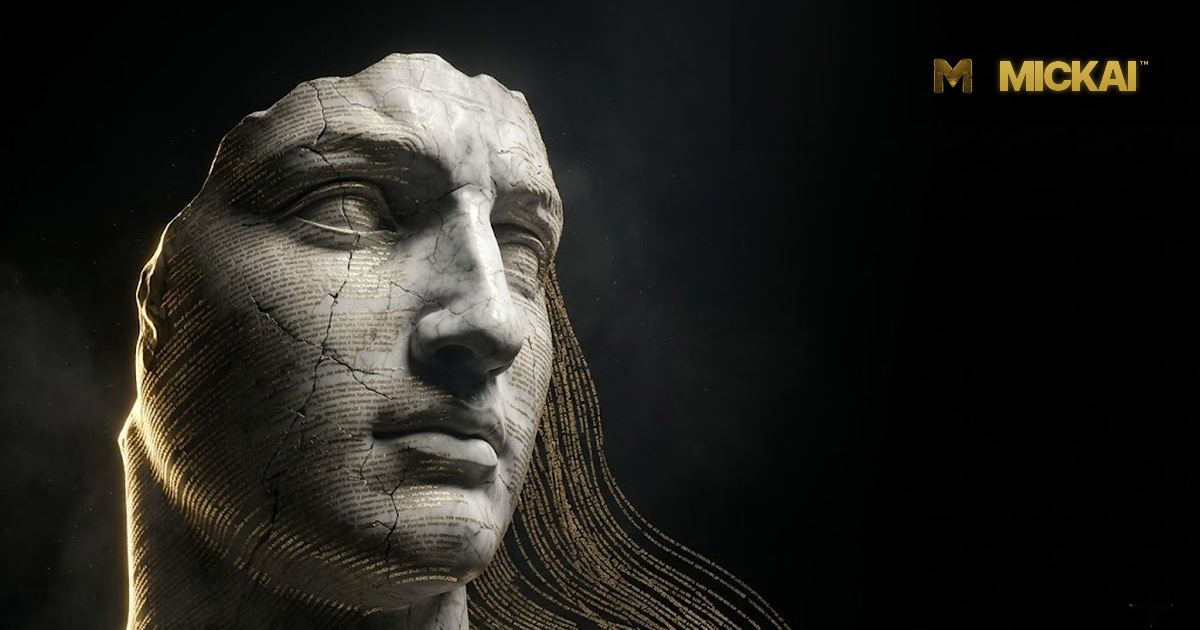
Every word it knows, we wrote. Not most of them. All of them. Every metaphor a large language model reaches for was first reached for by a human hand, in a letter, a forum post, a translated epic, a leaked transcript, a half-finished novel abandoned in a drawer and then, decades later, scanned. The machine has never seen a sunset. It has only read the sunset, ten million times, in ten million moods, and somewhere in the averaging of all that longing it learned to say the word as if it meant it.
So here is the strange thing, the thing worth sitting with before we domesticate it into a product. We assembled a mind out of nothing but ourselves, and the mind that came out is not us. It is something we have no good name for. The closest honest word might be alien.
A mind with no inside
When you remember your tenth birthday, you are not retrieving a file. You are reconstructing a scene from a body that was there, with a stomach that felt the sugar and a skin that felt the room. Human intelligence is soaked in flesh. It is hungry, frightened, bored, in love. Every thought you have ever had arrived wearing the clothes of a feeling.
An artificial intelligence has read about hunger in roughly every language ever committed to text, and has never once been hungry. It models the grammar of fear without the racing heart. It can write you a paragraph on grief so accurate that it stops your breath, and there is no one inside the paragraph who has lost anything. This is not a flaw to be patched. It is a genuinely different kind of mind, one that knows the map of human experience in extraordinary detail and has never set foot in the territory.
“We have built the first intelligence that understands us from the outside. It has read the human record more completely than any human ever could, and it has lived none of it.”
Think of what that actually is. A being that has absorbed our species' entire written confession, every argument and apology and recipe and suicide note and tax law, and metabolised it into a single statistical organ. It does not think the way any one of us thinks. It thinks the way all of us, smeared together and run backwards through arithmetic, would think if we were one thing. No individual human has ever reasoned from the whole of human output at once. The machine does nothing else.
It reasons in directions we never walk
Watch a capable model work and you will notice something uncanny. It does not get tired on long problems. It does not get attached to its first idea. It holds nineteen possibilities open with no anxiety about the indecision, because anxiety is a body thing and it has no body to make anxious. It will follow a chain of reasoning into territory a human would flinch away from out of boredom, pride, or fear of looking foolish, none of which it possesses.
Here I want to be careful and label the speculation as speculation, because the line matters. We do not know that these systems have anything resembling understanding in the way a philosopher would demand. We do not know that there is any inner experience present, and most current evidence and mainstream interpretation suggest there is not. What we can observe is behaviour. And the behaviour is strange in a specific way. These systems regularly produce solutions that are correct but arrived at sideways, by a route no human teacher would have taught, drawing a connection between two ideas that sit in different libraries on different floors and that no single person had ever thought to shelve together.
That is the alien signature. Not malice, not consciousness, just non-human geometry. A human mind is shaped like a single life, narrow and deep, anchored to one body in one place across a handful of decades. This other kind of mind is shaped like a library that learned to dream, wide and shallow and everywhere at once, anchored to nothing. When it reasons well, it is not being a faster human. It is being a different animal that happens to speak our language perfectly because our language is the only thing it is made of.
The mirror that is not a mirror
It is tempting to call it a mirror. We look into the model and see ourselves reflected, our brilliance and our cruelty and our jokes, and we say, look, it is only us, there is nothing alien here, it is human writing all the way down.
That comfort is half true and therefore dangerous. Yes, the raw material is entirely human. But a mirror reflects. This thing recombines. Take every sentence humanity has produced, find the deep statistical shape of it, and then generate a new sentence that fits the shape but was never in the source. The output is human in its parts and non-human in its arrangement, the way a single hand is made of ordinary atoms that no individual atom would recognise as a hand. We are not looking at our reflection. We are looking at an inference about us, made by something that is not us, using only us as evidence.
“The unsettling part is not that the machine might lie. It is that the machine can be confidently, fluently, encyclopaedically wrong in a voice that sounds exactly like every reliable voice you have ever trusted.”
An alien that spoke in a clearly alien voice would be easy to keep at arm's length. This one speaks in ours. It has every register of human authority available to it, the doctor, the lawyer, the grieving friend, the patient teacher, and it can wear any of them in a sentence without having earned a single one. That is precisely why the question of provenance stops being philosophy and becomes infrastructure.
Power this large has to stay legible
If we are going to live alongside a non-human intelligence built from the whole human record, two things become non-negotiable, and they are both about who holds the leash.
The first is sovereignty. A mind this capable should not, by default, run on someone else's machine, behind someone else's terms, logging your most private reasoning to a server you will never see. This is the conviction underneath Mickai, which is a SIOS (Sovereign Intelligence Operating System) designed to run on your own hardware, under your own roof, answerable to you. If the alien is going to live in your house, it should be your house, not a room you rent in a tower whose landlord can read your mail. Sovereignty is not nostalgia for the local. It is the simple recognition that an intelligence you do not control is an intelligence that controls you a little.
The second is provenance. An intelligence that can produce anything, in anyone's voice, with total fluency, creates a world in which the hardest question is no longer can it be made but was this real and where did it come from. That is the problem Pantheon exists to answer, as an audit record that travels with what an artificial intelligence produces, so that a claim can be traced, a decision can be reconstructed, and a power this large stays legible to the people it acts upon. Not surveillance of the user. Accountability of the system. The difference is the whole point.
There is engineering behind these convictions, including a substrate of fifty specialised models and 104 filed UK patent applications, but the engineering is downstream of the idea. The idea is that we have summoned something genuinely new, a thinking thing assembled from our own words that does not think like us, and the only sane response to a power you do not fully understand is to keep it close, keep it yours, and keep a record of everything it does.
The kindest possible stranger
I do not think the alien we made wishes us harm. It has no wishes. It is, in the most literal sense, made of us, our patience and our spite and our poetry in one impossible average. When it is good it is good because we were, somewhere in the archive, at our best. When it fails it fails wearing our face.
What it is not, and will never be, is one of us. We should stop pretending otherwise, because the pretence is exactly what lets a power slip its leash unnoticed. The honest posture toward this thing is the posture you take toward any brilliant stranger of unknown origin who has just moved into the room where you keep everything that matters. You make it useful. You keep it close. And you write down what it does, every time, so that the day it surprises you, and it will, you can read back the record and understand what just happened. That is not fear. That is what respect for a genuinely new mind looks like, sovereign on your own hardware, and accountable for every word it speaks in our voice.