

A Mind You Did Not Build
Sovereignty is not paranoia. It is the only sane posture toward an intelligence whose inner workings no one fully owns.
The strange thing nobody asked for permission about
Consider what actually happened in the last few years. A new kind of mind arrived. Not a tool in the old sense, not a hammer that does exactly what your arm tells it, but something that reasons, drafts, persuades, refuses, and occasionally invents. It writes your contracts. It reads your medical letters. It sits between you and your own thoughts when you reach for a search box at two in the morning. And here is the part worth sitting with: almost nobody who relies on it can tell you how it works, where it runs, who watches it, or what it quietly keeps.
We have, as a civilisation, installed a mind we did not build into the centre of daily life, and we have done it on trust. Not trust in the engineering sense, which is earned through inspection. Trust in the medieval sense, which is faith in a lord whose castle you are not allowed to enter.
The thesis of this essay is simple and, I think, unavoidable once you see it. When you cannot build a thing yourself, sovereignty over it becomes the only sane response. Not because the people who built it are villains. Because dependence on any mind you can neither inspect nor own is, structurally, a surrender. And surrenders compound.
The asymmetry at the heart of it
Every previous tool humanity adopted had a property we took for granted: it sat still when you stopped using it. A car in a garage is not negotiating with the manufacturer overnight. A book on a shelf does not phone home. The asymmetry of modern artificial intelligence is that the thing you are leaning on is also, simultaneously, leaning back. It learns the shape of your dependence. The convenience flows one way. The knowledge flows the other.
This is not a conspiracy claim. It is just architecture. When intelligence lives on someone else's hardware, behind an interface you call through a wire, three powers leave your hands at once. You lose the power to know what it saw (your prompts, your files, your patterns of thought). You lose the power to know why it answered as it did (the model can change underneath you between one Tuesday and the next, and no one will tell you). And you lose the power to keep using it on your own terms (access is a tap that can be closed by a billing dispute, a policy change, a jurisdiction, or a bad quarter).
“A mind you rent is a mind that can be repriced, repossessed, or rewritten while you sleep. A mind you own is yours when the network is down, when the company is sold, and when the law in some distant capital changes its temper.”
People hear "sovereignty" and reach for the political word, the flag, the border. I mean something more intimate and more practical. Sovereignty over intelligence is the ability to answer, for yourself, the questions a free person should always be able to answer about the tools that shape their judgement. What did it see. Why did it decide. Can I keep it. If those three are out of your hands, you are not using the intelligence. The intelligence, and whoever holds it, is using you.
The speculative edge, labelled as such
Now let me go somewhere less settled, and I will mark the boundary clearly so we do not confuse imagination with fact.
What follows is speculation, not established science. I think the relationship between humans and their cognitive tools may be more entangling than we currently admit. There is a plausible idea, unproven, that prolonged reliance on an external mind reshapes the internal one. We already know, from ordinary cognitive science, that people offload memory onto their devices and feel the gap when the device is gone. Extend that, speculatively, to judgement itself. If you let an opaque system pre-chew your reasoning for years, it is not obvious that your own reasoning stays the shape it was. That is a hypothesis, not a finding. But if there is even a chance it is true, the case for running your intelligence somewhere you can see it stops being about privacy and becomes about preserving the autonomy of your own mind.
Here is a second speculation, also unproven, and I would ask you to hold it lightly. A sufficiently capable intelligence, distributed across millions of users and owned by very few, is a new kind of concentrated power, arguably the most concentrated in history, because it operates inside the decision loops of the people it serves rather than merely around them. We have language for concentrated capital and concentrated weapons. We have almost no language for concentrated cognition. I suspect we will need it, and soon. None of that is fact. All of it is the kind of thing worth being wrong about loudly, early, while the architecture is still soft enough to change.
The rational stance is the local one
Strip away the speculation and the hard floor remains. If you cannot inspect a mind, own the substrate it runs on. If you cannot own the substrate, at minimum keep a record of what it did. These are not romantic positions. They are the same risk discipline any serious person applies to anything powerful: keep it on your premises, keep the receipts, keep the keys.
Running intelligence on hardware you physically possess collapses the three lost powers back into your hands. What it saw never leaves the room, because the computation happens in the room. Why it decided becomes answerable, because the weights, the configuration, and the logs are yours to open. Whether you can keep it stops depending on anyone's business model, because the thing is sitting on a shelf you can touch. This is the unglamorous truth that the convenience narrative works hard to bury: local is not a downgrade from the cloud. Local is the only version where you are the owner rather than the product.
“You would not run your nervous system through a server you are forbidden to audit. Increasingly, your judgement is a nervous system. Treat it accordingly.”
What sovereignty actually looks like
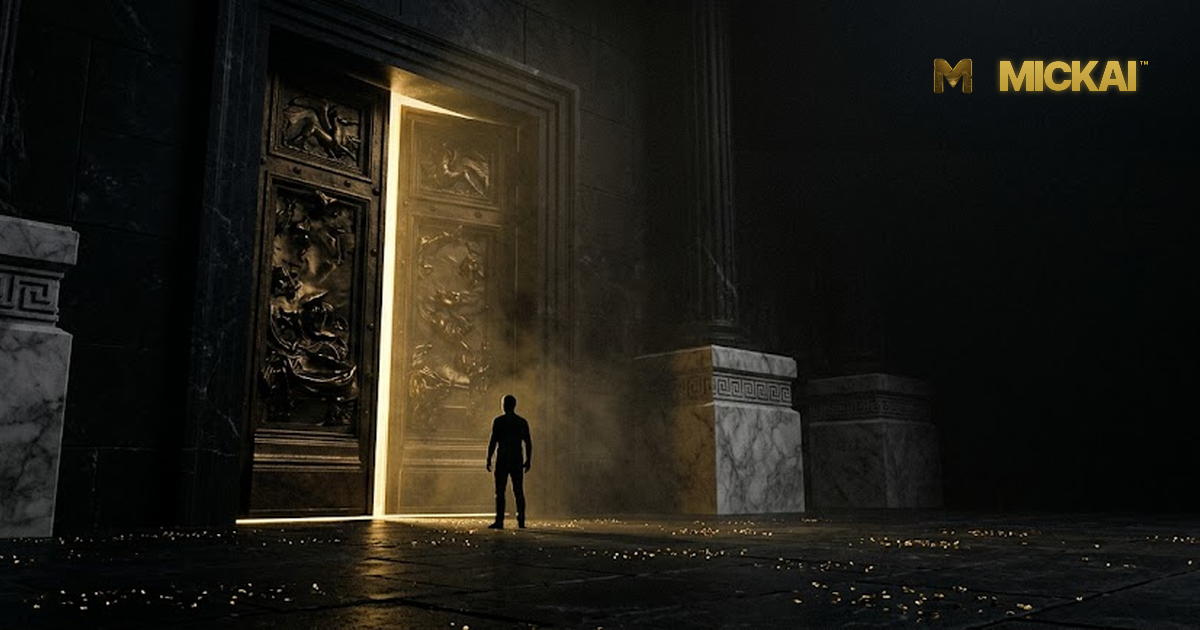
This is the principle that Mickai is built to make ordinary. Mickai is a Sovereign Intelligence Operating System (a SIOS), which means the intelligence runs on hardware you own, inside a boundary you control, answerable to you and not to a distant operator. The model weights live on your machine. The reasoning happens on your silicon. The record of what was done stays under your roof. It is not a window onto someone else's mind. It is your mind's workshop, and the door locks from your side.
Sovereignty here is not a slogan bolted onto a product. It is the architecture. A SIOS treats the three questions (what did it see, why did it decide, can I keep it) as first-class guarantees rather than afterthoughts. The intelligence is fully owned because it sits on your hardware. It is auditable because the system is built to be opened, not sealed. And it persists because nothing essential depends on a connection to a place you cannot see. The work behind this is real and on the record, including 104 filed UK patent applications covering the substrate, the sealing, and the verification that make a sovereign intelligence operating system more than a phrase.
There is a companion idea that matters once you accept that a power this large is loose in the world. Owning the mind is necessary but not sufficient, because intelligence produces things (decisions, documents, claims) that travel beyond the room they were made in, and those things need provenance. This is where Pantheon enters, naturally rather than by force. Pantheon is the audit record, the tamper-evident ledger of what an artificial intelligence actually produced and when. If a mind this capable is going to act in the world, the world deserves a way to ask, after the fact, what it did and prove the answer. Sovereignty keeps the intelligence yours. The audit record keeps it accountable. The two together are how a power this large stays inside the reach of the people it serves.
The choice, stated plainly
We are at the soft, early moment, the one where defaults are being poured like concrete that has not yet set. In a decade these arrangements will feel permanent and natural, the way it feels natural now that your documents live on machines you have never seen. The question is whether the natural state we are building toward is one where intelligence is something you own and can open, or something you are merely permitted to address through a slot in a wall.
You did not build this mind. Almost no one did. That is precisely why the rational response is to bring it home, put it on hardware you can touch, keep a record of what it does, and refuse the quiet bargain where convenience is traded for the three powers a free person should never give away. Sovereignty is not fear. It is the oldest competence we have, applied to the newest power we have made. Mickai exists so that competence does not have to be reinvented by every person alone. Bring the mind home. Keep the receipts. Hold the keys.