The Off-Switch You Do Not Own
On 2 June 2026 Claude went dark worldwide, the API, the Console, and Claude Code, and every business built on it went dark at the same moment. The outage was fixed in hours. The dependency it exposed is permanent. The Mickai SIOS runs the intelligence offline, on hardware the operator owns, with no provider to fail and no subscription for context or usage.
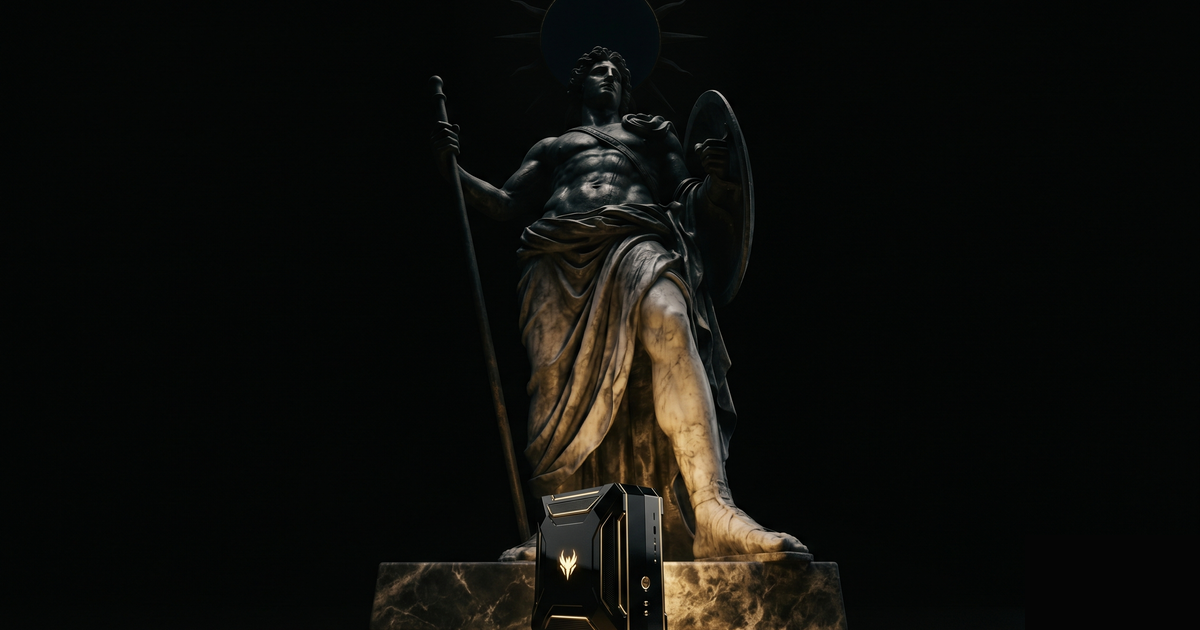
On the morning of 2 June 2026, a great many companies learned, all at the same moment, that the intelligence they ran on was not theirs to keep. Anthropic's Claude had stopped answering. The website returned errors, the mobile app failed, and the quiet machinery that runs other people's businesses, the API, the Console, and the Claude Code developer platform, went down with it. Downdetector filled in the familiar shape, most complaints against the chat interface, a quarter against the mobile app, the rest against the developer tooling. Anthropic confirmed the elevated error rates, traced the fault to its own sub-agent system spawning in a runaway loop under capacity strain, shipped a fix within hours, and reset the depleted quotas of its paying accounts. Measured as incident response, it was good work done fast, and no serious person should pretend otherwise.
Keep the camera on the people downstream instead. A company that had wired Claude into its support desk, its code review, its document pipeline, and its agents did not have a slow morning. It had no morning at all. The reasoning it had come to lean on lived in a building it did not own, and when that building had a bad release, there was no lever anywhere on the customer's side to pull. You cannot escalate an outage that is already the headline. You refresh a status page, you wait, and you explain to your own customers that the thing you sold them is down for a reason you can neither see nor touch. The off-switch was real, and it was in somebody else's hand.
This is the architecture, not the accident
It is comforting to read an outage as a one-off, a single bad day for a single vendor, the sort of thing a better runbook prevents next time. The honest reading is harder. Centralised cloud intelligence means the model, the weights, and the machines that run them all sit on infrastructure the buyer neither owns nor controls. That arrangement carries a failure mode no amount of good engineering removes, because the failure mode is the arrangement itself. When the provider's capacity, region, or release pipeline goes, every customer goes at the same instant, together, with no independent road back. Claude had a comparable disruption earlier in the year. The other large labs have had their own. The names on the status page change. The shape of the dependency does not.
And the outage is only the visible edge of it. The same arrangement that decides whether you have a morning also decides how much you may use before a quota stops you, what each token costs and the week the price moves, what this quarter's terms permit and forbid, and where your prompts, your code, and your documents travel the moment you press send. None of that arrives as a single dramatic event. It runs quietly underneath everything, until an outage switches the lights off for a few hours and lets you see the wiring. The wiring was always there. Most days it works well enough that nobody is made to look at it.
The answer that keeps answering
Mickai was built from the opposite end. It is a Sovereign Intelligence Operating System, not a polished window onto somebody else's model. Its fifty brains run on the operator's own hardware, served locally over a loopback runtime against weights that sit on the machine, with no remote provider anywhere in the path. Nothing leaves the building to be answered, and so there is no provider whose bad morning can take the answer away. When the cloud goes dark, the sovereign system is still lit, for the plain reason that it was never drawing its light from the cloud.
Every other good property falls out of that single decision. There is no quota to deplete, because the compute belongs to the operator. There is no meter, because there is no per-token rental in the path, and no subscription for context or for usage. The data does not leave, because an egress gateway holds it inside an allowlist by default, and the vault that keeps it is sealed with post-quantum encryption. Every answer is sealed into the Open Audit Record, so the operator can check, offline and for themselves, what the system did, and prove what it was at any moment in the past. The HELIOS line carries the same intelligence past the grid entirely, onto solar and hand-cranked hardware that answers with no network and no mains power at all. The outage that emptied the cloud for a morning would not have reached it, on the worst day, in the most remote place a person could carry it.
What sovereignty actually feels like
Set the architecture aside for a moment and ask what it is like to live with. Intelligence you own does not ask permission. It does not check whether your subscription renewed, whether you are in a supported country this week, or whether the region you happen to be standing in is having an incident. It is simply there, the way the books on your own shelf are there, the way the tools in your own workshop are there. You can take it down a mine, into a hospital with the network sealed, onto a boat, into a forward position, through a blackout, and it answers exactly as it did on the desk, because it is the same machine and the same weights and they came with you. What you paid for on the first day is what you hold on every day after, at the price you already paid. Nobody can reach across a wire and quietly make it less.
That is a different feeling from renting, and people know the difference in their bones. Renting is a relationship you do not control, dressed as convenience. Ownership is plain. It is the difference between a house and a hotel room, between a library and a turnstile. Mickai is built so that the most capable thing in an organisation, the intelligence the whole place increasingly leans on, sits on the owned side of that line, where an outage somewhere else is news you read over coffee rather than a morning you lose.
Fifty minds, and they answer to you
The intelligence inside is not one model wearing a brand name. It is fifty Mickai brains, twenty-five that carry the fields of knowledge and twenty-five that run the system itself, a single sovereign mind made of many, each one accountable to the same sealed record. Today they run on Mickai's own specialised sovereign models, hardened, and sharpening with every sealed interaction the operator chooses to keep, and Mickai is already training them now on that sovereign sealed corpus, with the funded road ahead scaling the work, at scale, into fully Mickai-native weights. We say exactly that, plainly, because a thing you intend to own for life is not a thing you should be misled about at the start.
They run on Poseidon, the sovereign silicon they are built for, and they coordinate through a governance core that breaks a request into steps, checks each against policy before anything acts, and seals what it did so it can be proven afterward. It is a mind you can interrogate. That is part of being owned too. You are not asked to trust a black box on faith across a wire. You are handed the box, and the key, and the record.
What this is, and what it is not
The claim is precise, and it is worth keeping precise, because the easy version would be a lie. Mickai is not telling you that a machine on your own desk out-reasons the very largest frontier models on every benchmark today. It is telling you something different, and for a great many buyers more important. The intelligence you own cannot be switched off by someone else's deploy, throttled by their capacity, repriced by their meter, or read on its way out of your building. For a defence supplier, a regulated bank, a hospital, a field team beyond coverage, or a government that cannot place its reasoning on foreign infrastructure, continuity and control are not features to be weighed against a benchmark. They are the requirement, and renting the model fails that requirement, on a long enough timeline, by construction.
Built to be owned, and built in Britain
None of this is a promise on a slide. The architecture is the subject of one hundred and four filed UK patent applications, named inventor Mickarle Wagstaff-Irons, and the offline-by-construction core, local weights, loopback runtime, blocked egress, the sealed vault, and the audit seal, is exercised today and passes a standing validation suite with zero failures. The frontier-scale Mickai model is in active development with a manufacturing partner in Birmingham, with a retail aim of six to twelve months after funding. It is being built in Britain, deliberately, so that a country, and the people and institutions inside it, can hold their own intelligence rather than borrow it.
The sun went dark for a few hours on the second of June, and then it came back, the status pages turned green, and the world moved on. The machines that people own did not have that morning, and they will not have the next one. That is the quiet promise under all of it. Build the most important thing you run on ground that belongs to you, seal it, carry it, prove it, and keep it. Sovereign intelligence has no off-switch in another hand. That is the whole of the case, and it is why Mickai exists.