Sovereign email: your inbox, no provider can read it
Mail on hardware you own, an assistant that drafts on device, and a reply sealed to the audit record before it sends.
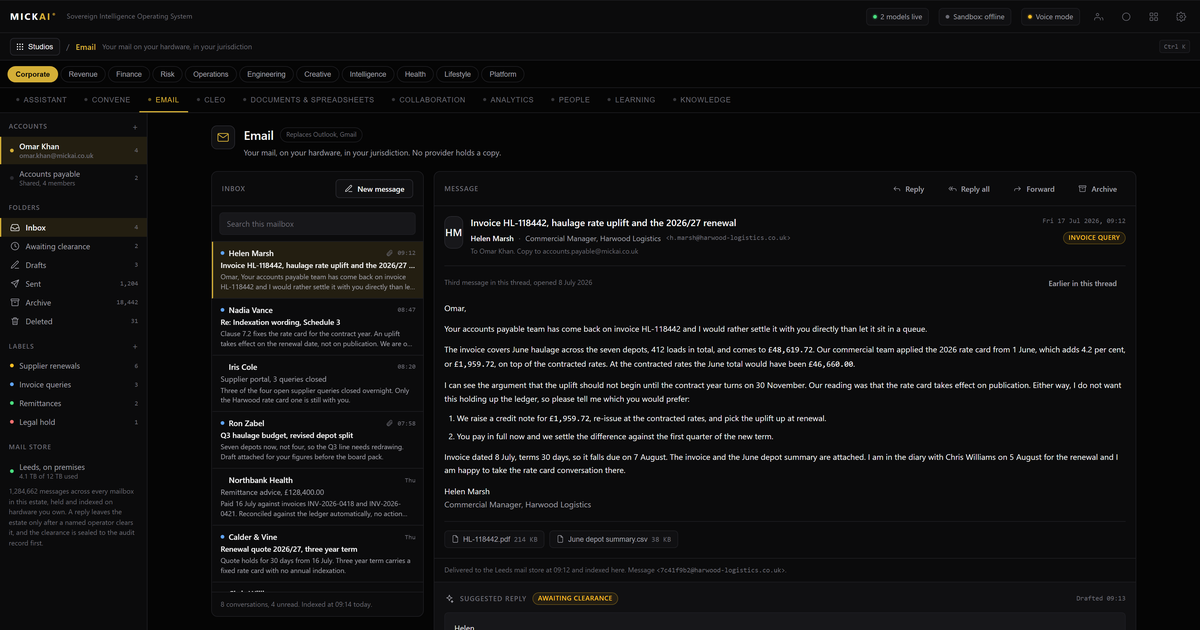
Sovereign email is your organisation's mail held on hardware you own, stored and indexed where no provider can read it or be compelled to hand it over. The assistant drafts each reply on the device itself, and that draft is sealed to an audit record before a single byte leaves the building.
That is the whole claim, and everything below is about why each part of it holds. If you run a regulated organisation you already know the awkward version of the present arrangement: your correspondence lives on infrastructure you do not control, under a jurisdiction you did not choose, legible to parties you will never meet. Sovereign email removes that dependency without stripping out the assistance you now expect from a modern inbox.
Cloud email is the right answer for a great many organisations, and we will say so plainly. Our argument is narrower than a comparison of features. For the institution that has to prove where its data lived and who touched it, the measure that matters is not convenience but the total cost of trust.
What makes an inbox sovereign rather than merely private?
Privacy is a promise; sovereignty is a property of where the data sits and who holds the keys. In the email studio the mail is stored and indexed on hardware the organisation owns, inside its own perimeter. No provider holds a copy, so no provider can read it, and no provider can be served an order to produce what it does not possess. The system runs offline when the day requires it, in your own jurisdiction, which means custody is a fact you can demonstrate rather than a policy you have to trust.
What happens the moment the assistant drafts a reply?
The assistant reads and drafts entirely on the device. When you ask it to answer a message, one prompt is routed across the sovereign models running on your own hardware, and what comes back is a proposal, not an action. The draft waits for the operator to clear it. Nothing is sent because the assistant decided it should be; a person holds the release, and the moment that release is given the reply is sealed to the audit record before it leaves. The convenience is real, and the accountability is not traded away to get it.
Why does an accountable inbox matter to a regulated organisation?
Because the questions a regulator asks are questions about evidence. Under GDPR you must be able to show what happened to personal data and who had access to it. Under NIS2 and DORA the expectation reaches further into how you govern systems and prove operational resilience. An accountable inbox answers those questions by construction. Every consequential action is sealed to the Open Audit Record before it executes, and that record is post-quantum signed with FIPS 204 ML-DSA-65, hash-chained, and verifiable offline by a regulator or a court. You are not assembling the story after the fact; the story wrote itself as the work happened.
Is email the only studio, or part of something larger?
Email is one studio in a Sovereign Intelligence Operating System, and it sits alongside the Assistant, Collaboration, Customer Relationship Management, Accounting and Financial Crime Detection, among others. Each studio replaces a cloud service, and each runs on hardware you own. The point of building them as one operating system rather than a shelf of separate tools is that they share a single spine: the same on-device execution, the same sealed record, the same offline verification. A message in the collaboration studio that triggers an action becomes a sealed record in exactly the way an email does.
Does the same spine really run under every studio?
It does, and you can see it in something as ordinary as the settings screen. A theme, or a customer's own brand, re-skins the whole operating system at once, because there is one system underneath rather than a federation of applications pretending to be one. That shared foundation is what lets a guarantee made in the inbox hold everywhere else. Agents are confined to a gated sandbox under per-action clearance, so no studio can quietly reach beyond what it was cleared to do.
Where does an accountable system matter most?
It matters most where a wrong decision is expensive and a hidden one is dangerous. In the Financial Crime Detection studio, screening runs inside the bank's own perimeter, on its own hardware, and every decision is sealed to the audit record as it is made. An investigator can show precisely what was checked, what the model saw, and who cleared the outcome, without exporting a single customer record to a third party. The same shape that keeps an inbox sovereign keeps a screening decision defensible.
Frequently asked questions
Can a provider or a court still compel access to sovereign email?
No, because there is nothing for a provider to hand over. The mail is stored and indexed on hardware the organisation owns, so no third party holds a copy that could be compelled. A lawful order for your data goes to you, the custodian, which is where accountability belongs. That is the difference between privacy as a promise and sovereignty as a fact of custody.
Does drafting on the device mean giving up a capable assistant?
No. The assistant routes your prompt across sovereign models running on your own hardware, so the drafting, summarising and searching happen locally rather than in someone else's data centre. The one deliberate change is that a draft is a proposed action you clear, not a message the system sends on its own. You keep the help and you hold the release.
How can a regulator verify the audit record without our systems?
The Open Audit Record is verifiable offline. It is post-quantum signed with FIPS 204 ML-DSA-65 and hash-chained, so a regulator or a court can confirm that a sequence of actions is intact and unaltered without access to the live system or any cooperation from a vendor. Verification does not depend on trusting us. It depends on mathematics that anyone can check.
Do we have to adopt the whole operating system to get sovereign email?
No, email stands on its own, and it shares its spine with the rest of the operating system if you choose to widen. Many organisations begin with the inbox because it is the most exposed surface, then add Collaboration, Customer Relationship Management or Financial Crime Detection as the case for each becomes clear. Because every studio runs on the same sealed, on-device, offline-verifiable foundation, adding one does not mean re-architecting what you already trust.
If you want to see how the whole system fits together, /sovereign-ai sets out the operating system and the studios that run on it. If you want to understand the spine that makes every one of them accountable, /oar explains the Open Audit Record and how offline verification works. Sovereign email is where most organisations start; the sealed, on-device record is why they stay.