Sovereign AI for Aviation: MRO Records and Airworthiness Intelligence Inside the Hangar
An aircraft is only as legal as its records, and those records are ITAR and EAR controlled, which is exactly why airworthiness intelligence has to run on-prem and air-gapped rather than on public cloud.
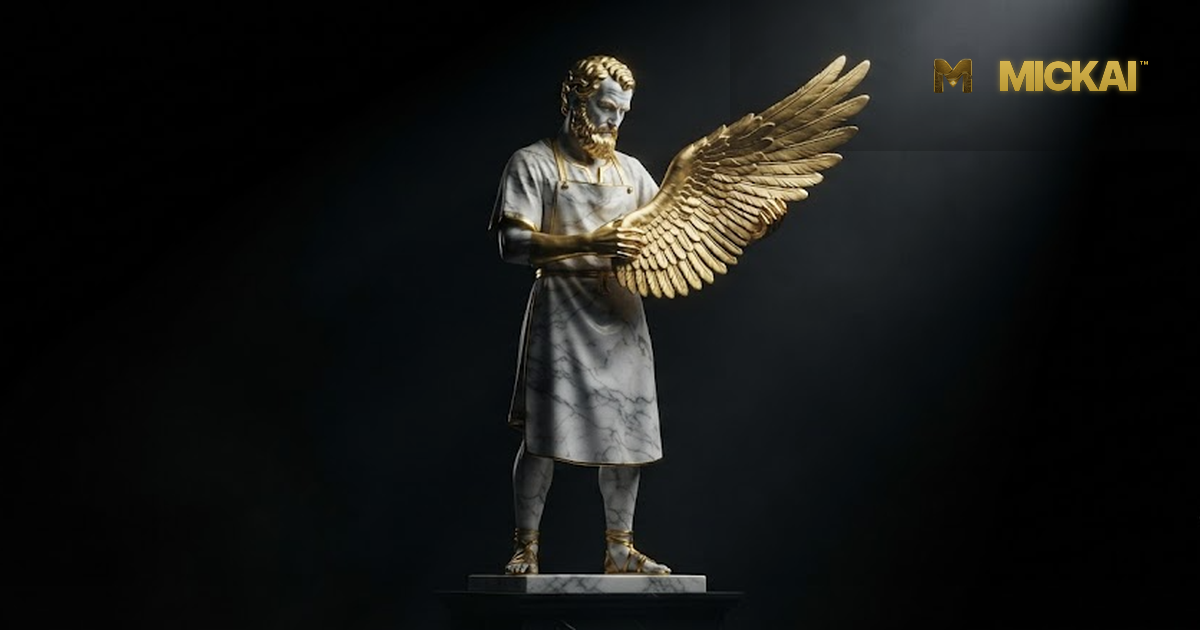
The record is the aircraft
In aviation, the paperwork is not administration. It is the asset. An airframe with a missing logbook entry, an unverifiable back-to-birth trace on a life-limited part, or a broken chain of custody on a component certificate is not an aircraft you can dispatch. It is a very expensive object sitting on the ramp. Continuing airworthiness is a records discipline before it is an engineering one, and the records in question are among the most tightly controlled data any business holds.
That is the problem I built Mickai to solve. Mickai is a sovereign AI operating system: artificial intelligence that a regulated business owns and runs entirely inside its own walls, on-prem and air-gapped, with every action written to a tamper-evident, post-quantum-signed audit record we call the OAR. For an MRO provider, an operator continuing airworthiness management organisation, an OEM, or a defence sustainment shop, that architecture is not a convenience. It is the only way the numbers work.
Why aviation records cannot touch public cloud
Maintenance, repair and overhaul data is a compliance stack several layers deep. Technical data for military and dual-use platforms falls under ITAR and the EAR, and once a controlled drawing, a repair scheme, or a component specification lands on infrastructure subject to the US CLOUD Act, you have a potential export event and a jurisdictional exposure no legal team wants to own. Civil operators sit under EASA Part-CAMO and Part-145 record-keeping obligations, national aviation authority oversight, and increasingly the NIS Regulations covering operators of essential services in air transport. Feed those records into a public large language model and you have shipped controlled technical data to a third party you do not control, in a location you cannot attest to, under a legal regime you did not choose.
This is why so much of aviation still runs on scanned PDFs and manual cross-checks. The people doing the work are not behind on technology. They are correctly refusing to put controlled data where they cannot govern it. Sovereign AI removes that trade-off. The intelligence comes to the data, inside the hangar, and the data never leaves.
What airworthiness intelligence actually does
Put a sovereign model over the complete maintenance corpus and the manual reconciliation collapses. Mickai reads decades of dirty-fingerprint logbooks, work packs, service bulletins, airworthiness directives, engine health monitoring feeds, and component certification trails, and answers the questions that today take an engineer days of hand cross-checking.
Which life-limited parts on this tail are approaching their cycle limits, and does the paperwork trace cleanly to birth. Which airworthiness directives and service bulletins are open against this MSN, and where does the compliance evidence live. Does this incoming used serviceable material have a defensible provenance, or is it a suspected unapproved part. Where are the gaps in a records set before an aircraft goes on lease return or into a pre-purchase inspection. When a return-to-service decision is made, the reasoning, the sources, and the sign-off are written to the OAR as a signed, tamper-evident record. The auditor does not get a narrative. They get cryptographic proof of what was decided, on what evidence, by whom.
The architecture, briefly
Under the surface, Mickai runs 50 specialist brains under a single deterministic arbiter. Air-gapped retrieval augmented generation keeps every answer grounded in the operator's own document set, with no call to the outside world. The identity of every action is bound to hardware, so a signature cannot be forged or replayed off-box. Signing uses ML-DSA-65, a post-quantum algorithm, because airframe records outlive the aircraft and outlive today's cryptography. When something needs to be undone, compensating rollback reverses it cleanly rather than leaving a half-applied change. The result is a system a regulator can inspect and a records auditor can trust, because trust here is a schema, not a promise.
For the roles that carry the risk, this maps directly. The Head of Continuing Airworthiness gets a defensible, queryable record state. The General Counsel gets ITAR and EAR exposure contained inside the perimeter. The CISO gets an air-gapped system with hardware-bound identity rather than another cloud tenancy to threat-model. The Board gets an asset base whose value is provable on demand, which matters the day an aircraft is sold, leased, or transferred.
Where this sits in the business
Airworthiness is the sharp edge, but the same substrate serves the whole operation. Our Nomos studio handles regulatory compliance mapping across CAMO and Part-145 obligations. Aletheia runs the audit trail. Prometheus forecasts component removals and shop visit demand so material planning stops being a fire drill. Pythia turns fleet reliability data into board-level intelligence without exporting a single controlled record. Vinis gives engineers a voice interface on the shop floor, hands busy and gloves on, with a voice-biometric quorum for anything that needs authorised sign-off. It is one sovereign estate, not ten disconnected tools.
Momentum and the moat
Mickai is built and LIVE, and building to scale. The platform is underwritten by 104 filed UK patent applications carrying 2,340 claims, held by Mickai LTD, covering the sovereign architecture from the OAR schema to the deterministic arbiter. Filed, not granted, which means priority and a genuine prior-art position rather than marketing language. As a third-party momentum signal, Crunchbase data in June 2026 ranked me at number four globally and placed the Mickai company in the top one to two percent, external validation that the sovereign-AI category is arriving quickly.
The market backs the thesis. Sovereign AI was around USD 40 billion in 2025 and is tracking toward USD 148 billion by 2032, and aviation sustainment sits squarely inside the regulated core that cannot use public cloud. Roughly 0.85 million UK businesses and around 5 million across the EU are legally constrained from public-cloud AI. Aviation is one of the clearest cases in that population.
Working with selected partners
I built Mickai as an ally to the operators, MROs, and OEMs who have been told for years that they must choose between modern AI and their compliance obligations. That was always a false choice. The intelligence can live inside your walls, over your records, under your control.
We are working with a small number of selected partners in aviation and defence sustainment who want airworthiness intelligence running on their own metal rather than a pilot on someone else's cloud. This is a deliberate selection, not a broad call. If that is you, the door is open for a direct conversation.
Micky Irons, founder and CEO of Mickai. Contact: micky@mickai.co.uk
Frequently asked questions
Why can't aviation MRO and airworthiness data run on public cloud AI?
Much aviation technical data is ITAR and EAR controlled, and civil records sit under EASA Part-CAMO and Part-145 obligations plus the NIS Regulations. Sending that data to a public model on CLOUD Act infrastructure can be an export event and a jurisdictional exposure. Mickai runs on-prem and air-gapped so the intelligence comes to the data and the controlled records never leave the operator's walls.
What is the OAR and why does it matter for a records auditor?
The OAR is Mickai's tamper-evident audit record. Every decision, its evidence, its sources, and its sign-off are written and signed with ML-DSA-65, a post-quantum algorithm, and bound to hardware identity. An auditor gets cryptographic proof of what was decided, on what evidence, and by whom, rather than a reconstructed narrative.
How does Mickai support a return-to-service or lease-return decision?
Mickai reads the full maintenance corpus, logbooks, work packs, service bulletins, airworthiness directives, and certification trails, and surfaces open items, life-limited part status, provenance concerns, and record gaps before an aircraft goes on lease return or pre-purchase inspection. The decision and its basis are captured in the OAR as a signed record.
Is Mickai a replacement for existing maintenance systems?
No. Mickai is a sovereign AI substrate that reads across the operator's existing record set and adds queryable, defensible intelligence and a signed audit trail. It is built as an ally to operators, MROs, and OEMs, not a rip-and-replace of the systems they already run.
What stage is Mickai at?
Mickai is built and LIVE and building to scale, underwritten by 104 filed UK patent applications carrying 2,340 claims held by Mickai LTD. In June 2026, third-party Crunchbase data ranked founder Micky Irons at number four globally and the company in the top one to two percent.