Owning the intelligence that runs your business
We believe the intelligence deciding your future should be something you own outright, not something you rent from a black box you are never allowed to open.
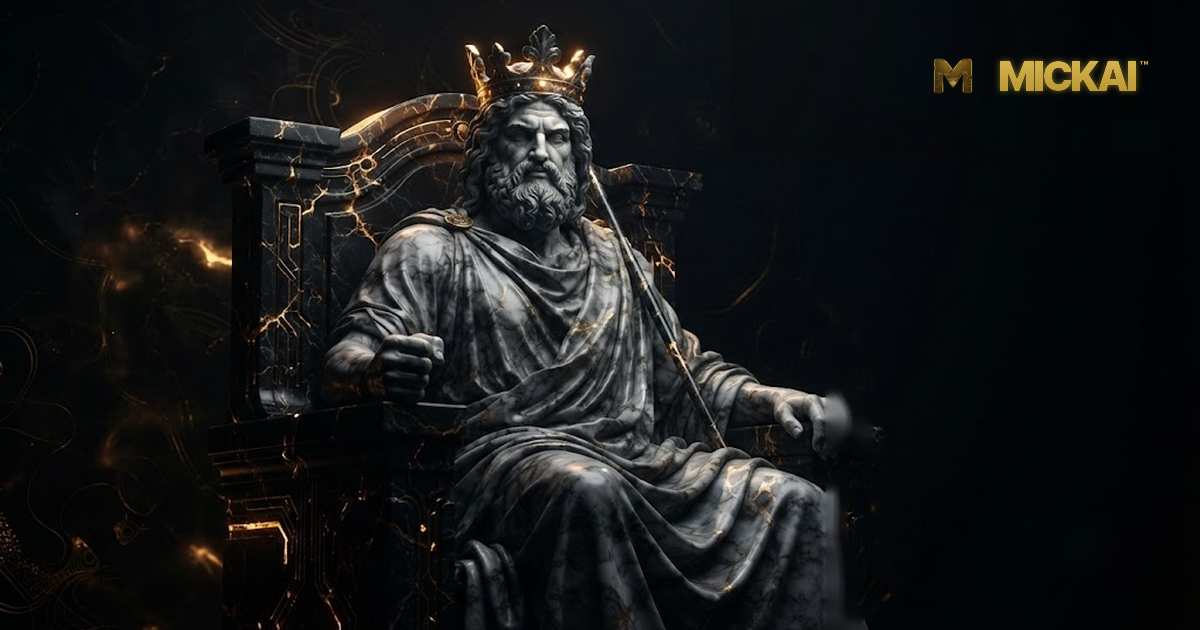
The difference between owning and renting is who gets to say no
Most organisations today do not own the intelligence that runs their business. They rent it. Every decision, every summary, every draft contract, every customer conversation flows out to a service someone else controls, gets processed on hardware they will never see, and comes back shaped by rules they are not allowed to read. It feels like ownership because the answers arrive on time. It is not ownership. It is tenancy, and tenancy can be revoked, repriced, or quietly changed while you sleep.
We built Mickai because we think this arrangement has the incentives backwards. Mickai is a Sovereign Intelligence Operating System, a SIOS. It runs on your own hardware, on premises and air gapped where you need it, with zero data egress and no public cloud round trip. The intelligence lives where you live. When you own the substrate, ownership stops being a marketing word and becomes a physical fact you can point at in a rack.
The angle we care about most is not speed or cost. It is consent. When intelligence is rented, consent is a fiction. You clicked agree once, years ago, and every prompt since has been an act of trust you cannot audit. We wanted to replace that trust with proof.
Consent has to mean something after the click
Consent that cannot be withdrawn is not consent. It is a signature on a document you were not allowed to keep. In a rented model, your data becomes training fuel, cached context, and log entries scattered across infrastructure you will never map. Asking for it back is like asking a river to return the water you poured in last spring.
Ownership changes the physics of this. When the memory belongs to you, the right to be forgotten is not a support ticket sent to a company that profits from remembering. It is an operation you perform on your own system, on your own terms, with a record that proves it happened. That is the whole point of memory the customer owns. Forgetting is only real when you hold the only copy.
- Rented intelligence: your data leaves, gets copied, and forgetting depends on someone else keeping a promise you cannot verify.
- Owned intelligence: your data never leaves, forgetting is an action you take, and the deletion itself is signed and recorded.
- Rented governance: the rules are hidden, change without notice, and vary by whatever the operator decided this quarter.
- Owned governance: the rules are yours, they are deterministic, and the same input under the same policy produces the same behaviour every time.
Deterministic governance instead of a black box you cannot inspect
The phrase people reach for when they describe a rented model is black box. They mean it fondly, as if mystery were a feature. We think mystery is a liability dressed as sophistication. If you cannot inspect the thing that is deciding on your behalf, you have not delegated a task. You have surrendered a decision.
Mickai works differently on purpose. It runs 50 specialist brains, 25 domain and 25 operational, under deterministic governance. That word deterministic is not decoration. It means the system behaves according to rules you can read, not moods you have to guess at. When a question comes in, the right specialists are engaged, the governing policy is applied the same way each time, and the outcome follows from inputs you can trace rather than from a probability cloud nobody is accountable for.
Determinism is what makes an audit meaningful. There is no point recording the actions of a system that would do something different tomorrow for reasons it cannot explain. Governance you can inspect is the foundation. Everything else is built on top of it.
A signed record of every action, not a story told after the fact
Every action Mickai takes produces a cryptographically signed audit record. We call it the Open Audit Record. It is not a log you have to trust, written by the same system that might have something to hide. It is a signed statement that this action, with these inputs, under this policy, happened at this moment, and it cannot be edited after the fact without the signature breaking.
The signing is post-quantum, using ML-DSA-65, because a record meant to prove what happened should still prove it in a decade when today's cryptography has aged. An audit trail that expires quietly is not an audit trail. It is a countdown. We would rather hand you something that holds up under scrutiny long after the decision that created it has faded from memory.
“You should never have to take our word for what your intelligence did. That is exactly the trust we set out to abolish. The record signs itself, you hold the key, and the proof outlives the argument.”
Why this is not a fringe concern
It is tempting to file all of this under compliance, something for the legal team to worry about while the rest of the business gets on with the work. We think that is a mistake. Ownership of intelligence is becoming the central question of how organisations operate, because the intelligence is no longer a tool at the edge of the work. It is moving into the middle of it, touching decisions that used to be reserved for people who could be held to account.
When intelligence sits at the centre, the questions of consent, forgetting, and inspectable governance stop being footnotes. They become the difference between a business that can explain itself to a regulator, a customer, or a court, and a business that can only shrug and point at a vendor. We would rather help you build the first kind.
We are aware that arguing for ownership from a standing start invites a fair question about whether anyone is listening. The public signal we can point to is our own. Our founder now ranks number 2 on Crunchbase, and the company Heat Score has reached 94 out of 100, climbing from single digits. We take that as evidence that owning your intelligence, rather than renting it, is starting to sound less like a philosophy and more like common sense.
Where this goes next
The intellectual property behind all of this is real and documented. We have 104 filed UK patent applications carrying 2,340 claims, each with full specification, claims, and figures, building toward examination and grant. They describe the governance, the signed record, the sovereign memory, and the way the specialist brains coordinate. We filed them because the ideas matter enough to protect, and because a claim to sovereignty should be backed by more than a slogan.
The direction we are heading is simple to state and hard to walk back from. Intelligence that runs a business should be owned by that business, should ask for consent it can actually honour, should forget what it is told to forget, and should govern itself by rules anyone with the authority can read. We are building toward a future where owning your intelligence is the default expectation, and renting it looks like the strange, risky arrangement it always was. If you are ready to stop renting the thing that decides your future, we would like to help you own it.