On Device AI Operating Systems: The Shift Off the Cloud
We believe the next decade of serious AI belongs on the customer's own hardware, and we built Mickai to prove it.
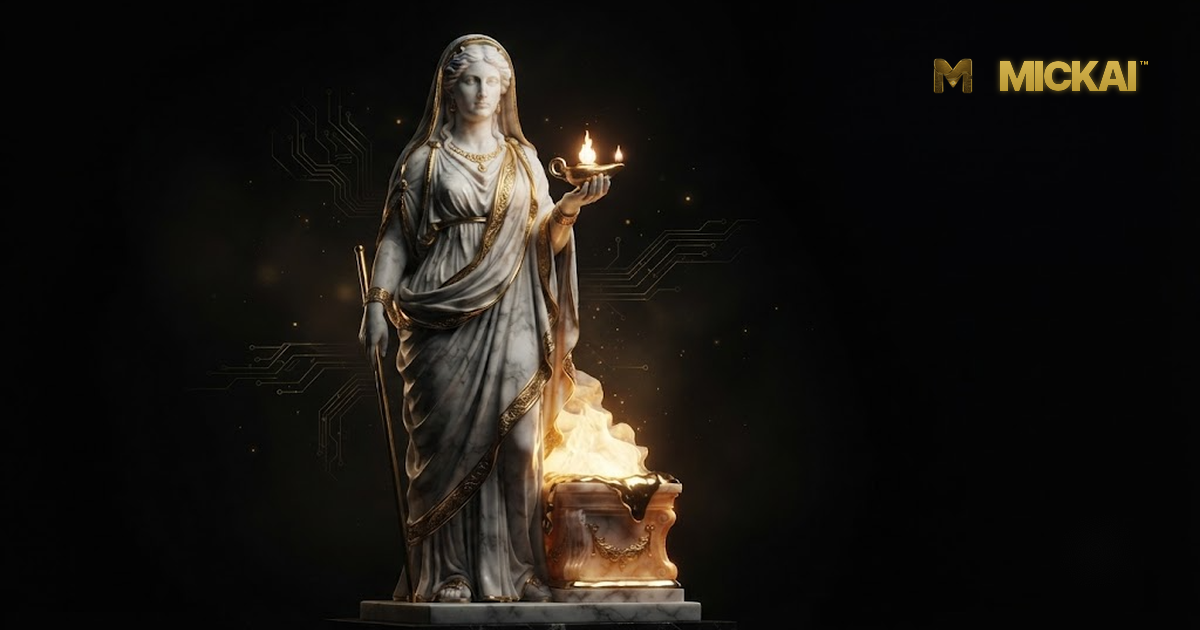
The cloud was the on-ramp, not the destination
For most of the last decade, using advanced AI meant sending your data somewhere else. You typed a prompt, your words left your building, they crossed a public network, they landed in a data centre you will never see, and an answer came back. That arrangement made a lot of powerful capability available very quickly, and we do not pretend otherwise. But it was always a compromise, and the industry is now waking up to the size of that compromise. The centre of gravity is moving. Serious organisations are pulling their most important AI work back onto hardware they control, and we think that shift is one of the defining infrastructure stories of this era.
The reasons are not ideological. They are practical, and they compound. Security, latency and sovereignty each push in the same direction, and once you feel all three at once, the case for keeping intelligence local stops being a preference and starts being a requirement.
Three forces pulling AI back on premises
We see the same three pressures again and again when we talk to people who run regulated, sensitive or high stakes operations. They are not exotic concerns. They are the everyday physics of running a business that cannot afford to leak, wait or lose control.
- Security. Every prompt sent to a public cloud is a copy of your data leaving your perimeter. It sits in someone else's memory, passes through someone else's logs, and depends on someone else's promises. For a hospital, a defence supplier, a bank or a law firm, that is not a footnote. It is the whole risk model. The only data that cannot be exfiltrated from a third party is data that never went to a third party.
- Latency. Round trips to the cloud cost time, and time is not free when a machine on a factory line, a trading desk or a clinical workflow is waiting on an answer. Local inference removes the network from the critical path. The model answers where the question is asked, at the speed of the hardware in the room rather than the speed of the internet on a bad day.
- Sovereignty. Increasingly the law itself insists on it. Data residency rules, sector regulators and national security requirements are converging on a simple demand. Know where your data is, prove it never left, and be able to switch everything off yourself. You cannot meet that demand honestly if your intelligence lives on infrastructure you neither own nor can inspect.
Put those three together and the conclusion writes itself. The cloud was the on-ramp that let the world try AI. It is not where the most valuable and most sensitive work is going to stay.
Local models are not the same as a local operating system
A lot of teams have already taken the first step. They download an open model, run it on a workstation, and congratulate themselves on going local. That is a real improvement, and we respect the instinct. But a model on a laptop is an engine sitting on a workbench. It is not a car you can drive to work. Between a raw model and a system a serious organisation can actually rely on sits everything that matters. Governance. Memory. Audit. Identity. Orchestration across many specialised capabilities. Security that will still hold up when the threat landscape changes. That gap is exactly the gap we set out to close.
This is why we describe Mickai not as an app, a tool or a platform, but as a Sovereign Intelligence Operating System, a SIOS. An operating system is the layer that turns raw silicon into something coherent that many programs can trust and share. We built Mickai to be that layer for AI, running entirely on the customer's own machines.
What a complete SIOS on your hardware actually gives you
The point of an operating system is that the hard parts are handled once, underneath, so that everything above them is safe and simple. Here is what that looks like when the whole thing lives on hardware you own.
- It runs on your own hardware, on premises and air gapped when you need it, with zero data egress. There is no public cloud round trip. The work happens inside your walls, and nothing has to leave for the system to think.
- It coordinates 50 specialist brains, 25 domain and 25 operational, under deterministic governance. Instead of one general model guessing at everything, the right specialist handles the right task, and a governance layer decides who is allowed to do what. That is how you get both breadth and control.
- It writes a cryptographically signed audit record on every action, the Open Audit Record. Every decision the system takes leaves a tamper evident trace you can inspect and prove. When a regulator, an auditor or your own board asks what happened and why, you have the receipts.
- It signs with post-quantum cryptography, using ML-DSA-65. The audit trail and the identities behind it are built to survive the arrival of quantum computers, not just today's attackers.
- It keeps memory the customer owns. The system's knowledge of your organisation lives with you, under your control, deletable by you. It is not a deposit in someone else's account that you rent access to.
None of that is a bolt on. It is the operating system doing its job, which is to make sovereignty, safety and accountability the default state rather than an upgrade you have to remember to buy.
“The only data that cannot be leaked from a third party is data that never reached a third party. Everything else is a promise, and promises are not a security architecture.”
Why we protected the architecture with filed patents
Building an operating system for sovereign intelligence is not a weekend project, and the ideas inside it are worth protecting. We have 104 filed UK patent applications covering this work, carrying 2,340 claims, and they are moving through the system toward examination and grant. Each application contains a full specification, its claims and its figures, describing the governance, the audit record, the memory model and the way the brains are coordinated. We mention this not to boast, but because it tells you the architecture is deliberate and documented, not improvised.
The signal that the market sees it too
We are early, and we would rather be honest about that than dress it up. But the interest is real and it is measurable in public. On Crunchbase, our founder now ranks number 2, and the company's Heat Score has reached 94 out of 100, climbing from single digits. That is a public, third party signal that the thesis behind an on device Sovereign Intelligence Operating System is landing with the people who watch this space for a living.
Where this goes next
The direction of travel is clear to us. The organisations with the most to protect will not be content to rent intelligence from infrastructure they cannot see. They will want it in the building, under their own keys, answering at the speed of the room, and leaving a record they can stand behind. The cloud showed the world what AI could do. The next phase is about who controls it, and that phase runs on your hardware, not somewhere else's. We built Mickai for that phase, and we intend to be there when the rest of the industry arrives.