Inside the Mickai studios: one seat opens a department of agents
We built Mickai so a single seat opens a working studio of bespoke agents, running on your own hardware, doing the job that a stack of cloud tools does today.
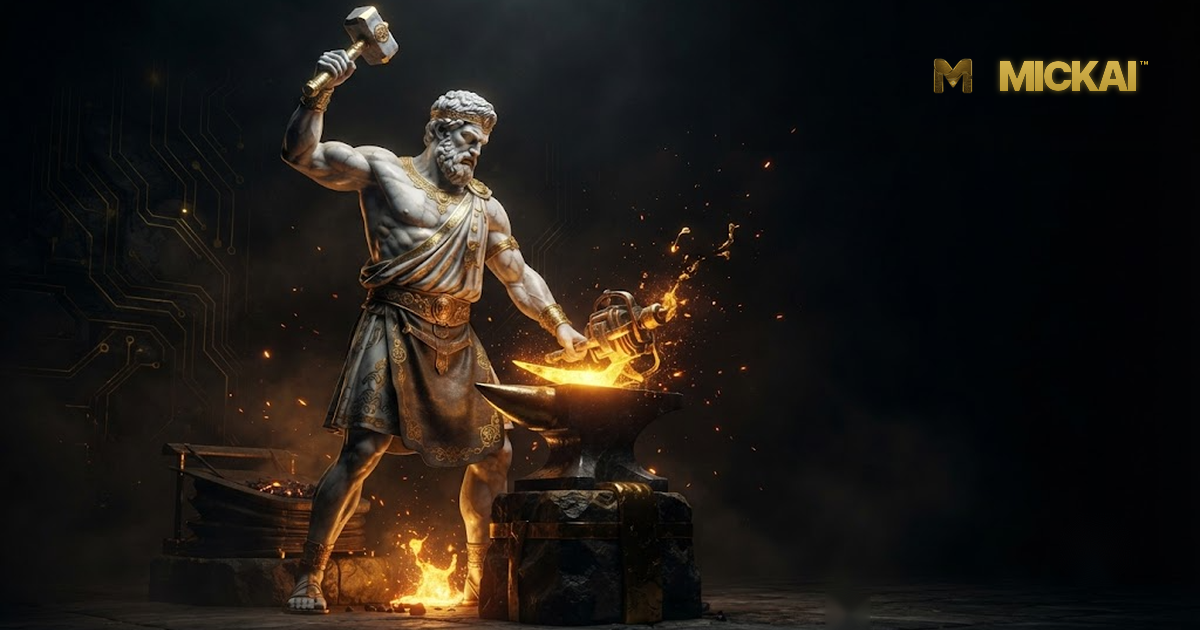
One seat, a whole department
Most organisations do not buy one piece of software any more. They buy a drawer full of subscriptions. A writing assistant here, a research tool there, a coding copilot, a support summariser, a compliance reviewer, a meeting note taker. Each one lives in someone else's cloud, each one takes a copy of your data on the way past, and each one sends you a separate bill. We looked at that sprawl and asked a simpler question. What if one seat opened a whole department instead.
That is what a Mickai studio is. When a customer takes a seat, they do not get a single narrow assistant. They get a studio, a set of bespoke agents shaped to the work in front of them, all running under one roof and all answering to the same rules. Mickai is a Sovereign Intelligence Operating System, a SIOS, and the studio is how that system meets the people who actually do the work.
What a studio actually contains
Underneath every studio sit 50 specialist brains, 25 for domains and 25 for operations, coordinated by deterministic governance rather than left to improvise. A studio is a view onto those brains, arranged around a particular job and given the context, the memory, and the permissions that the job needs. The research agent knows how to gather and cite. The drafting agent knows the house voice. The reviewer agent knows the policy it has to enforce. They hand work to each other in the open, and a human stays in the loop where a human should be.
Because the studio is composed rather than bolted together from third party services, it can quietly replace a long list of separate tools at once. A single seat can cover work that today is split across:
- Research and synthesis across your own documents, with citations back to the source
- Long form drafting and editing in a consistent, house voice
- Code generation and review kept inside your own network
- Support and inbox triage that never ships a customer's words to an outside cloud
- Compliance and policy checks run before an action, not discovered after it
- Meeting capture, summaries, and follow ups that live in memory you own
The point is not that any one of these is new. The point is that they run together, on one system, on your terms, so the seams disappear and the data never leaves the building.
It runs on your hardware, not ours
This is the part that changes the maths. A Mickai studio runs on the customer's own hardware. On premises and air gapped if that is what the work demands, with zero data egress and no public cloud round trip. Your documents, your code, your customer records, and the reasoning the agents do over them all stay where you put them. There is no quiet copy taken on the way to an external model, because there is no way out to take it.
For anyone who has spent a procurement cycle mapping where their data goes, that inverts the usual anxiety. The question stops being how many third parties now hold a slice of our information, and becomes how much can we consolidate onto one system we fully control. A studio is designed to be that consolidation.
The memory belongs to the customer too. The context an agent builds up over weeks of work is an asset, and we treat it as the customer's asset, not something rented back to them or mined in the background. When the studio remembers a decision, a preference, or a piece of house style, that memory sits on hardware the customer owns and can inspect.
Governance you can read back
Agents that can act need a record of what they did, and Mickai writes one. Every action a studio takes produces a cryptographically signed audit record, what we call the Open Audit Record. It is not a log file that anyone could quietly edit. Each entry is signed, and it is signed with post-quantum signing, ML-DSA-65, so the record stays trustworthy even as the cryptographic ground shifts under all of us over the coming decade.
That matters for two very different readers. It matters for the regulator or auditor who needs to see exactly what happened and be sure the account was not altered afterwards. And it matters for the team on the floor, who can trust the studio precisely because they can check it. Deterministic governance and a signed record turn a set of capable agents into something an organisation can actually stand behind.
“We did not want to build one more clever assistant that you have to take on faith. We wanted a studio you can open, put to work, and read back, all on hardware you own.”
Why we built it this way
The architecture is protected in depth. We hold 104 filed UK patent applications, containing 2,340 claims across full specifications, claims, and figures, and they are moving toward examination and grant. Those filings describe the studio composition, the governance layer, the audit record, and the way memory is owned and kept sovereign. We built the moat into the design rather than around the marketing.
We would rather show a public signal than a private promise, so here is the one we can point to. Our founder now ranks number 2 on Crunchbase, and the company Heat Score reached 94 out of 100, climbing from single digits. We take that as a sign that a sovereign, on premises answer to the cloud tool sprawl is landing with the people who have been living with the problem.
What comes next
The studios grow as the brains grow. Every new specialist we bring under the same deterministic governance and the same signed audit record widens what a single seat can cover, without widening the surface where data can leak. Our direction is steady and it is simple. More of the work, more of the department, folded into one seat that the customer runs, on hardware the customer owns, with a record they can read back at any time. That is the future we are building toward, and we are building it so that owning your intelligence is the default, not the upgrade.