Enterprise AI audits you can actually verify
We built Mickai so that every action an AI takes leaves a cryptographically signed record, turning audit from a promise into proof.
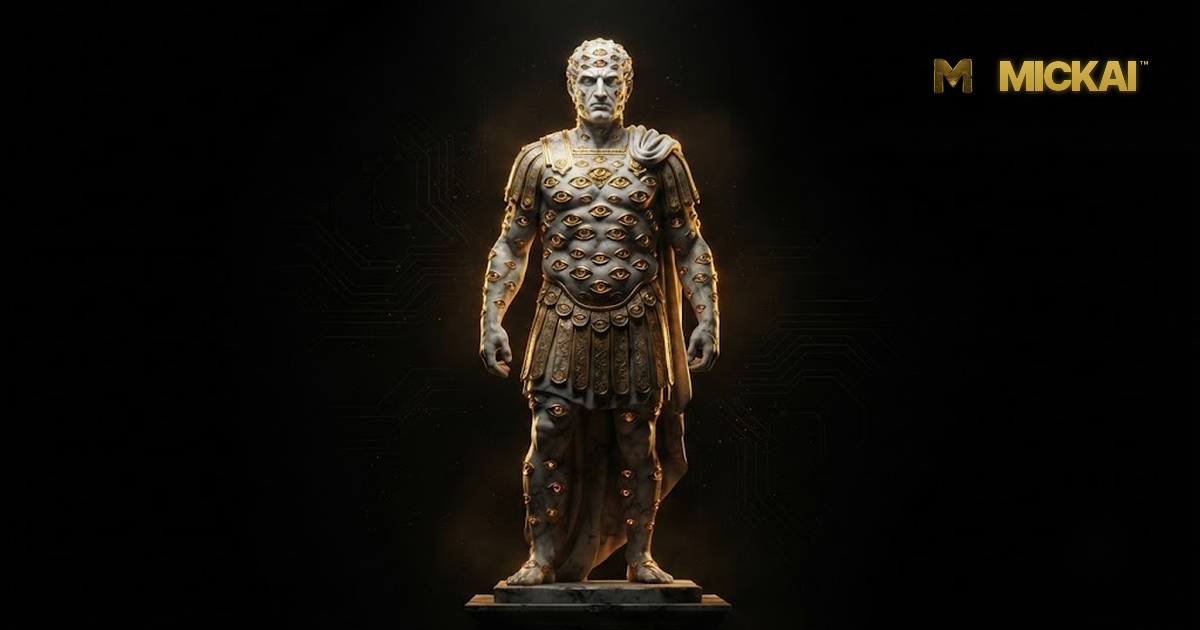
The gap between an audit you are promised and an audit you can prove
Ask any bank, hospital, insurer, or government department what keeps them awake about enterprise AI, and the answer is rarely about accuracy alone. It is about accountability. When a model makes a decision that affects a loan, a diagnosis, a benefit claim, or a national security judgement, someone will eventually ask a simple question. What exactly happened, who or what authorised it, and can you show us. In most AI deployments today, the honest answer is a shrug dressed up as a dashboard. Logs can be edited. Screenshots prove nothing. A vendor telling you their system is compliant is not the same as your regulator being able to check.
We think this is the central problem of AI in regulated sectors, and we designed Mickai around it from the first line. Mickai is a Sovereign Intelligence Operating System, a SIOS, and one of its founding principles is that an audit should be a mathematical fact rather than a marketing claim. If you cannot independently verify what your AI did, you do not have an audit. You have a story.
Why the usual approach fails under real scrutiny
Most enterprise AI runs somewhere you do not control, on infrastructure you cannot inspect, and it hands you a trail of activity that lives in the same place it could be quietly changed. The reasoning is often opaque even to the people operating it. When an examiner arrives, the organisation is left assembling an after the fact narrative from application logs, support tickets, and the memories of whoever happened to be on shift. That narrative might be accurate. The trouble is that nobody can prove it is, and in a regulated setting an unprovable defence is close to no defence at all.
The failure modes are consistent, and they are structural rather than accidental:
- Records are written by the same system that could benefit from altering them, so the fox is guarding the henhouse.
- Data leaves the building to reach a public cloud model, which means the trail crosses boundaries you can neither see nor certify.
- The AI reasoning is a black box, so even a complete log tells you what happened without telling you why it was allowed.
- There is no independent way to prove a record was not touched after the event, so integrity rests on trust rather than evidence.
- When the record matters most, in an incident or an investigation, it is exactly when its credibility is most easily questioned.
None of these are solved by adding another logging library. They are solved by changing where the AI runs and how each action is recorded, which is a decision you have to make in the architecture, not bolt on later.
What a verifiable record actually requires
For an audit to be verifiable rather than merely available, three things have to be true at the same time. The record has to be created at the moment of the action, not reconstructed afterwards. It has to be signed in a way that reveals any later tampering. And the whole thing has to run somewhere the organisation fully controls, so the chain of custody never leaves its hands. Miss any one of those and you are back to asking people to take your word for it.
This is the standard we hold Mickai to. Every action taken inside the system produces what we call the Open Audit Record, a cryptographically signed entry created as the action happens. Because it is signed, any change after the fact breaks the signature and becomes visible to anyone checking. The record is not a convenience feature sitting beside the real work. It is part of the real work, produced by the same governed process that carries out the action.
“An audit you are asked to believe is a story. An audit you can check is proof. We built Mickai so that regulated organisations never again have to choose between the two.”
Signing that holds up beyond today
A signature is only as durable as the mathematics behind it. Records in regulated sectors are not disposable. A decision made this year may be examined in a dispute, a claim, or an inquiry many years from now, and the signature protecting it has to remain trustworthy across that whole span. This is why the Open Audit Record is signed using ML-DSA-65, a post-quantum signing scheme designed to withstand the kind of computing power that would eventually undermine older approaches. We would rather your evidence outlast the technology used to challenge it than sign records with a method that has a shelf life.
Signing is also only half of governance. Behind every action sits our arrangement of 50 specialist brains, 25 focused on domains and 25 on operations, working under deterministic governance. Deterministic matters here. It means the same inputs and the same rules produce the same governed outcome, so behaviour can be examined, explained, and reproduced rather than hand waved. An audit of a system that behaves differently each time is not much of an audit. Predictability is what makes the record meaningful.
The record stays inside your walls
A signed record is far more powerful when the entire system runs on your own hardware. Mickai runs on the customer's own machines, on premises and air gapped where that is required, with zero data egress and no public cloud round trip. The material being reasoned over, the actions taken, and the audit record produced all stay inside the customer's boundary. The memory belongs to the customer, not to us and not to some third party.
That containment closes the last gap. When nothing leaves the building, there is no external hop where a record could be lost, altered, or exposed. The chain of custody is short, local, and yours. For sectors where sending sensitive material to a public model is either forbidden or unwise, this is the difference between an AI you can deploy and one you can only admire from a distance.
Protected by a deep body of filed invention
This approach did not appear overnight, and we have documented it carefully. We hold 104 filed UK patent applications containing 2,340 claims, with full specifications, claims, and figures, building toward examination and grant. Those filings describe the governed brains, the signed audit record, the sovereign runtime, and the way they fit together. We mention this because verifiable AI is not a slogan for us. It is a body of engineering we have set out in detail and put on the record.
The signal we can point to
We are careful about what we claim, so we will point only to a signal that anyone can check for themselves. On Crunchbase, our founder now ranks number 2, and the company Heat Score has reached 94 out of 100, having climbed from single digits. We read that as growing attention from a market that is tired of being asked to trust the untrustworthy, and increasingly interested in AI it can actually verify.
Where this goes next
The direction of travel in regulated AI is clear. Oversight is tightening, examiners are asking harder questions, and the tolerance for unprovable assurances is falling year on year. The organisations that will thrive are the ones that can answer the awkward question instantly and completely, with a record no one can quietly rewrite. We built Mickai for that world. An AI that runs on your own hardware, keeps your data inside your walls, and leaves a signed and durable trail of everything it does is not a compliance burden. It is the moment audit stops being a promise and becomes proof, and we intend to keep widening the distance between those two things.