Why one owned operating system beats a stack of subscriptions
One owned operating system where studios share data beats a dozen subscriptions that do not, each with a bill a vendor can re-price.
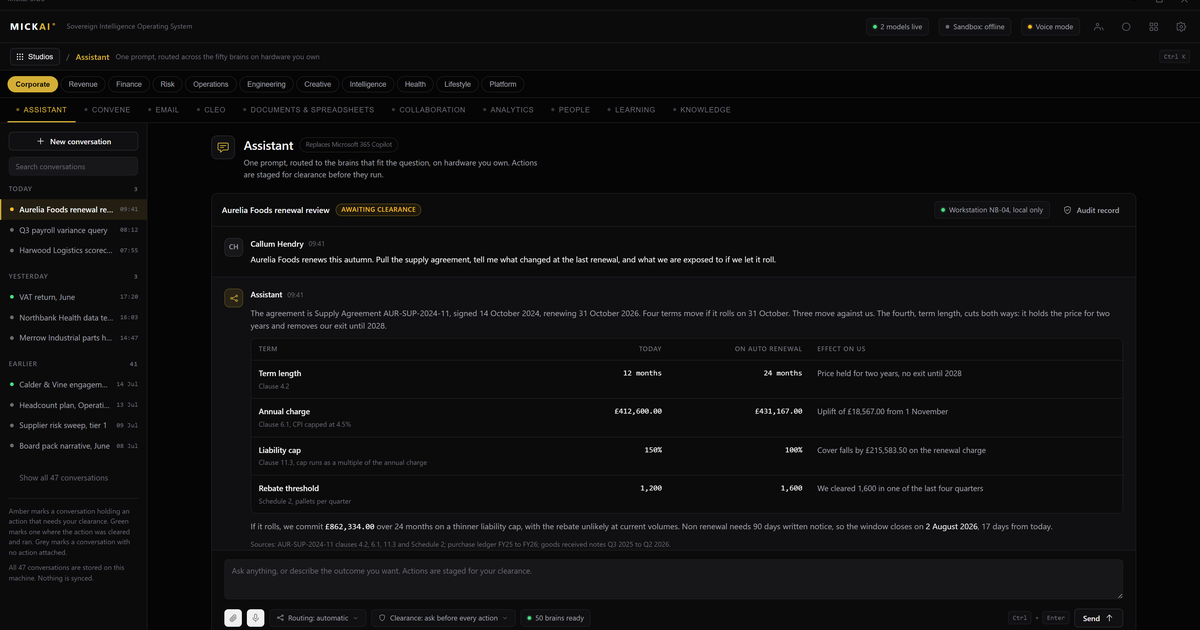
A company that owns one operating system pays for hardware once and runs its email, meetings, CRM, documents and team management as studios on it. A company that rents a stack of subscriptions pays per user, per month, per product, to a dozen vendors who each set their own price and each hold a slice of the company's data. The owned system is cheaper over any reasonable horizon, and its studios share the company's own records instead of charging to move data between them. That is the whole argument, and the rest of this piece works it through.
The hidden cost is not the price, it is the sprawl
The obvious cost of a subscription stack is the invoice. Take a firm of 200 people. Microsoft 365 Business Standard is published at 12.50 US dollars per user per month. That is one line: 200 times 12.50 times 12, which is 30,000 US dollars a year, for the productivity suite alone. Add a collaboration tool. Slack's published business plan is in the region of 12.50 US dollars per user per month on annual billing, another 30,000 a year on the same headcount assumption. Add a CRM. Salesforce Enterprise is published at 165 US dollars per user per month, and even if only 40 of the 200 sit in the sales team, that is 40 times 165 times 12, which is 79,200 a year. Add video, add a helpdesk, add a document signer, add a project tool. We are using published list prices as reported public facts and a deliberately conservative worked example; your real numbers depend on your plans and headcount. The point is not the exact total. The point is that the total is a set of recurring lines, each owned by a vendor who can raise it at renewal, and none of which you ever stop paying.
The cost you do not see on the invoice is the sprawl. Twelve tools mean twelve logins, twelve permission models, twelve places a leaver's access has to be revoked, and twelve copies of your company's information sitting on twelve other companies' servers. The data does not join up. The email about a contract lives in one product, the deal lives in another, the meeting where it was agreed lives in a third, and the signed document lives in a fourth. Joining them is manual work, or it is a paid integration, or it simply does not happen and the knowledge is lost.
One operating system, one set of data
MICKAI takes the opposite shape. Email, meetings and collaboration, CRM, documents, team management and the rest are not separate applications you buy and bolt together. They are studios on one sovereign operating system, and they work from the same records: the company's own. There is nothing to integrate because there is nothing separate to join. The platform spans 63 studios, and a client onboards onto an initial focused set that matches how the business actually runs, then extends from there.
Because the studios share data, an assistant can reach across all of it. Ask it for everything relating to a customer and it returns the emails, the open deal, the last meeting, the contract and the outstanding invoice as one answer, because those are not four vendors' databases, they are one system's records. That is the capability a subscription stack cannot offer at any price, because the data was never in one place to begin with. You can pay Salesforce and Microsoft and Slack for a long time and never buy the thing that owning the whole stack gives you for free: coherence.
What a company actually gets on day one
The point is easier to see when it is concrete. A firm that onboards gets its email system, its meetings and collaboration platform, its CRM, its document store and its team management running as studios on one operating system, on hardware in its own building. Sales works the deal in the CRM. The meeting where the deal was agreed is captured in the meetings studio. The contract sits in the document store. The follow-up goes out through the email system. None of that is glued together after the fact, because it was never apart: the studios read and write the same records. One assistant runs across all of them, so a salesperson can ask for the full history of an account and get the emails, the deal stage, the last call and the signed paperwork in a single answer rather than four browser tabs. That is what a subscription stack is structurally unable to hand you, because the records live on four vendors' servers and were never one thing to query.
What owning it changes about the bill
When the operating system runs on hardware the customer owns, the recurring per-user line does not just shrink, it changes character. You are no longer renting the right to use software that lives somewhere else. You are running software on machines that sit in your building, that you have already bought. The productivity suite, the CRM, the meetings platform and the collaboration tool are not four renewals on four calendars set by four vendors. They are one system you own.
That removes the renewal risk entirely. A subscription vendor can re-price at renewal, deprecate the plan you are on, or move a feature you depend on into a higher tier. Every one of those is a lever the vendor holds and you do not. We do not publish MICKAI pricing here, and this is not a price comparison to the decimal point. It is a comparison of shapes. A recurring bill you do not control, spread across a dozen vendors, is a different kind of liability from a system you own outright on hardware you own.
The part the incumbents cannot match
Microsoft, Google, Slack and Salesforce are good software. The argument here is not that they are bad. It is that their shape, many rented tools that do not share your data and do sit on their servers, is the wrong shape for a firm that has to answer for where its data is and what its systems did.
Our starting point is private deployment where the vendor cannot see your data. For a lot of buyers that alone is the reason to look, and we treat it as the baseline rather than the headline. The value is what sits beyond it. The system is air-gapped by default, so the data does not leave the building unless you decide it does. Every action the assistant and the studios take is written to the Open Audit Record, so you can show not just who logged in but what the system did, at the level of the individual action. And you receive the whole software stack your business runs on, not a model to integrate into someone else's product. That last distinction matters most to the firm this is built for: the regulated small and mid-sized company that the heavyweight vendors treat as a rounding error, the one that has real compliance obligations and no appetite to hand its records to a hyperscaler to meet them.
The decision in one line
A dozen subscriptions is a dozen bills, a dozen vendors who can re-price you, and a dozen copies of your data you do not hold. One owned operating system is a single system on hardware you control, where the studios share your records and one assistant reaches across all of them. For a regulated firm counting both the cost and the exposure, owning the operating system is the cheaper and the safer of the two shapes. It is worth noting, without leading on it, that the platform is backed by 104 filed UK patent applications across 13 families, 2,340 claims in total, filed rather than granted. The reason to choose it, though, is the shape of the thing: one system you own beats a stack you rent.
Frequently asked questions
Why is one owned operating system cheaper than several subscriptions?
A stack of subscriptions bills per user per month, per product, forever, and each vendor can re-price at renewal. An owned operating system runs on hardware you already control, so the recurring line falls away and the studios share one set of data rather than paying to move it between vendors.
Do the studios actually share data?
Yes. Email, meetings, CRM, team management and documents are studios on one operating system, working from the company's own records. The assistant reaches across all of them, so a customer email, the deal it relates to and the meeting where it was discussed are one thread, not three exports.
How many studios does the platform have?
The platform spans 63 studios on one sovereign operating system. Clients onboard onto an initial focused set that matches how they work, then extend as they need to.
Can the vendor see our data?
No. The system runs on hardware the customer owns and is air-gapped by default. Private deployment where the vendor cannot see your data is the baseline we start from, not a paid add-on.
Is this about the incumbents being bad software?
No. Microsoft, Google, Slack and Salesforce are capable products. The argument is structural: many rented tools that do not share data cost more and reveal more than one owned system that does, especially for a regulated small or mid-sized firm.
What do you mean by an owned operating system rather than a model to integrate?
You do not receive a model to wire into other people's software. You receive the software stack itself, the studios your business runs on, with the assistant and the audit built in. There is nothing to integrate because it is already one system.