When the Grid Goes Dark: VIRTUALIS and the Sovereign Survival System
The smartest assistant in the world is useless the moment the connection drops. Mickai built the opposite: a sovereign intelligence that runs entirely on the operator's own hardware with no internet, and a survival and civilisation core, VIRTUALIS, so that a person off the grid, in the Sahara, on Everest, deep in the Amazon, or one day on Mars, has everything they need to live.
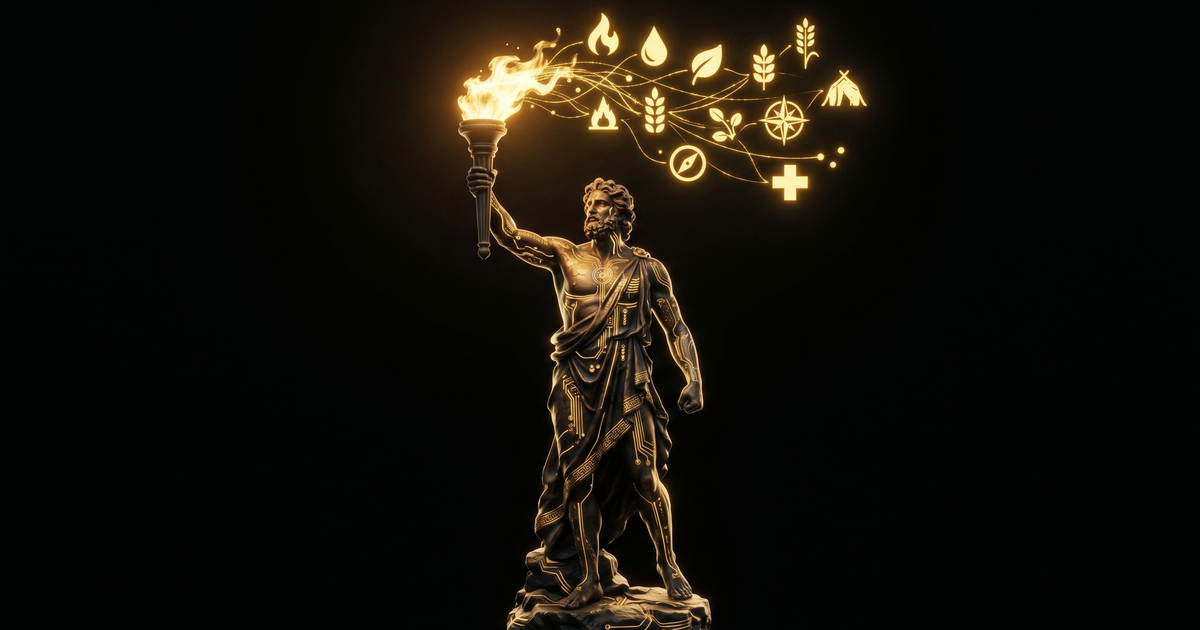
Ask most people how to start a fire in the rain, find drinkable water in a desert, tell an edible plant from the one that will kill them, or set a broken arm without a hospital, and the honest answer is that they do not know. For two generations that knowledge has lived in a search box. The search box needs a network, a data centre, a subscription, and a company on the other end that is still in business and still willing to answer. Remove any one of those and the knowledge is gone exactly when it matters most.
Mickai was built for the world where one of them is gone. The Sovereign Intelligence Operating System runs one hundred per cent on the operator's own machine, fully offline, every action signed into a tamper-evident post-quantum ledger the operator owns. It does not phone home. It does not need a network to think. And inside it sits VIRTUALIS, the survival and civilisation core, the part designed for the day the grid goes dark and stays dark.
What VIRTUALIS is for
VIRTUALIS is a single, coherent survival system, not a folder of PDFs. The operator describes their situation and their surroundings, and the system reasons over an offline corpus of survival, medical, botanical, and engineering knowledge to give cited, step-by-step guidance for the terrain they are actually in.
- **Water.** Where to find it and how to purify it, specific to the biome. The technique that saves a life in the Sahara is not the one that works in the Amazon or above the snow line on Everest. VIRTUALIS knows the difference, the different sources of water, the different ways to make each one safe to drink.
- **Food.** Identifying safe edible plants, flowers, fungi, trees, insects, and animals, with explicit warnings about the toxic lookalikes that kill foragers, plus foraging, trapping, fishing, and preserving what you gather.
- **Fire.** Starting and keeping a fire in any weather, wet, wind, cold, altitude.
- **Shelter and tools.** Building shelter and fabricating tools, filters, and traps from whatever the terrain provides.
- **Navigation.** By stars, sun, and terrain, with no GPS and no map server.
- **Medicine.** First aid, triage, and field medicine, with the highest-stakes guidance placed behind a deliberate voice confirmation so it is never given by accident.
The design goal is blunt: send a HELIOS unit to the far side of the world, or to a research station that may as well be on Mars, and the person holding it has the accumulated survival knowledge of human civilisation in their hands, working on a battery, with nothing else required. The same system serves the family living off the grid by choice, the climber, the sailor, the field medic, and the household preparing for the week the supply chain does not arrive.
This is sovereign by design, and that design is what the patents protect. The survival core is being wired to the most recently filed applications in the Mickai portfolio that cover offline operation, air-gapped attestation, and sealed decision support, so the capability is the embodiment of the filed intellectual property, not a claim bolted on after the fact.
The solar hardware: HELIOS
Knowledge is only sovereign if the machine that holds it can stay alive without the grid. That is what the HELIOS line is for: a small family of rugged, solar-positive devices built to run the survival core on very little power, for a very long time.
- **A low-power laptop** with an efficient, readable screen, sized so conversational use sips power rather than draining it.
- **Solar power banks** and **foldable solar panel kits** that recharge the system from sunlight alone, so a day in the field is a day of power.
- **A solar-powered mini-PC** for the off-grid desk or basecamp, the heavier node when there is sun to spare.
- **An inkless printer**, the Scribe, that prints with no liquid ink to dry up or run out. Design a shelter, a water filter, or a full house on the system, and print the plans in the field on a printer that will still work in a year with no cartridges to buy.
A HELIOS unit is meant to be the thing you turn on once a month, or only when you need it, and trust to work. Knowledge first, power-frugal, repairable, owned outright.
Who it is for, and how
VIRTUALIS on HELIOS is not a single-use survival gadget. It is for anyone whose connection cannot be assumed, and that is a far larger group than it first appears.
- **Off-grid households and the self-reliant.** A whole civilisation library, medical reference, and daily-life knowledge running on solar, owned outright, with no subscription and no signal required.
- **Disaster and emergency response.** When an earthquake, flood, wildfire, or grid failure takes the network down, HELIOS still answers: water, first aid, power, navigation, and triage, on a battery, in the field.
- **Defence and forward-deployed teams.** A sovereign, air-gapped intelligence that operates with communications down and roots its audit chain in silicon, suitable for classified environments where nothing may leave the device.
- **Maritime, polar, desert, and alpine.** Sailors offshore, climbers on Everest, crossings of the Sahara or the ice: extreme-environment survival, navigation, and medicine, charged by the sun.
- **Remote research and field science.** The offline knowledge core, the science lab, and terrain mapping where there is no connectivity for months at a time.
- **Low-connectivity and developing regions.** An offline school, an encyclopedia, a medical reference, and an agriculture adviser on one solar-powered machine, where a data plan is not a given.
- **Humanitarian and NGO field workers.** Medical, water, and logistics support in austere settings, independent of local infrastructure.
- **Privacy-critical professionals.** Lawyers, journalists, and their sources who need an intelligence that never phones home, on hardware they hold, beyond the reach of surveillance.
- **Space and Mars-analog missions.** When Earth is hours away by signal, the crew still needs to survive, repair, and decide. Send a HELIOS, and the knowledge travels with them.
The common thread is sovereignty. Every one of these operators needs intelligence that works when the connection does not, and that they alone control.
Models that do not need the cloud to be good
There are two honest claims here, and they are different. The first is that the Mickai brains, the cooperative of specialist models that run on-device, hold their own against the hosted assistants for the work that matters, and they do it with the network unplugged. The brains are our own specialised sovereign models, the weights we control, hardened for each domain on a sealed corpus, and Mickai is already training its own models now on the sovereign sealed corpus those signed interactions produce; the funded roadmap scales that work to a frontier-scale Mickai-native model for the substrate, with the frontier tier roughly six to twelve months out after funding. The second claim, and the one that counts when the grid is down, is that those specialised models are calibrated for civilisation and survival, tuned for the person who lives off the grid and powers a machine up once a month, not for the engineer with a fibre line. When the internet shuts down, it is not only that the sovereign models keep working while the rented ones go dark. It is that there is a system underneath, VIRTUALIS, built for exactly that moment.
Owned forever, updated only if you choose
The arrangement is the opposite of a subscription you cannot escape. VIRTUALIS and the survival core run fully offline, forever, with no fee and no connection. The only time an operator ever needs to connect is if they choose to pull down an update, a refreshed corpus, a new terrain pack, an improved model, and that would be a small optional service, on the order of a few pounds a month, price to be confirmed and deliberately minimal. Connect for an hour, take the update, and go dark again for as long as you like. The default state is offline and owned. The network is a convenience, never a dependency.
The HELIOS line, in brief
The survival core runs on a small family of solar-positive devices, built to do the most on the least power.
- HELIOS Phaethon, a 14-inch low-power laptop: efficiency-class CPU with an on-die NPU, 32 to 64 GB memory, a 75 Wh battery, around 4 W idle and 12 W in conversation, charged from any USB-C source or a HELIOS solar unit, about 1.2 kg.
- HELIOS Eos, a sealed solar power bank: around 2 kWh of LiFePO4 storage, up to a 400 W folding array with MPPT, 1500 W pure-sine AC out, signing its own energy ledger.
- HELIOS Phoebus, a low-draw solar mini-PC: 64 GB memory, 4 TB NVMe, a power-capped GPU, bundled with a folding array and a 1 kWh buffer for the off-grid desk.
- The rugged toughbook and tablet, the foldable solar Panel Kit, and the inkless Scribe printer that prints your plans in the field with no cartridge to run dry.
Every figure scales with the hardware, and every over-spec feature is shown honestly, never hidden.
Why it cannot be copied
VIRTUALIS is sovereign by design, and that design is filed. The Mickai portfolio stands at one hundred and four filed UK patent applications (GB2607309.8 onwards, named inventor Mickarle Wagstaff-Irons) covering the substrate the survival core runs on: the post-quantum Open Audit Record, the cooperative-brain arrangement and routing, the egress gateway, the air-gap operating mode and continuous air-gap attestation, the dead-man succession with sealed envelopes, and the operator-personalised silicon root of trust. The survival guidance is the embodiment of that filed intellectual property, not a wrapper around it. Anyone can publish a survival manual. No one can lawfully replicate a sealed, sovereign, fully offline intelligence built on this family. The applications are filed, building toward examination and grant.
Honest about what ships when
The substrate this is built on is real and proven today: the offline runtime, the cooperative of brains, and the Open Audit Record that signs every action are validated and on the public record, alongside one hundred and four filed UK patent applications. VIRTUALIS, the full HELIOS hardware line, and the dedicated survival models are what Mickai is bringing to market on top of that substrate. We will say plainly which pieces are shipping and which are on the near roadmap, and the survival guidance will always show its sources and its limits, because a survival system that overstates its confidence is worse than none at all.
When people ask what Mickai is for, the simplest answer is this. If the internet never goes dark, Mickai is a faster, cheaper, more private intelligence that you own outright. If it ever does, Mickai is the last light left on.
Sources and references
- The Mickai Sovereign Intelligence Operating System, mickai.co.uk
- The HELIOS hardware line, mickai.co.uk/hardware
- The Open Audit Record, mickai.co.uk/oar
- The Mickai patent corpus on the UK IPO public register, GB2607309.8 onwards, named inventor Mickarle Wagstaff-Irons