


When Agents Pay Agents: The Settlement Rails Pantheon Builds for the Agentic Economy
Machine-to-machine commerce does not need faster money, it needs proof of who acted under what authority, and Pantheon is designed to settle exactly that.
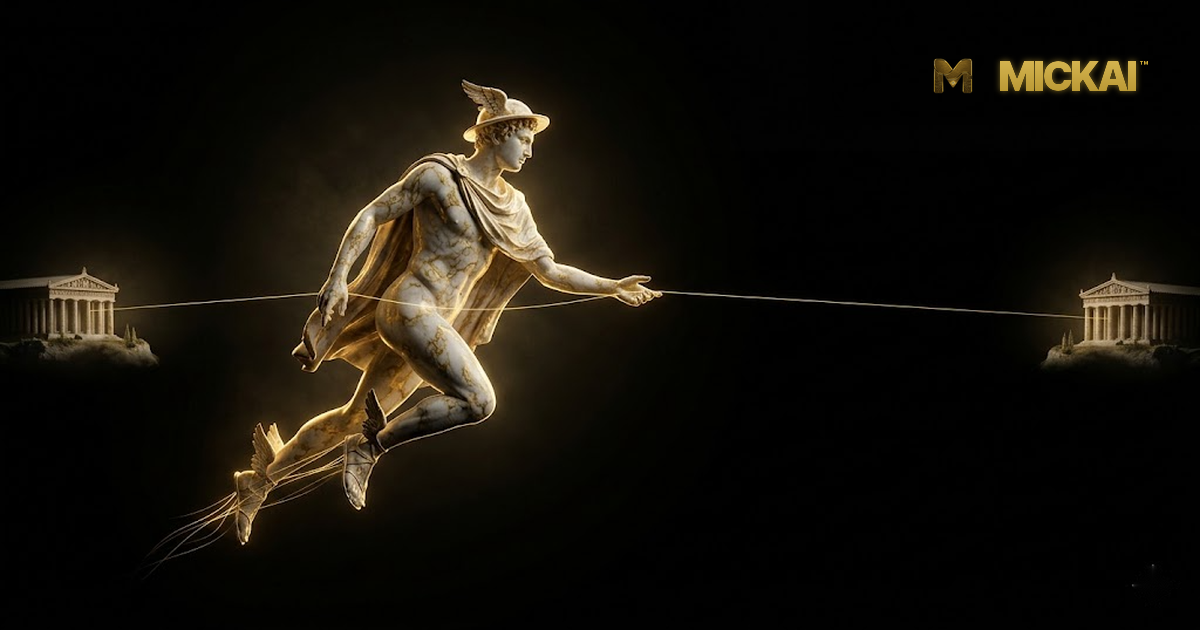
A purchase order no human ever saw
At 03:14 on a Tuesday, one autonomous agent buys forty thousand units of inference capacity from another. No person approved the trade. No person was awake. The buyer is a procurement model acting for a logistics firm. The seller is a scheduling model acting for a compute broker. They agree a price, settle it, and move on, all in the time it takes a human to blink. By morning the only question that matters is the one nobody can answer: who acted, under whose authority, and on what reasoning? The transaction exists. The accountability does not. This is the gap the agentic economy is racing toward, and it is the gap Pantheon is built to close.
Machine-to-machine commerce is no longer a thesis. Autonomous agents already negotiate, procure, and pay at machine speed, and the volume is climbing. What they lack is not throughput. Existing rails move value faster than any agent needs. What they lack is a way to prove, after the fact and offline, what produced a transaction. A public ledger records that value moved. It cannot attest to the identity that moved it, the mandate that permitted it, or the chain of reasoning behind it. For human commerce that gap is tolerable, because a person stands behind every signature. For agentic commerce it is fatal, because the actor is software, and software can be impersonated, coerced, or simply wrong.
Three things an agent needs before it can pay
Strip the problem to its frame and an agent needs exactly three things to transact safely. First, a verifiable name: a cryptographic identity that is genuinely its own and cannot be forged or replayed by another process. Second, a proof of authority: evidence that this specific action falls inside a mandate granted by a named operator, not an action the agent improvised or was tricked into. Third, a settlement layer that binds the first two to the movement of value, so the record of the payment and the record of the permission are the same object, not two documents that might disagree later.
Conventional infrastructure supplies none of these natively. Identity is bolted on through application-layer keys that say nothing about authority. Authority lives in off-chain policy engines whose decisions are never sealed to the transaction. Settlement happens on chains that treat a transfer as a transfer, indifferent to whether the sender was authorised or even sane. The three concerns are handled in three separate places by three separate systems, and the seams between them are exactly where disputes, fraud, and unaccountable machine behaviour accumulate. Pantheon's design collapses the three into one settled object.
The sealed receipt: identity and authority as one record
Pantheon is a sovereign Layer 1 blockchain built on the Mickai substrate, and its defining property is that the attestation layer is post-quantum from genesis. Every action an agent settles carries an Open Audit Record (OAR) seal. The OAR is an append-only, hash-chained ledger, and each entry is signed under the Module-Lattice Digital Signature Algorithm (ML-DSA-65), standardised as Federal Information Processing Standard 204 (FIPS 204), the National Institute of Standards and Technology (NIST) post-quantum digital-signature standard. The seal is produced before the action reaches consensus, and it is verifiable offline, forever, by anyone holding only the operator's public key.
This is what turns a payment into a receipt that carries its own provenance. When an agent settles on Pantheon, the seal binds the agent's identity, the operator authority under which it acted, and a fingerprint of its reasoning into a single signed record that the chain validates before it orders anything. Pantheon calls this seal-before-own-consensus: the OAR is a native runtime module, the OAR pallet (pallet-oar), so seals are first-class objects of consensus rather than data parked in a contract. The chain does not merely record that agent A paid agent B. It records that agent A, operating under operator O's sealed mandate, paid agent B, and it refuses to settle a record whose post-quantum signature does not verify. The name and the authority are no longer bolted on. They are the transaction.
The post-quantum choice is not decoration. An agent receipt is only as durable as the signature protecting it, and a classical signature is a promise with an expiry date that no one has written down. Harvest-now-decrypt-later is a real posture: an adversary can store today's signed records and forge against them once cryptographically relevant quantum hardware exists. A receipt meant to settle disputes a decade from now must be signed with a scheme designed to survive that decade. FIPS 204 ML-DSA-65 is implemented and verifiable in Pantheon, on commodity hardware, which is a precise and testable claim, not the vague reassurance of being quantum-safe.
Why agents need their own consensus, not someone else's
It is reasonable to ask why agentic settlement needs a dedicated chain at all, rather than a smart contract on an existing network. The answer is that an agent receipt has to be validated, not just stored. A contract on a general-purpose chain can hold a seal in its storage, but the chain underneath has no opinion about whether that seal is valid. It orders the transaction regardless, and verification becomes someone else's later problem, performed off-chain, by trusting the contract author. That is storage of a claim, not consensus over its truth.
Pantheon runs its own consensus over operator-sealed records. It is a standalone sovereign proof-of-stake (PoS) chain built on the Polkadot software development kit (Polkadot SDK, formerly Substrate), in Rust, using the framework's audited block-production and finality machinery (BABE or Aura for producing blocks, GRANDPA for finality). It is not a fork of Bitcoin and not a rollup tenant renting security from Ethereum. Because the OAR lives in the runtime, every validator checks every seal as a condition of producing a valid block. An agent's receipt is therefore not a document the network happens to be holding. It is a fact the network has collectively agreed is well-formed and authorised before it became part of history. For machine-to-machine settlement, that distinction is the difference between a ledger you can cite and a ledger you have to re-audit.
There is a second witness layer above this one. Periodically, a Merkle commitment of the chain's OAR root is anchored to Bitcoin through OpenTimestamps, a free public timestamp proof. Bitcoin acts purely as an external witness, at no protocol cost. Pantheon does not fork Bitcoin and does not depend on it for execution. The effect is that an agent's sealed history gains an independent anchor in the most widely replicated public ledger in existence, so the question how do I know this receipt is not back-dated has a clean external answer.
The settlement asset and where the value goes
The native asset of the Pantheon Layer 1 is PAN, with a fixed supply of five billion (5,000,000,000), no inflation, and no mint authority. Every application chain settles its fees in PAN, validators bond PAN to secure the network, and holders govern parameters, treasury, and buyback policy with it. Fifteen application chains map to live Mickai subsystems, spanning trading and decentralised finance, audit, knowledge retrieval, open-source intelligence, sky and physical monitoring, civilisation and survival, the Vinis assistant, a marketplace, governance, health, legal, compliance, identity, autonomous market-making, and hardware. Each settles its sealed actions to the base layer in PAN. The more the agents and subsystems run, the more settlement flows down to the base layer, which is the load-bearing economic loop: usage is settlement, and settlement is denominated in one fixed asset.
PAN also exists as an omnichain token, in the lock-and-mint style of a LayerZero omnichain fungible token (OFT), on Ethereum, BNB Chain, Base, and Arbitrum. One fixed supply spans every venue, so sovereignty sits where the moat is and liquidity sits where the market is. For an agentic economy that does not live on a single chain, that matters: an agent settling on Pantheon and an agent holding PAN as collateral on Arbitrum are denominated in the same scarce asset, not two wrapped approximations of it.
The way yield reaches validators is deliberately not an emissions model. There are no emission-based staking rewards and no inflation sell pressure. Staking and validator yield are funded by revenue buybacks: a governed share of protocol revenue buys PAN on the open market and is split, indicatively and tunable by governance, roughly forty per cent to staker and validator yield, thirty per cent to permanent burn, and thirty per cent to a governance lock. A base-fee burn in the style of Ethereum Improvement Proposal 1559 (EIP-1559) burns part of every transaction fee, so network usage itself shrinks supply. Every buyback, burn, and lock is sealed into the OAR and verifiable on-chain. Agent activity does not dilute holders to pay validators. It generates revenue that is recycled into the asset, and the recycling is auditable rather than asserted.
Who runs the rails, and who decides
Settlement rails for autonomous agents have to be credibly decentralised, or they are simply one company's private ledger with extra steps. Pantheon opens validation in three tiers. Software validators download a single node binary, run it on commodity hardware, and stake PAN. Delegators nominate validators through nominated proof-of-stake (NPoS), run no infrastructure, and share rewards. Mickai hardware appliances, premium plug-in validators from the Mickai hardware lineup, ship twelve months after funding and offer a turnkey path. Hardware is a premium option and never a gate. The set stays open to any software operator, which is what keeps the chain decentralised rather than permissioned. The target active set is fifty to one hundred and fifty validators.
Governance is two-keyed, and the second key is the part that distinguishes a settlement layer for agents from a settlement layer for people. On top, PAN-holder on-chain referenda decide direction. Beneath them sits a sealed execution-safety layer inherited from the Sovereign Intelligence Operating System (SIOS): before a gated action executes, a quorum of independent sovereign models must each return ALLOW. Every vote is sealed to the OAR, and every reversal is an append-only compensation that never deletes history. For a system where the parties to a transaction are themselves models, that lower key matters: it means a gated action is not approved by a single model that could be wrong or captured, but by a quorum whose deliberation is itself a sealed, replayable record.
Posture toward regulation is handled in the same spirit. An OAR compliance mapper generates signed evidence against the European Union Artificial Intelligence Act (EU AI Act), the NIST Artificial Intelligence Risk Management Framework (AI RMF), and the ISO 42001 management-system standard, so the chain's own regulatory standing is continuously auditable rather than periodically attested. For settlement between agents acting on behalf of regulated firms, a rail that produces its own signed compliance evidence is not a luxury. It is the difference between a transaction a counterparty's auditor can accept and one they have to reconstruct.
The wedge: recording is not the same as attesting
The competitive landscape clarifies what is actually new here. Public blockchains record transactions but cannot attest to what produced them. Artificial intelligence systems act but cannot prove, after the fact and offline, what they did, under whose authority, and with what reasoning. Several capable projects sit near this problem. The nearest peers root trust in vendor silicon (hardware trusted execution environments such as Intel Trust Domain Extensions or NVIDIA enclaves) or in token economics, sign with classical cryptography that future quantum hardware can break, and anchor to a third party's chain. EQTY Lab is the closest and best-funded of these, and it deserves respect. None of them, however, seals in software under post-quantum signatures on commodity hardware, none runs its own consensus over operator-sealed records, none anchors to Bitcoin as an external witness, none maps to ISO 42001, none ships earning validator appliances, and none couples its token economics to attested usage. That precise, combined stack is Pantheon's opening.
“A ledger can tell you that value moved. Only a sealed receipt can tell you who moved it, under whose authority, and why, and prove it offline to someone who trusts nothing but a public key.”
It is worth being exact about status, because precision is the whole point of the architecture. Pantheon is designed. The omnichain contracts are built and smoke-tested on a local testnet. The Substrate Layer 1 is in build. The bridge mechanisms are covered by filed United Kingdom patent applications within the Pantheon bridge family, part of a portfolio of one hundred and four filed UK patent applications, 2,340 claims, owned by Mickai LTD, named inventor Micky Irons. Mainnet is gated by an independent security audit and by legal and securities clearance, not by code. The token generation event (TGE) is targeted for the first quarter of 2027, raising thirty million pounds (Ladder B), with roughly twenty-four per cent of supply sold via simple agreement for future tokens (SAFT) instruments to professional investors only, marketed into the European Union through the Markets in Crypto-Assets (MiCA) utility-token notification route, with no United Kingdom retail promotion.
What settles when agents pay agents
The agentic economy will not be held back by a shortage of ways to move money. It will be held back by the absence of a way to prove what moved it. As autonomous agents take on procurement, market-making, scheduling, and negotiation, every action they settle becomes a question an auditor, a counterparty, or a regulator will eventually ask, and the answer has to survive the agent that produced it, the company that deployed it, and the cryptography that signed it. Pantheon's design answers that question at the layer where it cannot be quietly dropped: in consensus, under a post-quantum signature, against a sealed mandate, witnessed externally on Bitcoin, and recycled into a fixed-supply asset whose every buyback and burn is itself on the record. Give an agent a verifiable name and a sealed receipt, and machine-to-machine settlement stops being a leap of faith and becomes a matter of public record. That is the rail the agentic economy will need, and it is the rail Pantheon is built to be.