What Makes Mickai Different: Governance as an Engineering Property
Fifty sovereign brains, a signed audit record, 104 filed patents, hardware-bound identity, and a system you own rather than rent.
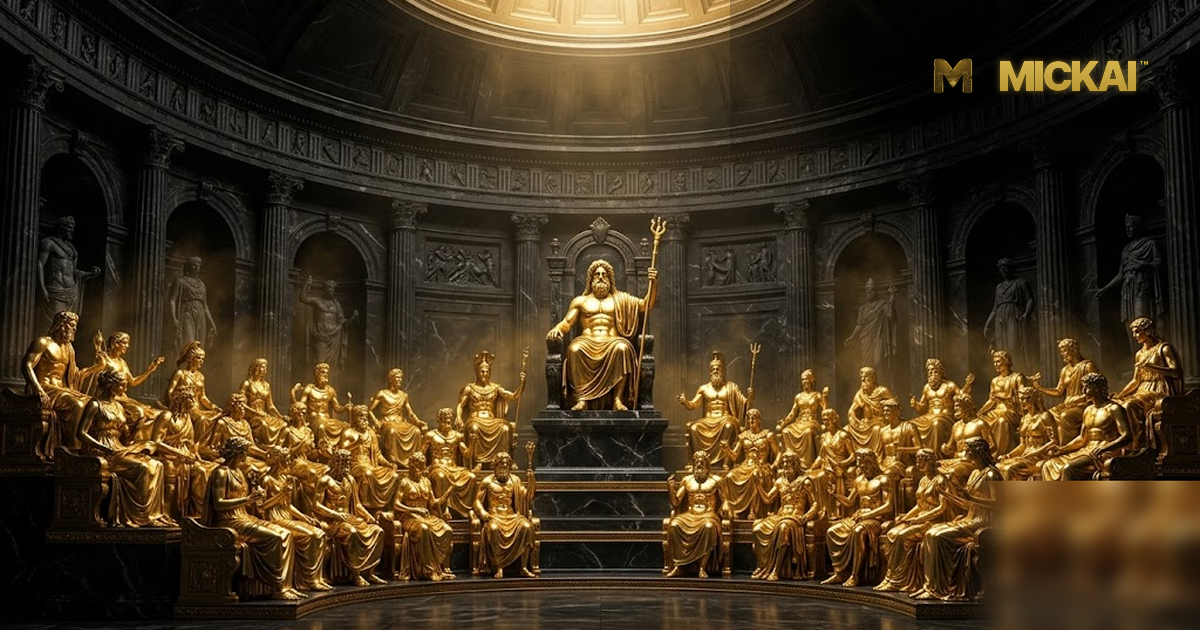
What makes Mickai different from every cloud AI vendor is a single design decision: governance is built as an engineering property, not offered as a promise. Where the cloud asks a regulated institution to trust a contract, Mickai gives it a system whose privacy, auditability and ownership are physical facts of the architecture. The data does not move, the actions are signed, the identity is bound to the hardware, and the institution owns the whole thing. Micky Irons, founder, chief executive and named inventor, built the Sovereign Intelligence Operating System (SIOS) so that the strongest claims a buyer needs to make to a regulator are the ones the engineering already enforces.
Most AI procurement comes down to assurances: the vendor promises not to train on your data, promises to keep it in-region, promises an uptime number. Those promises may be sincere, but they are about behaviour, and behaviour is exactly what fails in a breach, an outage or a transfer dispute. The Mickai difference is to replace promises with properties. The five differentiators below are the load-bearing ones, and each is an engineering fact rather than a clause.
1. Fifty sovereign brains, on hardware you own
Mickai is not a single model behind an endpoint. It is a Sovereign Intelligence Operating System with fifty specialised brains, twenty-five domain brains covering intelligence, governance, health, science and identity, and twenty-five operational brains that run the system itself. They are Mickai's own sovereign models, served on the institution's silicon through a local inference engine, not a remote API and not a shared tenant.
This matters because capability and sovereignty usually trade off against each other in the cloud-versus-on-premise debate. Mickai refuses the trade. The institution gets a full operating system of specialised intelligence, finance, fraud, compliance, audit, clinical reasoning, engineering, knowledge retrieval, and the rest, all running under Compute-to-Data, where the artificial intelligence comes to the data and the data never leaves the building. Mickai is actively training and specialising its own models, so the capability is the firm's to own rather than a service to rent.
2. The Open Audit Record
The Open Audit Record is the answer to the regulator's hardest question, which is not what the model promised but what it actually did. Every material action the system takes can be written to a signed, inspectable, locally reproducible record of the inputs, the model and the result. The institution, or its auditor, can verify behaviour without trusting a vendor's logging and without anything leaving the premises.
“Governance should be something you can verify, not something you have to believe. The Open Audit Record turns every model action into inspectable evidence you reproduce yourself, on your own hardware.”
This is governance as an engineering property in its purest form. A cloud vendor's audit log is a record the vendor keeps and shows you. The Open Audit Record is evidence the institution holds, signs and can reproduce locally, which is what an auditor under a real standard actually needs. It is the difference between being told the system behaved and being able to prove it.
The practical consequence shows up wherever an institution has to answer to someone else. A regulator asking how a decision was reached, an internal audit committee testing a control, a court examining how a privileged document was handled: each of these is a demand for inspectable evidence, and each is a question a cloud audit log answers only as far as the vendor's word goes. The Open Audit Record moves the proof inside the institution's own walls, where it can be examined without a third party in the loop. For a General Counsel, that is the difference between a defensible position and a hopeful one. Mickai is actively developing the record as a vendor-neutral substrate precisely because the need for portable, signed AI assurance is becoming a regulatory expectation rather than a nicety, and owning that primitive is part of the moat.
3. 104 filed UK patent applications as a defensible moat
Mickai is protected by 104 filed UK patent applications, all owned by Mickai LTD, spanning the Compute-to-Data approach, the audit-record substrate and the surrounding mechanisms. For an institutional buyer this is not vanity, it is durability. It means the architecture is a defensible moat rather than a configuration a hyperscaler can replicate next quarter and then deprecate when its strategy shifts.
The filed IP is also an E-E-A-T signal in the plainest sense: it is documented, original expertise rather than a marketing claim. When a board commits to an intelligence platform for a five-year horizon, the question of who owns the underlying invention, and whether the capability can be pulled or copied out from under them, is a real one. Mickai owns the invention, and the moat is what makes the long-term commitment safe.
4. Hardware-bound identity
Identity in Mickai is bound to the institution's own hardware. The deployment, its weights and its audit trail are tied to the specific machines in the institution's server room rather than to an account on someone else's platform. This is what makes the sovereignty real rather than rhetorical: the system cannot be quietly relocated, mirrored or accessed from outside, because its identity is the silicon the firm controls.
Hardware-bound identity is also what lets the architecture run air-gapped with integrity. The interface wires into the firm's existing Active Directory, LDAP or OAuth2 with role-based access control, so the people who can use the system are governed by the institution's own identity stack, and the system itself is anchored to the institution's own metal. The attack surface is reduced because there is no external account to compromise and no internet path to the data; the residual insider and physical risks remain the institution's to manage, as they already are for every crown-jewel system it runs.
5. Built and owned, not rented
The final difference underwrites the other four. Mickai is built and owned, not rented. The institution holds the model snapshot, the weights, the Mickai sovereign vector store and the Open Audit Record. It is immune to a vendor changing its terms of service, deprecating a model, raising a per-token price, or being acquired and re-pointed. The system runs independent of cloud outages because the institution owns the compute, and the cost is a predictable, depreciable capital asset rather than a volatile metered bill.
Ownership is also what makes the honest boundary honest. Mickai removes the cross-border transfer and third-party processing path by keeping the data and the model in place; it reduces the attack surface by removing the internet route to the data; data residency holds because processing never leaves the geography. It does not claim to discharge the firm's own duties: the customer keeps its own obligations and internal controls over the people and machines inside the perimeter. That candour is itself a differentiator, because an engineering property you can verify is worth more than an absolute you are asked to take on trust.
The five hooks, delivered by the architecture
Everything above resolves into the five reasons a regulated institution chooses to own its intelligence:
- **Zero-trust data privacy**, because what happens in the server room stays in the server room.
- **Independence from vendor lock-in and outages**, because the institution owns the compute.
- **Data residency**, because processing never leaves its geography.
- **The freedom to fine-tune on proprietary alpha**, building an edge that stays in the building.
- **Predictable CapEx**, a depreciable asset rather than an uncapped operating bill.
Micky Irons designed Mickai so that a buyer does not have to choose between capability and control, or between using advanced AI and meeting a fiduciary duty. The whole system exists to collapse that false choice into a single defensible answer: own the intelligence, keep the data, and prove it.
Request a private demonstration
The Mickai difference is best understood by watching it, not reading about it: the brains running over an institution's own archive, the Open Audit Record producing inspectable evidence, and the entire system answering with the building's external connection switched off.
We invite the COO, CIO, CISO, CFO and General Counsel to request a private demonstration, on a sandboxed deployment using dummy data, and see governance delivered as an engineering property rather than a promise.