What a 50-person firm saves by leaving the SaaS stack
A worked, conservative annual cost of a typical 50-person SaaS stack, and what changes when those tools become studios on one owned operating system.
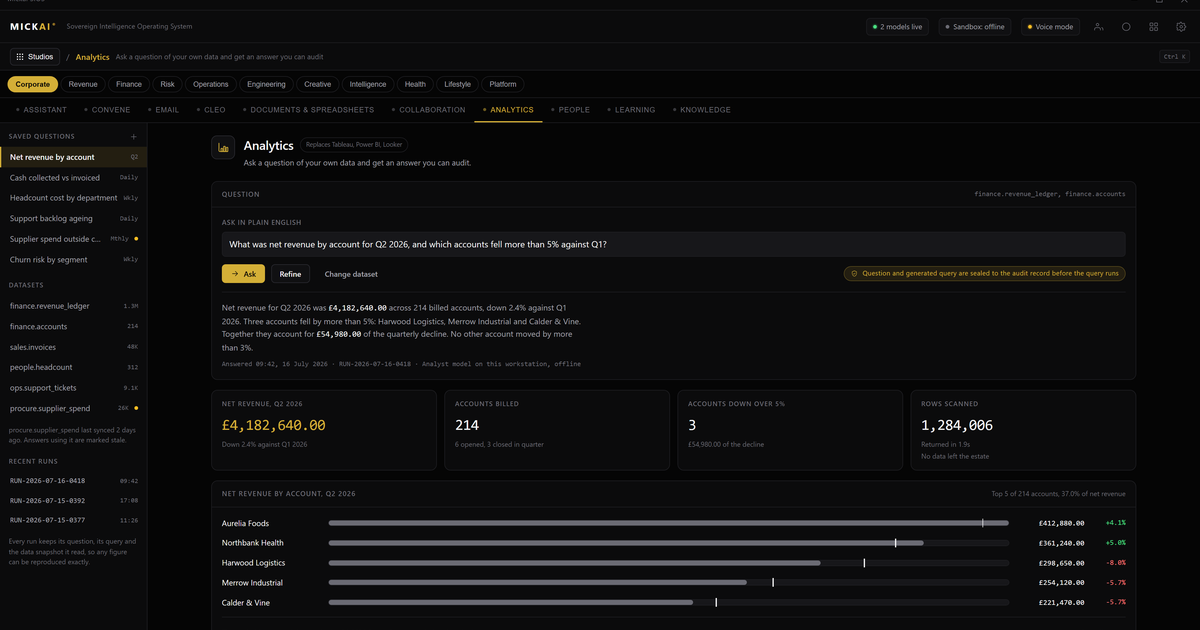
A 50-person firm on a typical subscription stack pays close to £43,000 a year, and that is the conservative figure. Put the same functions on one operating system the firm owns, running on its own hardware, and the recurring per-seat rent stops. The cost moves from an opex line that rises every year to a capital purchase the firm keeps.
That is the whole argument. Below is the working, with every assumption stated, using the incumbents' own published list prices.
The stack a 50-person firm actually pays for
Most firms this size do not run one tool. They run a productivity suite for email and documents, a meetings tool, a messaging tool, a CRM for sales and support, and increasingly an AI add-on bolted onto the suite. Each one is a separate per-seat subscription, billed monthly or annually, and each one raises its list price most years.
We priced a representative stack using published list prices at the time of writing. These are list prices before VAT and before any negotiated discount, and vendors change them, so treat them as the method rather than a quote frozen in stone.
The worked example
Assumptions, stated plainly:
- 50 staff.
- 12 months.
- Published list prices, per user per month, before VAT.
- Not every tool goes to every seat. The CRM and the AI add-on go to a subset, which is the conservative choice. Everyone gets the suite, messaging and meetings.
| Line | Tool | List price /user/mo | Seats | Annual |
|---|---|---|---|---|
| Productivity + email | Microsoft 365 Business Standard | £10.30 | 50 | £6,180 |
| Meetings + calling | Microsoft Teams (standalone) | £4.90 | 50 | £2,940 |
| Team messaging | Slack Pro | £6.75 | 50 | £4,050 |
| CRM | Salesforce Sales Cloud Professional | £75.00 | 20 | £18,000 |
| Meeting tool | Zoom Workplace Pro | £11.99 | 30 | £4,316 |
| AI add-on | Microsoft 365 Copilot | £24.70 | 25 | £7,410 |
| Total | £42,896 |
So a shade under £43,000 a year, and we were deliberately mean with the seat counts. The CRM sits on 20 desks, the AI seat on 25, the second meeting tool on 30.
Now roll the CRM and the AI seat out to the whole firm, which is where most growing companies end up. Salesforce at 50 seats is £45,000 a year. Copilot at 50 is £14,820. Zoom at 50 is £7,194. The total clears £80,000 a year. Same 50 people, same work, close to double the bill, because the model charges per head and the heads keep getting new add-ons.
Why the number keeps climbing
Three things push the subscription line up every year, none of them under the firm's control.
Price rises. Per-seat list prices tend to move up, not down. The AI add-ons in particular arrived as a new line that did not exist two years ago.
Headcount. Every hire is another set of seats across every tool at once. Growth that should feel like progress shows up first as a bigger invoice.
Unbundling. Functions that used to be included get pulled out and sold separately. A firm that thought it had one suite finds it now pays for the suite, the messaging, the meetings and the AI as four lines.
Over five years, the conservative £43,000 stack is more than £214,000 before a single price rise, and the realistic full-coverage stack is well over £400,000. None of that money buys anything the firm keeps.
What changes when these become studios you own
The functions do not go away. Email, meetings, messaging, the CRM, the AI assistant: a 50-person firm still needs all of them. What changes is who owns them and where they run.
On the MICKAI sovereign operating system, these are not separate apps stitched together. They are studios on one operating system, sharing the firm's own data, with one assistant working across all of them. The email system, the meetings and collaboration platform, the team messaging, the CRM: one login, one data layer, one audit trail. The assistant that drafts a reply in the email studio is the same assistant that updates a record in the CRM, because it is the operating system's assistant, not six different bots that cannot see each other.
And it runs on hardware the firm owns. That is the substitution. Instead of renting six tools per seat per month forever, the firm buys the operating system once and runs it on its own machines. The recurring rent stops. The cost becomes a capital purchase plus normal running and support, not a meter that ticks up with every hire and every price rise.
We do not publish a price, so this is not a smaller number set against a bigger one. It is a different shape of cost. Rent that compounds every year, against ownership the firm keeps.
The part the spreadsheet misses
The seat prices are only the visible cost. The stack also decides where the firm's data lives and who can see it.
On the subscription model, the data sits with the vendor, and the AI features read it on the vendor's infrastructure. For a regulated small or mid-sized firm, that is the awkward part. The vendor can, in principle, see the data the firm is paying to store.
The owned model starts from the opposite baseline. The operating system runs on the firm's own hardware, air-gapped by default, so the vendor cannot see the data because the vendor is not in the loop. Beyond that baseline, every action the assistant takes is written to the Open Audit Record: not just who logged in, but what the assistant did, to which record, when. That is the level regulated firms are asked to evidence, and it is the level the per-seat tools do not give you.
This is the segment the heavyweight vendors leave thin. The private, single-tenant, cannot-see-your-data deployments exist, but they are sold to organisations far larger than 50 people. The whole software stack a small regulated firm actually runs on, owned rather than rented, is the gap we build for.
What a 50-person firm should do with the number
Run your own version of the table. Take your real seat counts and your real list prices off your last few invoices. Add the lines the vendors unbundled since you signed. Multiply by 12, then by five years. That is the figure you are committing to before you have hired anyone new.
Then ask a simpler question. Of that annual spend, how much buys something you keep? On the subscription stack the honest answer is none of it. Owning the operating system changes that answer.
The platform spans a large set of studios on one operating system. Firms do not adopt all of it at once. They onboard onto an initial focused set that maps to how they already work, email, messaging, meetings, the CRM, then extend as they go. The point is not to swap one lock-in for another. It is to stop renting the software your business runs on.
FAQ
How much does a 50-person firm spend on SaaS a year? On published list prices, a conservative stack of Microsoft 365, Teams, Slack, a CRM, a meeting tool and an AI add-on lands close to £43,000 a year at partial coverage, and north of £80,000 if the CRM and the AI seat go to everyone. That is before VAT, price rises and headcount growth.
Does MICKAI publish a price? No. We do not publish pricing. This article compares the incumbent's own published list prices with a different model of ownership, not two price tags.
What replaces the subscription stack? The same functions run as studios on one operating system the firm owns: email, meetings and collaboration, team messaging, a CRM and one assistant across all of them, on hardware the customer owns.
Is the software still rented? No. The stack is owned software running on owned hardware. The recurring per-seat rent stops. The cost shifts from an opex line that rises every year to a capital purchase plus running and support.
Where does the AI run? On the firm's own hardware, air-gapped by default, so the vendor cannot see the data. Every action the assistant takes is written to the Open Audit Record.
Do we get all 63 studios on day one? No. The platform spans a large set of studios on one operating system. Firms onboard onto an initial focused set that matches how they already work, then extend from there.
Frequently asked questions
How much does a 50-person firm spend on SaaS a year?
On published list prices, a conservative stack of Microsoft 365, Teams, Slack, a CRM, a meeting tool and an AI add-on lands close to £43,000 a year at partial coverage, and north of £80,000 if the CRM and the AI seat go to everyone. That is before VAT, price rises and headcount growth.
Does MICKAI publish a price?
No. We do not publish pricing. This article compares the incumbent's own published list prices with a different model of ownership, not two price tags.
What replaces the subscription stack?
The same functions run as studios on one operating system the firm owns: email, meetings and collaboration, team messaging, a CRM and one assistant across all of them, on hardware the customer owns.
Is the software still rented?
No. The stack is owned software running on owned hardware. The recurring per-seat rent stops. The cost shifts from an opex line that rises every year to a capital purchase plus running and support.
Where does the AI run?
On the firm's own hardware, air-gapped by default, so the vendor cannot see the data. Every action the assistant takes is written to the Open Audit Record.
Do we get all 63 studios on day one?
No. The platform spans a large set of studios on one operating system. Firms onboard onto an initial focused set that matches how they already work, then extend from there.