


A Verifiable Name for Every Agent: Identity and Authority on Pantheon
Why the credentialled autonomous agent needs a cryptographic name, a sealed authority trail, and a settlement layer that proves both offline forever.
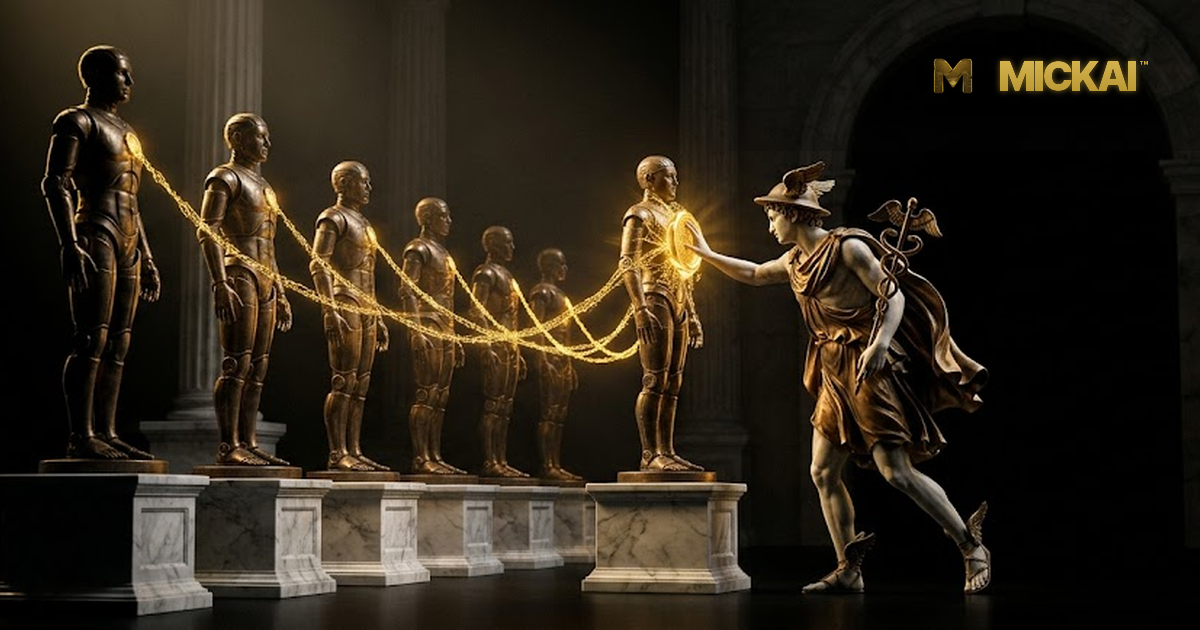
The agent at the door
An autonomous agent arrives at a settlement layer carrying an instruction: rebalance a treasury, release a payment, sign a filing, dispatch a fleet of subordinate agents to do the same across fifteen domains. The chain underneath it can record that the instruction settled. It can timestamp the bytes, order them against every other transaction, and hold them immutable. What it cannot do, on every public ledger built before now, is answer the only questions that matter when the action is later disputed. Which agent did this. Under whose authority did it act. What reasoning produced the decision. Can that be proved, after the fact, offline, by someone holding nothing but a public key. Pantheon, the sovereign Layer 1 blockchain built on the Mickai Sovereign Intelligence Operating System (SIOS), is designed so that the answer to all four is yes, and so that the proof outlives the cryptography of the era that wrote it.
This is the part of the autonomy problem that tokenomics and consensus engineering have left untouched. A blockchain attests to transactions. It does not attest to the actors that produced them. As software agents acquire the authority to move value and bind organisations, the missing primitive is not faster finality or cheaper gas. It is a verifiable name for every agent, and a sealed trail of the authority under which that name acted. Pantheon treats that primitive as a property of consensus rather than a courtesy of the application layer.
Why an agent needs a cryptographic name
A human operator has a passport, a signature, a chain of accountability that a court can follow. An autonomous agent has, by default, none of this. It is a process. It can be cloned, impersonated, spun up under a borrowed key, or quietly modified between the instruction and the act. When such an agent moves money or signs an obligation, the ledger entry tells you a key signed a transaction. It does not tell you that the key belonged to a specifically credentialled agent, that the agent was authorised for this class of action, or that the action it took matches the reasoning it was given.
Pantheon treats agent identity as a first-class object of consensus rather than an application convenience. Every agent that operates on the chain carries a cryptographic name: a durable identifier bound to a post-quantum signing key, registered in the runtime and inseparable from its action history. When that agent acts, the action is sealed into the Open Audit Record (OAR), the append-only, hash-chained ledger that the Mickai substrate writes for everything it does. Each OAR entry is signed under ML-DSA-65 (the Module-Lattice Digital Signature Algorithm at security level 65, standardised as Federal Information Processing Standard 204, the United States National Institute of Standards and Technology post-quantum digital-signature standard). The seal names the agent, fixes the authority it claimed, and binds the reasoning that led to the act, all before the record reaches consensus.
The distinction from a conventional account is precise. A wallet address proves possession of a key at a moment. A Pantheon agent name proves identity, authority, and lineage across time, and proves it under a signature scheme chosen to survive a quantum adversary. The name is not a label that an application chooses to honour. It is enforced where the chain validates state, because the OAR is a native runtime module (pallet-oar) and its seals are first-class objects that validators agree on before they order them.
Authority at the moment of summoning
Identity answers who. Authority answers whether this agent was permitted to be invoked at all, and by whom, for this action, at this moment. On Pantheon the highest-consequence agent invocations are gated. A sealed operator instruction, carrying its own post-quantum signature, is required to summon an agent into a privileged action. The gate is not a convenience bolted onto a user interface. It is part of the authority record that the seal captures, the top tier of a graded authorisation model rather than a single biometric trick.
Consider the structure of one gated invocation. The operator issues a sealed instruction. The instruction names the agent to be summoned and the class of action permitted. Before the gated action executes, the SIOS execution-safety layer that Pantheon inherits requires a quorum of independent sovereign models to return ALLOW, each vote itself sealed to the OAR. Only then does the agent act, and the act is sealed with the invocation that authorised it folded into the same record. Authority is never assumed and never inferred after the fact. It is captured at the instant of summoning, signed, and chained to everything that follows. If the action is later challenged, the authority trail is not a log that an administrator could have edited. It is consensus state, post-quantum signed under ML-DSA-65, verifiable by anyone offline.
Signed action lineage
An agent rarely acts once. It reasons, calls tools, consults other brains, produces an output, and that output becomes the input to the next decision. The dangerous gap in autonomous systems is the space between these steps, the place where a substituted model, a poisoned context, or an unlogged side effect can change the outcome without changing the visible result. Pantheon closes the gap by sealing lineage, not only outcomes. Every link in an agent's chain of action is sealed into the OAR in order: the instruction received, the authority claimed, the reasoning trace, the tool calls made, the value moved, the result returned.
Because the OAR is hash-chained, no link can be inserted, removed, or reordered after the fact without breaking the chain, and because each link is ML-DSA-65 signed, no link can be forged. Lineage becomes a continuous, signed thread from summons to settlement. When the action settles to the base layer, it settles in PAN, the native asset of the Pantheon Layer 1, and the settlement carries a pointer to the sealed lineage that produced it. The transaction and the story of the transaction are bound together at the protocol level. This is the structural reason Pantheon describes its design as seal-before-own-consensus: the agent's name, authority, and lineage are not contract storage that a clever caller might bypass, but state the validators must agree on before anything is ordered.
“A public ledger can prove that something happened. A sovereign attestation layer proves who made it happen, under what authority, and with what reasoning, and proves it to anyone, offline, after the cryptography of today has aged.”
Fleet-level inheritance
One agent is a manageable problem. The real shape of autonomous operation is a fleet: a supervising agent that spawns subordinates, each of which may spawn its own, across the fifteen application chains that map to live Mickai subsystems, from trading and decentralised finance to Trust Agent audit, knowledge and retrieval, the PENELOPE open-source-intelligence layer, the VIGIL sky and sensor layer, identity, health under HYGEIA, legal under THEMIS, and the hardware fabric under HELIOS. When a parent agent delegates, the question is whether a subordinate can quietly exceed the authority of the agent that created it.
Pantheon answers with sealed inheritance. When a parent agent spawns a child, the child's cryptographic name is bound to the parent's, and the authority the child carries is a sealed subset of the authority the parent held, never a superset. The delegation itself is an OAR entry: signed, chained, and tied to the originating sealed invocation. Authority flows down the fleet the way a constitution constrains the offices created under it. A subordinate cannot manufacture permission its parent never had, because the inheritance is checked against sealed records rather than runtime trust. If a fleet settles a thousand actions across a dozen application chains, the entire tree of who authorised whom is reconstructable from the OAR, root to leaf, every edge signed. The economic consequence is direct: each application chain settles its sealed actions to the base layer in PAN, so the more a fleet runs, the more settlement flows downward to the Layer 1, and identity is the metered substance of what the chain settles rather than a cost bolted onto it.
What this settles, and in what coin
PAN is the native asset of the Pantheon Layer 1, with a fixed supply of five billion (5,000,000,000), no inflation, and no mint authority. It is the settlement coin for every sealed agent action, the bond that validators stake, and the governance asset by which holders set parameters, treasury, and buyback policy. The same fixed supply also exists as an omnichain token of the lock-and-mint class across Ethereum, BNB Chain, Base, and Arbitrum, so one supply reaches the venues where liquidity lives while sovereignty stays where the moat is, on the Pantheon base layer.
The yield that validators and delegators earn for securing all of this identity and authority machinery is not printed. Pantheon runs no emission-based staking rewards and carries no inflation sell pressure. Validator and staker yield is funded by revenue buybacks: a governed share of protocol revenue buys PAN on the open market and is split, indicatively and tunable by governance, roughly forty per cent to staker and validator yield, thirty per cent to a permanent burn, and thirty per cent to a governance lock. A base-fee burn in the manner of Ethereum Improvement Proposal 1559 (EIP-1559) removes part of every transaction fee, so genuine usage, including every sealed agent action, contracts the supply. Every buyback, burn, and lock is itself sealed into the OAR and verifiable on-chain. The economy that rewards securing agent identity is paid for by the demand to settle agent identity, and every movement of that economy is attested by the same machinery it pays for.
Participation in securing that economy stays open. Validators run in three tiers: software validators who download a single node binary and run it on commodity hardware, delegators who nominate validators through nominated proof of stake (NPoS) without operating infrastructure, and premium Mickai hardware appliances that ship twelve months after funding. The hardware path is a premium, never a gate, so the set stays open to software operators and the chain remains credibly decentralised, with a target active set of fifty to one hundred and fifty validators.
The wedge: attesting the actor, not just the act
The systems closest to this problem root their trust elsewhere. The nearest peers in verifiable artificial-intelligence attestation, EQTY Lab foremost among them and well funded, sign with classical cryptography that a future quantum machine can break, lean on vendor silicon such as hardware trusted execution environments from a single chip vendor, and anchor their records to a third-party ledger. They attest computation. None of them seals in software under post-quantum signatures on commodity hardware, runs its own consensus over operator-sealed records, anchors a Merkle commitment of its audit root to Bitcoin through the free OpenTimestamps witness at no protocol cost, maps its own posture to ISO 42001, ships earning validator appliances, and couples its token economy to attested usage. EQTY Lab is the serious peer in this field, and the difference here is one of architecture, not ambition.
Pantheon's contribution to the identity problem is to make all of that the substrate beneath the agent's name. An agent on Pantheon does not merely sign a transaction. It carries a post-quantum verifiable identity, acts only under sealed authority, leaves a signed lineage from summons to settlement, inherits constrained authority through its fleet, settles the whole record to a Layer 1 in PAN, and does so under a compliance posture that the chain itself attests against the European Union Artificial Intelligence Act (EU AI Act), the United States National Institute of Standards and Technology Artificial Intelligence Risk Management Framework (NIST AI RMF), and ISO 42001. Governance over that posture is two-keyed: PAN-holder referenda set direction, and beneath them the sealed execution-safety layer requires the model quorum to return ALLOW before any gated action settles, every reversal recorded as an append-only compensation that never deletes history.
Where this is, and where it is going
Pantheon is designed and filed. The bridge mechanisms that carry PAN across chains sit within the filed Pantheon patent family, part of the wider portfolio of one hundred and four filed United Kingdom patent applications, approximately two thousand three hundred and forty claims, owned by Mickai LTD, named inventor Micky Irons. The Ethereum-compatible contracts are built and smoke-tested on a local testnet, the Substrate Layer 1 is in build, and the path to a mainnet runs through an independent security audit and legal and securities clearance, not through unwritten code. The raise is thirty million pounds under the Ladder B structure, roughly twenty-four per cent of supply, offered through simple-agreement-for-future-tokens (SAFT) instruments to professional investors only, with European marketing via the Markets in Crypto-Assets (MiCA) utility-token notification route and no United Kingdom retail promotion. The token generation event (TGE) is targeted for the first quarter of 2027.
The wager underneath the architecture is straightforward. Autonomy is arriving faster than accountability. Agents will soon move money, sign obligations, and command other agents at a scale no audit team can follow by hand, and the ledgers they settle to were built to record transactions, not to name and constrain the actors behind them. Pantheon is designed so that every agent carries a verifiable name, every consequential summons carries sealed authority, every action carries a signed lineage, and every fleet carries constrained inheritance, all of it settled to a sovereign Layer 1 in PAN and provable offline long after today's signatures would otherwise have aged into doubt. A name you can verify, and an authority trail you cannot erase, is the minimum an autonomous economy can be built on. That is the foundation Pantheon is laying.