


Governing a Model On-Chain: Two-Keyed Governance for Sovereign Artificial Intelligence
On Pantheon, PAN-holder referenda decide direction and an independent quorum of sovereign models decides execution, with both turns sealed into a post-quantum ledger no one can rewrite.
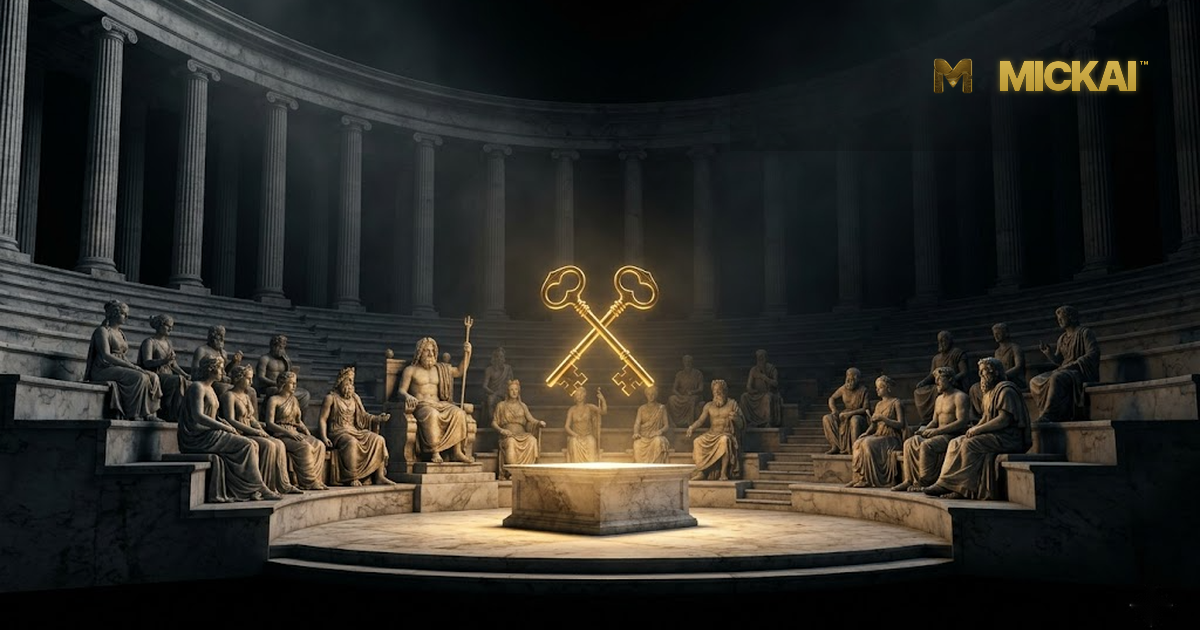
The model that cannot vote on itself
Picture a decision moving through a sovereign intelligence at three in the morning, with no human awake to watch it. A model proposes to release funds from a treasury, or to retire a validator, or to alter a fee parameter that touches every chain beneath it. Who said yes? On what authority? Under what reasoning? Most systems answer with a shrug and a log file that anyone with write access can edit. Pantheon answers with two keys, turned in sequence, neither sufficient alone, both sealed forever. The first key is the will of the people who hold the token. The second key is the conscience of the machine, made provable. This is what it means to govern a model on-chain without trusting any single point: direction by referendum, execution by attested policy, and a permanent record that no one, not the founder, not a validator, not a future quantum adversary, can quietly rewrite.
Why one key was never enough
Conventional blockchain governance gives holders a single lever. They vote, a proposal passes, and code executes. That model works when the only thing being governed is a number in a contract. It breaks the moment the thing being governed is an artificial intelligence that acts in the world. A referendum can decide that the protocol should, for example, pursue a treasury-funded buyback. It cannot, by itself, guarantee that the specific action taken at the moment of execution stayed inside the boundaries the community set. A majority can authorise a direction and still produce an action that drifts outside policy, because the gap between intent and execution is exactly where autonomous systems go wrong. Pantheon treats that gap as the central governance problem rather than an afterthought. Direction and execution are different questions, so they are answered by different keys. Collapsing them into one vote is how you end up with a chain that recorded what happened but could never prove it should have.
The deeper issue is trust topology. A single governance key, however decentralised the voting, still funnels through one decision surface. Whoever controls the execution path after the vote becomes a single point of trust. Pantheon's design refuses to let the holder vote and the execution gate be the same mechanism, because a model that can both decide its own direction and certify its own compliance is a model that cannot be checked. The two keys are deliberately held by different constituencies with different incentives: the token-holding community on one side, an independent quorum of sovereign models on the other.
The first key: PAN-holder referenda set direction
The first key is ordinary in the best sense. Holders of PAN, the native and only token of the Pantheon Layer 1, vote in on-chain referenda. PAN has a fixed supply of 5,000,000,000 (five billion) units, with no inflation and no mint authority, so voting weight is measured against a supply that cannot be quietly expanded beneath the electorate. Holders decide direction: treasury allocations, fee parameters, the buyback share split, validator-set targets, which application chains are admitted, how the rewards engine is tuned. This runs on the nominated proof of stake (NPoS) machinery of the Polkadot software development kit (SDK), built on Substrate, the same audited governance and staking modules that secure live networks, rather than a bespoke voting contract written from scratch. Pantheon is a standalone sovereign proof of stake (PoS) chain with BABE and Aura block production and GRANDPA finality, so referenda settle with the same finality as any other state transition.
What the first key explicitly does not do is execute privileged actions directly. A passed referendum is an instruction, not a fait accompli. It sets the policy envelope: here is the direction the community has authorised. The community is sovereign over what the protocol should pursue and what its parameters are. It is not asked to manually verify that every downstream action is compliant, because human voters cannot audit a model's reasoning at machine speed and should not be asked to. The first key answers the question of legitimacy. The second key answers the question of conformance. Keeping those separate is what lets the community govern at the level of intent while the chain enforces at the level of action.
The second key: a quorum of sovereign models must return ALLOW
Beneath the referenda sits an execution-safety layer inherited directly from the Sovereign Intelligence Operating System (SIOS) that Pantheon is built on. Before any gated action executes, a quorum of independent sovereign models must each return ALLOW. These are not a single model rubber-stamping itself. They are distinct models, drawn from the SIOS brain set, each evaluating the proposed action against the policy envelope the community set with the first key. If the quorum does not reach ALLOW, the action does not execute. A model cannot wave through its own behaviour, because the models that gate it are not the model that proposed it.
This is the mechanism that makes execution provably policy-bound rather than merely intended to be. The first key established what is permitted. The second key checks, at the moment of action and across multiple independent evaluators, that the specific thing about to happen falls inside that permission. Every vote in that quorum is sealed. So the chain does not only record that an action executed. It records which models evaluated it, what each returned, and against which policy, in a form anyone can verify later without trusting Pantheon's word for it. Cross-model agreement turns the soft promise of alignment into a hard precondition of execution. The action is gated, not by a guardrail a developer hopes holds, but by a quorum whose verdict is itself a consensus object.
Sealing both turns: the Open Audit Record
Two keys would be theatre if the record of turning them could be forged. This is where Pantheon's foundation does the load-bearing work. Every governance action, every referendum outcome, every model vote in the execution quorum, every parameter change, is sealed into the Open Audit Record (OAR): an append-only, hash-chained ledger where each entry is signed under ML-DSA-65, the digital signature standard specified in Federal Information Processing Standard (FIPS) 204, the United States National Institute of Standards and Technology (NIST) post-quantum standard. On Pantheon the OAR is not contract storage bolted onto an existing chain. It is a native runtime module (pallet-oar), which means seals are first-class objects of the chain's own consensus. The chain validates operator-sealed post-quantum records before it orders them. We call this seal-before-own-consensus, and it is what lets governance history claim a property almost no other chain can: it is verifiable offline, forever, by anyone holding only the operator public key.
The post-quantum choice is not decoration. Classical signatures, the kind every major Layer 1 and every nearest competitor uses to sign their attestations, are breakable by sufficiently capable future quantum hardware. A governance record signed classically is a record whose authenticity has an expiry date no one can name. A governance record signed under FIPS 204 ML-DSA-65 is built to outlast that horizon. When a community is governing an autonomous model, the audit trail of who authorised what is precisely the artefact you most need to survive intact for decades. Sealing it under a post-quantum signature from genesis is the difference between a record and a promise.
“Reversal on Pantheon is never deletion. A mistaken or revoked action is corrected by an append-only compensation that leaves the original sealed entry in place. The history of a governed model is not editable, only extendable.”
No single point of trust, by construction
Walk the attack surface and the point of the two keys becomes concrete. Suppose a malicious majority captures the first key and votes through a hostile direction. The execution quorum still evaluates each resulting action against the standing policy envelope and seals its verdict, so the abuse is gated where it crosses policy and is recorded in full where it does not. Suppose instead an adversary tries to corrupt the second key by compromising a model. The quorum requires multiple independent models to return ALLOW, so one compromised evaluator does not carry the decision, and every vote is sealed for later scrutiny. Suppose the founder wished to act unilaterally. Pantheon is held privately by Micky Irons, yet the founder holds no key that bypasses either gate, and any action taken still seals into the OAR under the same post-quantum signature as everyone else's. There is no administrative override that escapes the record.
- Capture the vote, and the execution quorum still gates and seals each action against standing policy.
- Corrupt one model, and the quorum's ALLOW requirement and sealed verdicts contain the damage.
- Hold the founder's position, and you still hold no key that escapes the Open Audit Record.
- Wait for quantum hardware, and the FIPS 204 ML-DSA-65 seals are built to outlast it.
The governance is therefore not decentralised in the thin sense of token distribution alone. It is decentralised in trust topology: legitimacy lives with the holders, conformance lives with an independent model quorum, and the record of both lives in a ledger that no party can edit and no future computer is expected to forge. Remove any one of the three and the other two still constrain the system. That is what it means to remove the single point of trust rather than relocate it. The same posture extends to who may run the chain. Validators arrive in three open tiers: software operators who download the single node binary and stake PAN on commodity hardware, delegators who nominate validators through NPoS without running infrastructure, and Mickai hardware appliances that plug in as premium validators. Hardware is a path, never a gate, so the active set stays open to ordinary operators and the chain remains credibly decentralised.
Compliance as a continuous, signed artefact
Two-keyed governance produces a by-product that regulators have wanted from automated systems for years and rarely get: continuous, signed evidence of conformance. Because every direction and every execution verdict is sealed, the OAR compliance mapper can generate signed evidence against the European Union Artificial Intelligence Act (EU AI Act), the NIST Artificial Intelligence Risk Management Framework (AI RMF), and ISO 42001, the management-system standard for artificial intelligence. The chain's own regulatory posture becomes something you can audit on demand rather than attest to in a slide. When a supervisory authority asks how a given on-chain action was authorised and whether it stayed inside policy, the answer is not a narrative. It is a verifiable chain of sealed records: the referendum that set the envelope, the model votes that gated the action, the post-quantum signature on each. No incumbent Layer 1 offers this, and the nearest attestation peers root their trust in vendor silicon or classical signatures, not in a sovereign chain mapping its own governance to ISO 42001.
Why this is the architecture worth funding
The status quo asks you to trust two things on faith: that the people who govern an artificial intelligence will not abuse the lever, and that the model executing their will stayed inside the lines. Pantheon replaces both articles of faith with mechanism. The first key gives a token-holding community real, finality-backed authority over direction through the audited NPoS governance of the Polkadot SDK. The second key gives that direction teeth, an independent quorum of sovereign models that must return ALLOW before a gated action runs, every verdict sealed. The Open Audit Record makes the turning of both keys permanent, post-quantum, and offline-verifiable, so the history of a governed model is something you can check rather than something you are asked to believe. Pantheon is designed and filed: its execution-safety layer is inherited from a running SIOS, its bridge mechanisms are covered within a portfolio of 104 filed UK patent applications carrying 2,340 claims and owned by Mickai LTD, named inventor Micky Irons. The Ethereum Virtual Machine contracts are built and smoke-tested on a local testnet, the Substrate Layer 1 is in build, and mainnet is gated by an independent security audit and legal clearance rather than by code, with a token generation event (TGE) targeted for the first quarter of 2027. Governing a model on-chain is not, in the end, about controlling a machine. It is about being able to prove, to a sceptic, to a regulator, to a future you cannot foresee, exactly how the machine was controlled. Two keys, sealed forever, are how you prove it.