


Tokenising Verifiable Compute: Paying for Artificial Intelligence You Can Prove Ran
On Pantheon, settling a sealed action in PAN turns proven, correct execution into a metered, payable primitive, where the proof itself is the receipt.
The Receipt Is the Reasoning
A machine in a warehouse outside Frankfurt rebalances a portfolio at 03:14, moves capital across four venues, and books the trade before any human is awake. By morning the question is not whether the transaction happened. The ledger shows that plainly. The question is the one no public blockchain can answer: which model decided, under whose authority, against what evidence, and was the decision permitted at the moment it executed. Conventional chains record the effect and lose the cause. Pantheon is built to keep both, and to make keeping both something you pay for in the same act that proves it. When a sealed action settles in PAN, the native asset of the Pantheon Layer 1 blockchain, the proof of correct execution and the payment for it become one object. The receipt is the reasoning.
This is the wager behind tokenising verifiable compute. Artificial intelligence is already metered: tokens in, tokens out, a price per million. What has never been metered is the property that actually matters when an autonomous system acts on consequence, namely that it ran correctly, within authority, and can prove so afterwards to anyone, offline, forever. Pantheon turns that property into a payable primitive. Run a sealed action, settle it in PAN, and the artefact you are left with is not a log entry that a vendor could later edit. It is a post-quantum signed record that is itself the basis of the bill.
What a Sealed Action Actually Is
Begin with the unit, because the economics follow from its shape. Every action taken inside the Mickai Sovereign Intelligence Operating System (SIOS), the fifty-brain substrate Pantheon settles to, is written into the Open Audit Record (OAR). The OAR is an append-only, hash-chained ledger. Each entry is signed under ML-DSA-65, the Module-Lattice Digital Signature Algorithm standardised as Federal Information Processing Standard 204 (FIPS 204), the National Institute of Standards and Technology (NIST) post-quantum signature standard. A holder of only the operator public key can verify any entry offline, with no network, no enclave, and no trust in the vendor who produced it. The signature does not assert that an outcome was good. It asserts that this exact action, with this exact reasoning trace and this exact authorisation, occurred and has not been altered since.
On Pantheon, that record is not contract storage bolted onto a general-purpose chain. The OAR lives in a native runtime module, pallet-oar, built on the Polkadot Software Development Kit (Substrate) in Rust. Seals are first-class objects of consensus. The validator set orders operator-sealed, post-quantum records as part of block production itself, a property worth naming precisely: seal-before-own-consensus. The chain does not merely store a proof somebody computed elsewhere. It validates the seal, then reaches agreement over it using the framework's audited machinery, BABE and Aura for block production, GRANDPA for finality. A sealed action is therefore a thing the network agrees about at the protocol layer, not a string a smart contract happened to keep.
That distinction is what makes the action billable in a meaningful sense. A log you can dispute is not a receipt. A seal the consensus layer has already validated, signed under a standard designed to survive quantum hardware, is a receipt that does not depend on the goodwill of the party being billed.
Hephaestus at the Forge: Work That Carries Its Own Proof
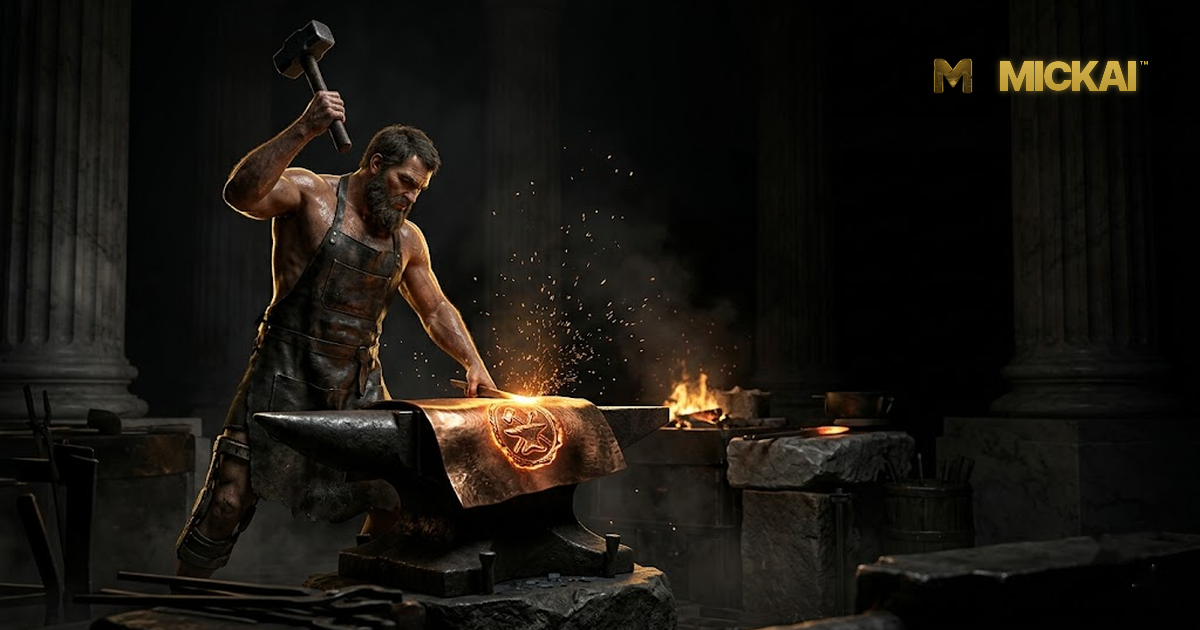
There is an old image worth borrowing. Hephaestus, lamed and exiled to his forge, built automata of bronze and gold that walked, worked, and bore the maker's mark in the metal itself. The mark was not a label applied afterwards. It was struck into the same heat that gave the thing its shape, inseparable from the work. Provenance and product came out of one fire.
Verifiable compute aims at the same inseparability. The dominant pattern in the wider market is to do the work first and attest to it later, in a different system, under a different trust model. The competitors nearest to this problem, EQTY Lab among them as the closest and most serious peer, root their attestation in vendor silicon, the hardware trusted execution environments of Intel or NVIDIA, sign with classical cryptography, and anchor to Hedera or to a chain of their own. The proof is real, but it is a second artefact made after the fact, and it inherits the lifespan of classical signatures, which is to say it is breakable by future quantum hardware. The mark is stamped on afterwards.
Pantheon strikes the mark in the same heat. The seal is produced as the action runs, in software, on commodity hardware, under FIPS 204 ML-DSA-65, and the chain's own consensus is the forge that fixes it. When the action settles in PAN, payment closes over a record whose proof was never separable from the work. You are not paying for a computation and then, optionally, for a certificate about it. You are paying for the certified computation, because under this design there is no uncertified version of it to buy.
The Loop: Run, Settle, Prove
Now the economics. Pantheon runs a base Layer 1 and fifteen application chains, each mapped to a live Mickai subsystem: trading and decentralised finance (DeFi), Trust Agent audit, knowledge and retrieval, PENELOPE open-source intelligence, VIGIL sky monitoring, civilisation and survival, the Vinis assistant, the marketplace, governance, health under HYGEIA, legal under THEMIS, compliance, identity, the autonomous machine layer, and hardware under HELIOS. Each application chain settles its sealed actions to the base layer, and each settlement is denominated in PAN. The loop is deliberately short. A subsystem runs an action. The action is sealed into the OAR. The seal settles to the base layer in PAN. The proof that the action ran correctly, and the fee that paid for settling it, are the same on-chain event.
The consequence is an economy whose throughput is tied to attested usage rather than to speculation about future usage. The more the fifteen subsystems do real work, the more sealed actions flow down to the base layer, and the more settlement accrues in PAN. This is not a network that mints a reward to manufacture the appearance of activity. PAN has a fixed supply of five billion tokens (5,000,000,000), no inflation, and no mint authority. Nothing about running the chain dilutes the holder. The link between work and value runs the other way: work is what produces the settlement, and settlement is what the token meters.
Consider the shape of a single metered action end to end:
- A subsystem, say the trading chain, executes a decision and writes it to the Open Audit Record, signed under ML-DSA-65.
- Pantheon's consensus validates the operator seal before ordering it, the seal-before-own-consensus property.
- The action settles to the base layer, with the fee paid in PAN and a base-fee portion burned in the manner of Ethereum's EIP-1559 (Ethereum Improvement Proposal 1559).
- The sealed record carries an external witness: periodically a Merkle commitment of the chain's OAR root is anchored to Bitcoin via OpenTimestamps, a free public timestamp proof, with Bitcoin used only as a witness and never as a dependency for execution.
- Anyone holding the operator public key can later verify, offline, that this exact action ran, under that authority, with that reasoning, and was paid for. The proof is the receipt.
Where the Yield Comes From, and Where It Does Not
A metered economy needs a way to reward the validators who secure it without poisoning the asset they secure. Most proof-of-stake (PoS) networks pay validators with freshly minted tokens, which means the security budget is funded by quietly taxing every holder through inflation. Pantheon refuses that trade. There are no emission-based staking rewards and no inflation sell pressure, because there is no emission and no inflation to begin with. The yield is funded by revenue buybacks. A governed share of protocol revenue, the settlement fees the loop above generates, buys PAN on the open market. That repurchased PAN is split, indicatively and tunable by governance, roughly forty per cent to staker and validator yield, thirty per cent to permanent burn, and thirty per cent to a governance-controlled lock.
Read that against the base-fee burn and the picture sharpens. Network usage already shrinks supply through the EIP-1559-style burn on every transaction. Buybacks then route real revenue back into yield, burn, and lock, every one of those operations sealed into the OAR and verifiable on-chain. So the reward paid to a validator is not a dilution of the holder beside them. It is a redistribution of revenue the network actually earned by sealing and settling real work. Yield is downstream of attested compute, which is exactly the property we set out to tokenise. The harder the fifty brains run, the more revenue settles, the more PAN is bought back, and the more is burned and locked. Usage and scarcity move together.
This is the substantive break from the emission-pool model that defines most token economies. There, rewards are a promise the protocol prints against the future. Here, rewards are a receipt for the past, paid out of money that has already been earned and sealed. The token does not inflate to pretend the network is busy. The network is busy, the busyness is proven, and the proof is what funds the yield.
Open Participation Under Sealed Governance
Tokenising verifiable compute only holds if the set of machines doing the verifying stays open. A proof system whose validators are a closed club proves less than it claims, because the operator and the auditor have collapsed into one party. Pantheon keeps three open tiers of participation. Software validators download a single node binary, run it on commodity hardware, and bond PAN. Delegators nominate validators through nominated proof-of-stake (NPoS) without running any infrastructure and share in the rewards. Mickai hardware appliances, premium plug-in validators from the Mickai hardware lineup, ship twelve months after funding and offer a turnkey path. The hardware is a premium option and never a gate. The set remains open to any software operator on ordinary hardware, with a target active set of fifty to one hundred and fifty validators, so the chain is credibly decentralised rather than nominally so.
Above the validators sits a two-keyed governance design carried over from the SIOS. PAN holders decide direction through on-chain referenda: parameters, treasury, the buyback policy itself. Beneath that political layer runs a sealed execution-safety layer. Before a gated action executes, a quorum of independent sovereign models must each return ALLOW, every vote sealed to the OAR, every reversal expressed as an append-only compensation that never deletes history. The result is governance you can prove was followed, not merely governance you were told was followed. When the buyback split is changed, the change is a sealed action. When a gated parameter moves, the quorum that permitted it is on the record. The economy that meters verifiable compute is itself metered the same way.
“Public blockchains can prove a transaction happened. They cannot prove what produced it. Pantheon seals the cause before consensus orders the effect, so the payment and the proof are the same artefact.”
The Posture, the Wedge, and the Honest Status
There is a reason this stack has no exact precedent, and it is worth stating plainly rather than triumphally. The compliance posture is part of the product: the OAR compliance mapper generates signed evidence against the European Union Artificial Intelligence Act (EU AI Act), the NIST Artificial Intelligence Risk Management Framework (AI RMF), and ISO 42001, so the chain's regulatory standing is continuously auditable rather than asserted in a slide deck. The competitive wedge is narrow and specific. The serious peers in this field root trust in vendor silicon, sign classically, and anchor to their own chains or to Hedera. None seals in software under post-quantum signatures on commodity hardware, none runs its own consensus over operator-sealed records, none anchors to Bitcoin as a free external witness, none maps to ISO 42001, none ships earning validator appliances, and none couples its tokenomics to attested usage the way the revenue-buyback loop does. That precise combination is the opening, and PAN is the instrument that prices it.
Be exact about where this stands today. Pantheon is designed. The omnichain Ethereum Virtual Machine (EVM) contracts, where PAN also exists as a LayerZero Omnichain Fungible Token (OFT) class lock-and-mint asset across Ethereum, BNB Chain, Base, and Arbitrum so one fixed supply of five billion spans every venue, are built and smoke-tested on a local testnet. The Substrate Layer 1 is in build. The bridge mechanisms are covered by filed UK patent applications within the Pantheon bridge family, part of a portfolio of 104 filed UK patent applications and 2,340 claims owned by Mickai LTD, named inventor Micky Irons. The raise is thirty million pounds under Ladder B, roughly twenty-four per cent of supply, sold via simple agreements for future tokens (SAFTs) to professional investors only, marketed in the European Union through the Markets in Crypto-Assets (MiCA) utility-token notification route, with no United Kingdom retail promotion. The token generation event (TGE) is targeted for the first quarter of 2027. Mainnet is gated by an independent security audit and by legal and securities clearance, not by code.
What changes, if this loop closes as designed, is the unit of account for autonomous systems. Today you pay for compute and hope the logs hold. Pantheon is built so that you pay for proven compute and the proof is the thing you bought. Hephaestus struck his mark in the same heat that made the work, and the two could not be prised apart. A sealed action settled in PAN is the modern version of that mark: artificial intelligence you can prove ran, metered and paid in one act, signed under a standard meant to outlast the machines that might one day try to forge it. The receipt is the reasoning, and the reasoning is what you paid for.