The total cost of the SaaS stack for a 200-person firm
A conservative worked example of the annual SaaS bill for a 200-person firm across mail, meetings, chat, CRM, docs and AI, then the owned-OS picture.
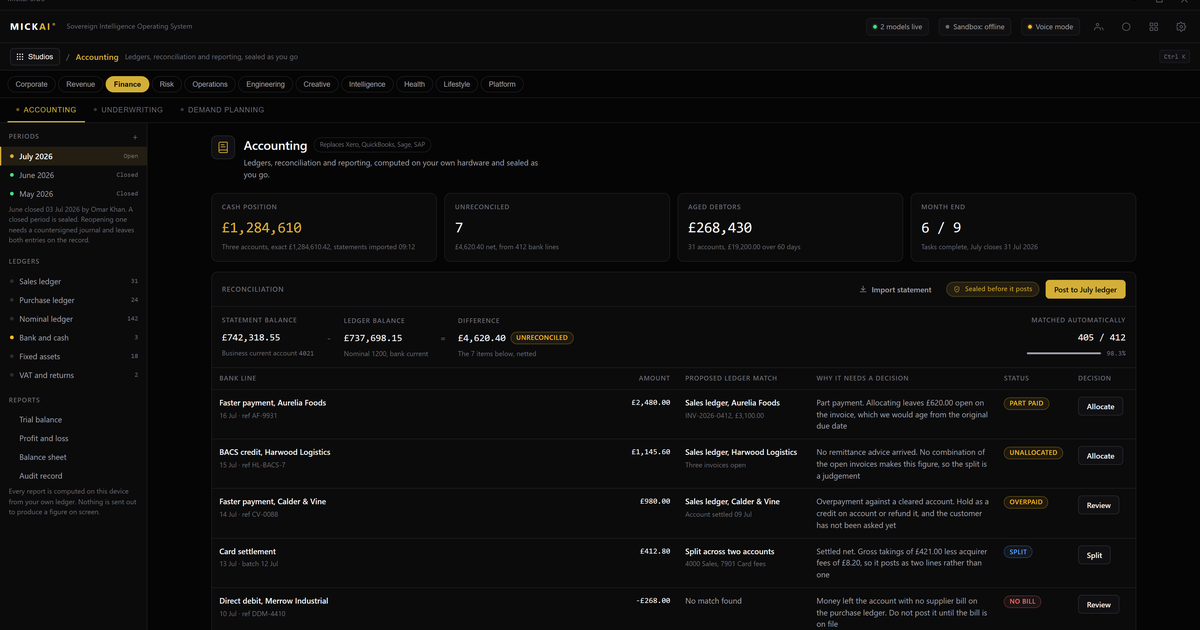
A 200-person firm running the ordinary business stack pays for six recurring subscriptions at once: mail, meetings, chat, CRM, documents and an AI add-on. Built from published list prices, with one seat per person, the annual bill runs comfortably into six figures and rises with every hire. Owning the same functions as studios on one operating system, on hardware you already control, turns that recurring rent into a fixed asset you keep.
This is a worked example. The prices below are the vendors' own published list figures, quoted per user per month, treated as reported public facts. We convert to an annual number the simple way: users times price times twelve. Where a current price is uncertain, we say so and give the method rather than a false figure. We state no MICKAI price. The purpose is to show you how to build the number for your own firm and then to show the shape of the alternative.
The assumptions, stated plainly
Every figure that follows rests on assumptions, so here they are before the maths.
We assume 200 people, and we assume every one of them holds a seat on every platform. That is the most conservative starting point, because in reality not everyone needs a CRM licence or an AI copilot. If only half your staff touch the CRM, halve that line. We keep it simple and count 200 everywhere.
We assume mid-tier business plans, not the cheapest starter tiers and not negotiated enterprise agreements. A 200-seat firm sits in the band where most buyers pay close to list, above the small-team discounts and below the large enterprise deals where a procurement team drives the number down.
We assume list price with no discount applied. Real invoices carry annual-commitment reductions and volume adjustments, so read the totals as an upper-bound built from public numbers, then apply whatever discount your own contract carries.
We assume the prices hold for a full year. They do not, in practice. Published SaaS prices move upward, and per-seat AI has been the fastest-climbing line of all. That direction of travel is the point of the exercise.
We assume one currency band and ignore tax, which varies by territory and buyer. Add your own VAT or sales tax on top.
Building the six lines
Take each platform in turn. The method is identical every time: find the vendor's published per-user, per-month price for the plan a 200-person firm would sensibly buy, multiply by 200, multiply by 12.
Mail and the productivity suite. The dominant office suites publish business tiers in the region of ten to twenty-two per user per month depending on whether you take the mid or upper business plan. Take a mid figure of fifteen. Fifteen times 200 times 12 is 36,000 a year for the productivity and mail layer alone.
Meetings. Video conferencing at a business tier publishes in the region of thirteen to twenty per user per month. Where meetings are bundled into the office suite you may not pay this separately, but many firms run a standalone meetings product on top. Take fifteen. Fifteen times 200 times 12 is 36,000 a year.
Chat. Team messaging at a standard business tier publishes in the region of eight to twelve-and-a-half per user per month. Take ten. Ten times 200 times 12 is 24,000 a year.
CRM. This is where the bill jumps. Mainstream sales-CRM professional and enterprise tiers publish anywhere from twenty-five to eighty per user per month and beyond, and the tiers a growing sales team actually needs sit at the higher end. Take a deliberately conservative fifty, and assume all 200 hold a seat. Fifty times 200 times 12 is 120,000 a year. If only 80 of your people use the CRM, that line is 48,000 instead. State which it is for your firm.
Documents and storage. Where document collaboration and storage is not already inside the office suite, a standalone plan publishes in the region of ten to eighteen per user per month. Take twelve. Twelve times 200 times 12 is 28,800 a year. Firms fully standardised on one office suite may fold this into the mail line, so treat it as optional and remove it if it double-counts.
The AI add-on. The per-seat AI copilots that bolt onto the suite, the CRM and the meetings tool publish in the region of twenty to thirty per user per month each. A single suite-wide copilot at thirty for all 200 is thirty times 200 times 12, or 72,000 a year. Firms that add a copilot to the CRM as well, and another to the meetings tool, multiply this line rather than share it.
The conservative total
Add the six lines at the conservative mid figures above.
- Mail and suite: 36,000
- Meetings: 36,000
- Chat: 24,000
- CRM: 120,000
- Documents: 28,800
- AI add-on: 72,000
That is 316,800 a year, on published list prices, for a 200-person firm, before tax and before a single implementation, integration or admin cost is counted. It is a conservative figure. Trim the CRM to the people who use it and drop the document line as a duplicate and you fall toward 200,000. Take the upper published tiers, add a second and third AI copilot, and you climb well past 400,000. The band is the message: a mid-sized firm rents its own working tools for a sum in the low hundreds of thousands every year, and the number grows automatically with headcount and with every published price rise.
None of that spend builds anything you own. At the end of the year you have paid the rent and you own nothing. Cancel, and the tools stop and the data becomes a migration problem.
The owned-OS picture
Now the alternative. Instead of six subscriptions from five vendors, the same six functions run as studios on one sovereign operating system, on hardware your firm owns.
Our email system, our meetings platform, our chat, our CRM and our document tools are not five products you stitch together. They are studios on the MICKAI operating system, sharing one data layer. A customer is one record the CRM and the mail system both see. A meeting, a message and a document about that customer sit against the same record. There is no per-seat licence on any of them, because you are not renting a seat from a vendor. You are running software on machines you own.
The intelligence layer is part of the operating system, not a copilot sold per head on top of each app. One assistant works across every studio, on your own data, inside your own building. It drafts the reply, prepares the meeting, updates the CRM record and pulls the document, and it does so as one capability spanning the stack rather than as three separate AI subscriptions you pay for three times.
The costs do not vanish; they change shape. You buy hardware once and own it. You pay for power and for the people who run the platform. Those are your capital and operating costs on your own assets, and they do not scale as a fixed rent per employee. Adding your two-hundred-and-first hire does not add another six subscription lines. The recurring per-seat bill, the line that grows every year on its own, is gone.
Why the shape matters more than the number
The headline saving is real, but the structural change is the larger prize. Your working data stops living in five vendors' clouds and comes home to hardware you own, where the platform can run air-gapped by default. Every action across the studios is written to an action-level Open Audit Record, so who did what to which record is answerable in one place rather than scattered across five separate audit logs you do not control.
Private deployment of the incumbents is the baseline we measure against, not the finish line. Our value sits beyond it: the whole software stack rather than a single model you integrate, air-gapped operation as the default, the action-level audit record, and a focus on the regulated small and mid-sized firm that has to prove where its data is and who touched it. For that firm, the annual SaaS bill is not just a cost. It is a standing dependency on other companies' clouds, priced per head, rising every year. Owning the stack ends the dependency and the rent in the same move.
Run the six-line method above against your own headcount and your own plan mix. Whatever total it produces, ask the harder question underneath it: for that money, every year, forever, what do you own at the end?
Frequently asked questions
Where do the per-user prices come from?
From the vendors' own published list pages, quoted per user per month. We use widely reported mid-tier business plans and convert to annual with users times price times 12. Published prices change, so treat the totals as a method to run against today's numbers rather than a fixed quote.
Why 200 people?
It is a round, mid-sized figure that sits above the small-team plans and below the enterprise-agreement band, where most firms pay close to list. We assume every one of the 200 holds a seat on every platform, which is the simplest and most conservative starting point.
Does the owned model really remove the whole bill?
It removes the per-seat subscription. You still pay for hardware you own, power and the people who run it. The point is that those are your costs on your assets, not a recurring rent per head that rises every time you hire and every time a vendor lifts its price.
Is this just private hosting of the same tools?
No. Private deployment is the baseline we start from. Our value is beyond it: an action-level Open Audit Record, air-gapped by default, the whole software stack rather than a model you integrate, and a focus on the regulated small and mid-sized firm.
What about the AI add-on specifically?
The per-seat AI copilots are the fastest-rising line in most stacks. In the owned model the intelligence layer is part of the operating system and works across every studio on your own data, so it is not a separate charge per head bolted onto each app.
What are the numbers in this article, then?
A worked method, not a proposal. We show how to build the annual figure from published list prices and stated assumptions. We state no MICKAI price here. Pricing is handled in a briefing against your real headcount and plan mix.