The software you run on, not a model you integrate
Most vendors sell a model and a platform to wire in. We give you the whole software stack your company runs on, on hardware you own.
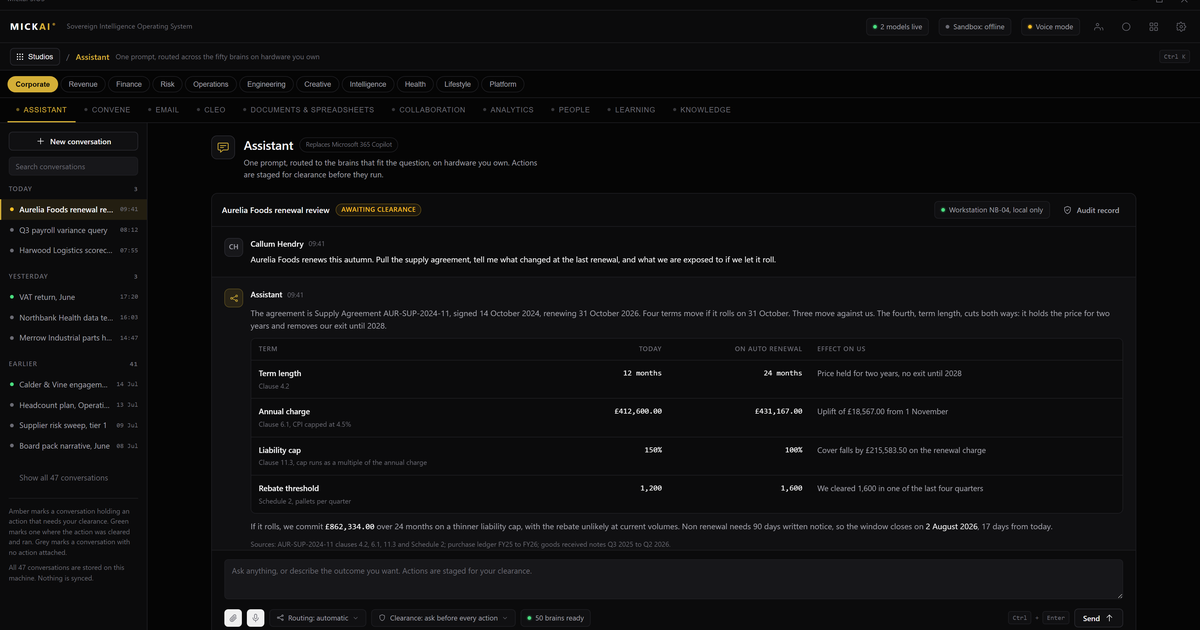
The clearest way to describe what we sell is by what we do not sell. We do not sell a model you integrate. We give a company the whole software stack it runs on: email, meetings, a CRM, a help desk, accounting and more, as studios on one operating system, with a single assistant across all of it, on hardware the company owns. It is working software from day one, not a component you spend months wiring into everything else.
The industry sells you a part; we give you the whole
The common shape of an enterprise AI offer is a model plus a platform to integrate it. You buy the intelligence, then you spend the next year connecting it to your email, your documents, your CRM, your ticketing system and your data warehouse, each of which is itself a separate vendor you already rent. The model is real and often good. But it arrives as one part in a landscape you still have to assemble and maintain, and every connection is another integration to license, secure and keep from breaking.
We start from the other end. The company does not run on a model. It runs on software: the mailbox people live in, the meetings they hold, the records they update, the invoices they raise, the tickets they close. So that is what we give them. The studios that do that work are the product, and the reasoning layer is built into them rather than sold as a thing to bolt on. You are not handed intelligence and told to find something for it to do. You are handed the software your company runs on, already intelligent, already joined up.
Studios on one operating system, sharing your data
Every studio is part of the MICKAI sovereign operating system, not a separate app. That word matters. Separate apps keep separate copies of your data and talk to each other through connectors that you buy, configure and pray hold together. Studios on one operating system read and write the same store.
So the email system, the meetings and collaboration platform, the CRM, the help desk and the accounting studio are not five products you integrate. They are five studios on one foundation, working from one set of records. A customer reply lands already attached to the right CRM record. A meeting's notes and actions sit against the same account. An invoice knows the deal it came from. Nothing is synced across a gap, because there is no gap. This is the difference between taking a whole software stack and taking a model you have to integrate into a stack you assembled yourself.
There are 63 studios on the operating system today. The number is not the point, and no company turns on all of them at once. The point is that they are one system. When you add a studio you are not adding another vendor to reconcile. You are lighting another room in a building that already shares its foundations, its data and its assistant.
One assistant across everything, running on your hardware
Because the studios sit on one operating system, one assistant works across all of them. Ask it what is happening with an account and it answers from the emails, the meetings and the CRM record together. Ask it to prepare for tomorrow and it reads your calendar, the open tickets and the relevant deals at once. It drafts the follow-up, updates the stage, sets the task, because it can see the whole picture, not one app's slice of it.
That assistant runs on hardware you own, air-gapped by default. The reasoning layer that drives it is local. We describe it by what it does for the studios, and we do not put the intelligence in someone else's cloud to do it. This is the practical benefit of owning the stack rather than renting a model: the assistant can be genuinely useful precisely because the whole picture is in one place that you control, and none of it has to leave your building for the intelligence to work.
Private deployment of a single model is now the baseline that serious buyers expect, and we take that as given. Our value sits beyond it. The whole software stack on your own kit, air-gapped, with every action written to an audit record you hold, is a larger claim than a model that happens to run in your tenant.
What you stop renting
Most companies run on a stack of rented tools: an email and documents suite, a chat and collaboration tool, a CRM, a help desk, a meetings platform, and connectors between them. Each is sold per user per month and billed every year, without end. The studios on our operating system do the jobs those tools do, on hardware you own.
We do not publish MICKAI pricing, so the honest way to see the difference is to model the rental you already pay. The method is simple and you can run it on your own numbers. Take your user count. For each incumbent tool, multiply your seats by the vendor's published list price per user per month, then by twelve, for one year. Add the tools together. Then add the connectors and extra clouds you buy to make the standalone tools talk to each other.
A worked example on a stated assumption. Take a 100 person firm. Suppose the productivity and email suite lists at a published tier of 20 pounds per user per month: that is 100 times 20 times 12, which is 24,000 pounds a year. Suppose the collaboration tool lists at 12 pounds per user per month: 100 times 12 times 12, which is 14,400 pounds a year. Suppose the CRM lists at 80 pounds per user per month for the 30 seats that need it: 30 times 80 times 12, which is 28,800 pounds a year. Those three alone come to 67,200 pounds a year, before the help desk, the meetings add-ons and the connectors. These are illustrative figures on a stated assumption, not quotes; put in your real seat counts and the current published prices and the sum is your own.
Now hold that recurring total, which repeats every year and rises with headcount and with each vendor's price changes, against the shape of what we offer: one software stack running on hardware your company owns, as studios on a single operating system rather than a shelf of separate perpetual subscriptions. We are not going to print our price. We are asking you to measure the rental you pay for the parts, then measure it against owning the whole.
Built for the regulated small and mid-sized firm
The largest vendors are built for the largest buyers. The regulated small and mid-sized firm, the practice, the broker, the clinic, the manufacturer with a compliance duty, usually gets the same multi-tenant clouds with none of the leverage and all of the exposure, then is asked to integrate a model on top. When a regulator or a client asks where the data sits and who can see it, an answer that spans five vendor clouds in regions you do not control is a weak one.
Owning the stack gives that firm a straight answer. The email, the records, the tickets and the invoices are here, on our hardware, in our building, on one operating system. Every action across every studio is written to the Open Audit Record at the action level, so we can show who viewed, edited or exported anything. It runs air-gapped, so an outside connection is not a condition of using your own software. To be plain about what we do not claim: we hold no SOC 2, ISO or Cyber Essentials certification. What we give you is architectural control and a full action level audit trail on kit you own, which is what most of these questions are really asking about.
The estate behind the product
The software stands on its own, and the work behind it is filed as intellectual property: 104 UK patent applications with 2,340 claims, filed rather than granted. We reach firms in regulated sectors through a distribution partner, and we keep that partner and every client confidential. None of that changes the offer. The offer is the software your company runs on, whole, on hardware you own, with the assistant across all of it, working from day one.
Frequently asked questions
What is the difference between buying a model and buying the software you run on? A model is one component you still have to wire into email, a CRM, a help desk and the rest, each its own vendor and subscription. We give you the whole stack: email, meetings, CRM, help desk, accounting and more as studios on one operating system, with the assistant already across all of it, running on hardware you own.
Do we still need Microsoft, Google, Slack and Salesforce alongside this? No. Those are the tools our studios replace. The email system, the meetings platform, the CRM and the collaboration studio are on the operating system, sharing your data, so you are not renting the incumbents and wiring a model in beside them.
Is this working software or something we integrate over months? It is working software from day one. Clients onboard onto a focused initial set of studios rather than all 87 at once, but each studio is built and runs. There is no model to fine-tune before you get value.
Where does the intelligence run? On your own hardware, air-gapped by default. The reasoning layer drives every studio locally, so it can read across your email, your CRM and your meetings without any of it leaving your building.
How does the cost compare to the tools we rent now? The incumbents publish a per user per month price that recurs forever, per tool. We do not publish MICKAI pricing. The honest comparison is the sum of those recurring rentals, plus the connectors between them, against owning one stack on your own kit.
What proof do we have of what happened inside the software? Every action is written to the Open Audit Record on your hardware, at the action level, across all the studios. You can show who viewed, edited or exported anything, without asking a vendor.
Frequently asked questions
What is the difference between buying a model and buying the software you run on?
A model is one component you still have to wire into email, a CRM, a help desk and the rest, each its own vendor and subscription. We give you the whole stack: email, meetings, CRM, help desk, accounting and more as studios on one operating system, with the assistant already across all of it, running on hardware you own.
Do we still need Microsoft, Google, Slack and Salesforce alongside this?
No. Those are the tools our studios replace. The email system, the meetings platform, the CRM and the collaboration studio are on the operating system, sharing your data, so you are not renting the incumbents and wiring a model in beside them.
Is this working software or something we integrate over months?
It is working software from day one. Clients onboard onto a focused initial set of studios rather than all 87 at once, but each studio is built and runs. There is no model to fine-tune before you get value.
Where does the intelligence run?
On your own hardware, air-gapped by default. The reasoning layer drives every studio locally, so it can read across your email, your CRM and your meetings without any of it leaving your building.
How does the cost compare to the tools we rent now?
The incumbents publish a per user per month price that recurs forever, per tool. We do not publish MICKAI pricing. The honest comparison is the sum of those recurring rentals, plus the connectors between them, against owning one stack on your own kit.
What proof do we have of what happened inside the software?
Every action is written to the Open Audit Record on your hardware, at the action level, across all the studios. You can show who viewed, edited or exported anything, without asking a vendor.