The Mickai Commitment
A founder's pledge, made in public and dated. When Mickai reaches revenue, a fixed share of its profits will endow a foundation to rebuild the communities the last twenty years left behind. This page is the commitment, the trigger, and the plan, written down before the money exists so it can be held against us later.
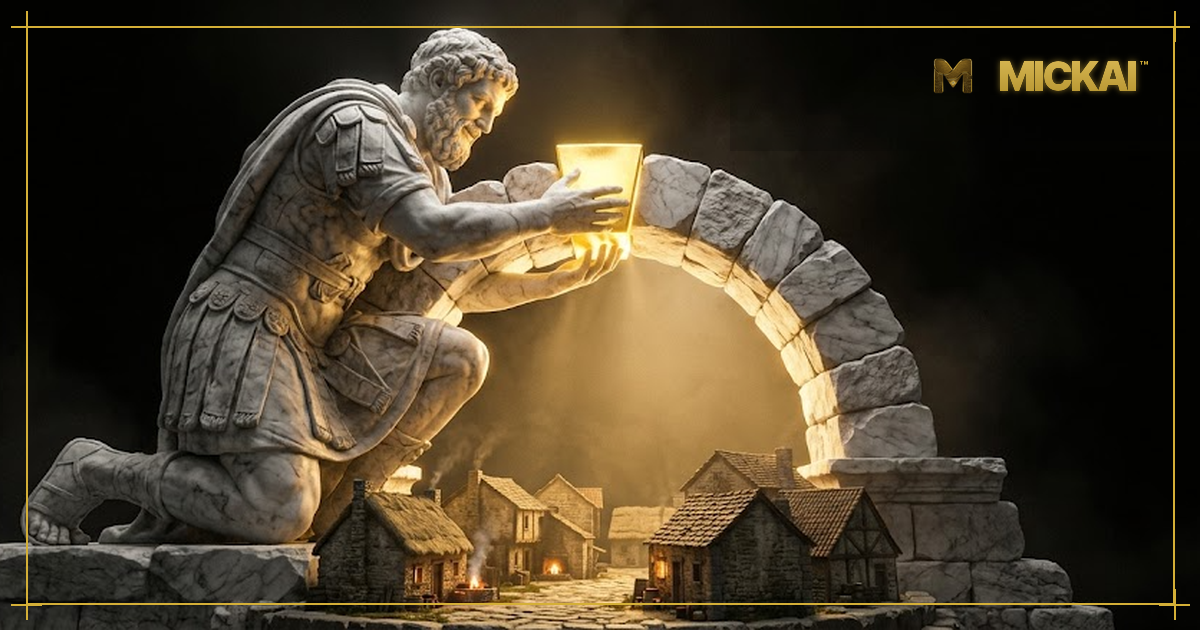
I have run Mickai for three years without paying myself a salary, and without claiming a pound from the state. That is not a complaint. It was a choice, and it taught me what most of the country already knows: the gap between working hard and living well has become a canyon. Rent, council tax, heating, fuel, insurance, food. I have done the arithmetic on an ordinary working week in an ordinary British town, and the arithmetic does not close. People who work full weeks are visiting food banks. That is the country this company was built in, and the country it intends to answer to.
So this page is a commitment, made before the money exists, so it can be checked against us later.
The commitment
When Mickai reaches sustained revenue, a fixed share of its annual profits will endow the Mickai Foundation, an independent charitable foundation with one purpose: rebuilding the communities that the last twenty years left behind.
The foundation does not exist yet. There is no fund today, no grants programme today, and I will not pretend otherwise. What exists today is this published, dated commitment from the founder, on the company's own site, in plain language. When the foundation is constituted, its deed, its trustees, and its share of profits will be published on this page, and every grant it makes will be on the public record.
What it will do
The work is deliberately unglamorous, because the need is unglamorous.
Community buildings repaired and reopened. High streets and green spaces restored in towns that have watched themselves fade. Youth facilities in places where there is nothing for a teenager to do but the street. Skills programmes and paid apprenticeships in the regions, not just the capital, because talent is everywhere in this country and opportunity is not. Support for working families who do everything right and still cannot make the week close.
And where it fits what we build: sovereign digital infrastructure for local councils at cost, so the towns that can least afford enterprise software are not the last to get it.
How it will work with government
The foundation will work with whichever government the country has elected. It will offer co-funded delivery where a council or department wants a partner, and it will publish a rollout plan it is willing to be measured against. It will take no political position, endorse no party and no politician, and fund no political activity. That is not timidity. It is the law governing charities in this country, and it is also the only way a foundation keeps its doors open to every community regardless of how that community votes.
Why a company should say this at all
Because I think the social contract between technology companies and the public has been allowed to rot. The pattern of the last decade has been extraction: build in a community, sell to the world, bank offshore, give back a press release. Mickai is a British company, built here, filing its patents here, and intending to manufacture here. If it succeeds, the towns around it should be able to point at something real, a roof, a workshop, a qualification, a job, and say that came from it.
I am putting this in writing while Mickai is still small precisely because commitments made after the money arrives are negotiations. Commitments made before it arrives are promises. This one is dated, it is public, and when the time comes you are invited to hold it against me.
Micky Irons, Founder, Mickai LTD