The Kill Switch Nobody Can Prove They Pulled
Automated decisions happen in milliseconds and accountability takes months. The fix is a record the operator can show but cannot secretly unmake.
The action that leaves no trace
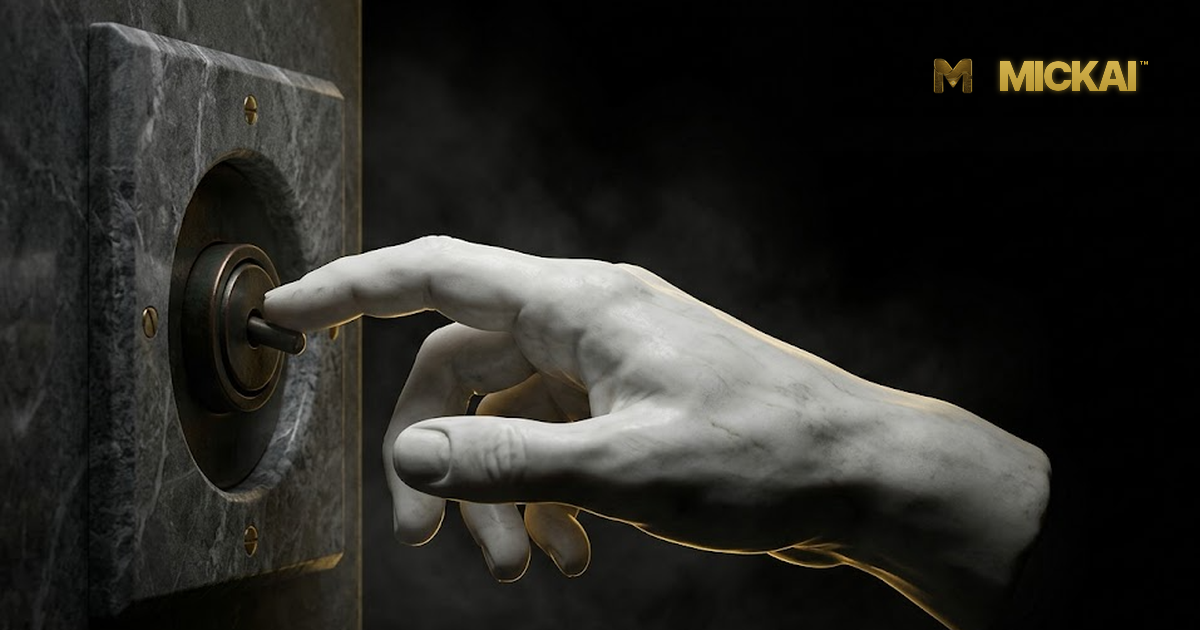
Every organisation now owns a kill switch. It might be a model that refuses a request, an automated pipeline that halts a payment, an agent that revokes an account, or a system that quietly drops a customer from a queue. The action happens in milliseconds. The question that follows takes months. Who decided this, on what evidence, under what authority, and can any of it be shown to a regulator, a court, or the person on the other end?
For most of these systems the honest answer is no. The decision lives in a log that the operator can edit, in a database row that can be updated, in a chain of services where each one trusts the last. The kill switch was pulled. Nobody can prove who pulled it, or that the reason given afterwards is the reason that actually applied at the time. That gap, between an action and provable accountability for it, is the quiet liability sitting under most automated decision-making today.
Why the ordinary log does not survive scrutiny
A standard audit log answers a friendly question for a friendly auditor. It does not answer a hostile one. The administrator who can write to the log can also rewrite it. The vendor who hosts it can lose it, leak it, or hand it to a third party under an order the operator never sees. When the dispute is real, money lost, a service withdrawn, a safety call challenged, the log is treated as what it is, an assertion by an interested party, not evidence.
Three properties separate evidence from assertion. The record must be tamper-evident, so a later change cannot pass as the original. It must be attributable, so the action ties to a specific actor and authority rather than a shared account. And it must be durable beyond the operator's reach, so it survives even if the operator wants it gone. Almost no decision-logging in production today holds all three. That is the design problem Mickai sets out to close, and it does so at the level of the operating system rather than as a feature bolted onto an application.
Sealing the decision at the moment it happens
Mickai is a Sovereign Intelligence Operating System (SIOS). It runs fifty specialised brains, twenty-five domain and twenty-five operational, on the operator's own hardware, fully offline-capable. Because the intelligence runs locally, the decision and the record of it are produced in the same trusted place, not stitched together afterward from logs held by separate services.
At the centre of this is the Open Audit Record (OAR). Every consequential action, the refusal, the halt, the revocation, is sealed and signed at the instant it is taken. The signature uses FIPS 204 ML-DSA-65, the published NIST post-quantum signature standard. Mickai did not invent that standard, it adopts it, which matters, because evidence built on a proprietary scheme is only as trustworthy as the party who controls the scheme. A standardised, post-quantum signature means the seal still means something years later, when the dispute finally lands and when classical cryptography may no longer be safe to rely on. The action and its justification are bound together and signed, so the reason given afterwards is the reason that was sealed at the time. There is no quiet edit.
Permanence the operator cannot revoke
A signed record still has one weakness. The operator who holds it can destroy it. To close that, Mickai anchors the record to something the operator does not control. Pantheon is Mickai's own sovereign Layer 1, Bitcoin-anchored, with a native token (PAN) and a fixed supply of five billion. It takes a hash commitment of the sealed record and anchors that commitment to Bitcoin, where it becomes permanent.
This is worth stating precisely, because it is widely misunderstood. Pantheon does not move Bitcoin, it is not a Bitcoin Layer 2, and no funds change hands. It commits a fingerprint of the record to the most durable public ledger available, so anyone can later prove the record existed at that time and has not changed since. Anchoring is not spending. The result is a decision that the operator can show to a regulator, but cannot secretly unmake. The kill switch can still be pulled. Now it cannot be pulled in the dark.
The standard worth holding systems to
The accountability gap is not theoretical. It is the exposure underneath every automated refusal, every algorithmic suspension, every model that says no on a company's behalf. Regulation is already moving toward demanding provable reasons for consequential automated decisions, and an editable log will not satisfy that demand.
The architecture behind this work is evidenced rather than asserted. Mickai rests on 104 filed UK patent applications, 2,340 claims, owned by Mickai LTD, with Micky Irons (Mickarle Wagstaff-Irons) named as inventor. The point of the portfolio is not the count. It is that the mechanism, local intelligence, a signed Open Audit Record, and a Bitcoin-anchored commitment through Pantheon, is specified in detail rather than gestured at. The test for any system that can refuse, halt, or revoke is simple. When someone asks who pulled the kill switch and why, can you answer with a sealed, attributable, permanent record, or only with a log you could have edited? Most systems fail that test today. The work is to build the ones that pass it.