The intelligence layer that connects every studio
One reasoning layer across every studio, on hardware you own, offline, with nothing sent to a third party. The intelligence that ties it together.
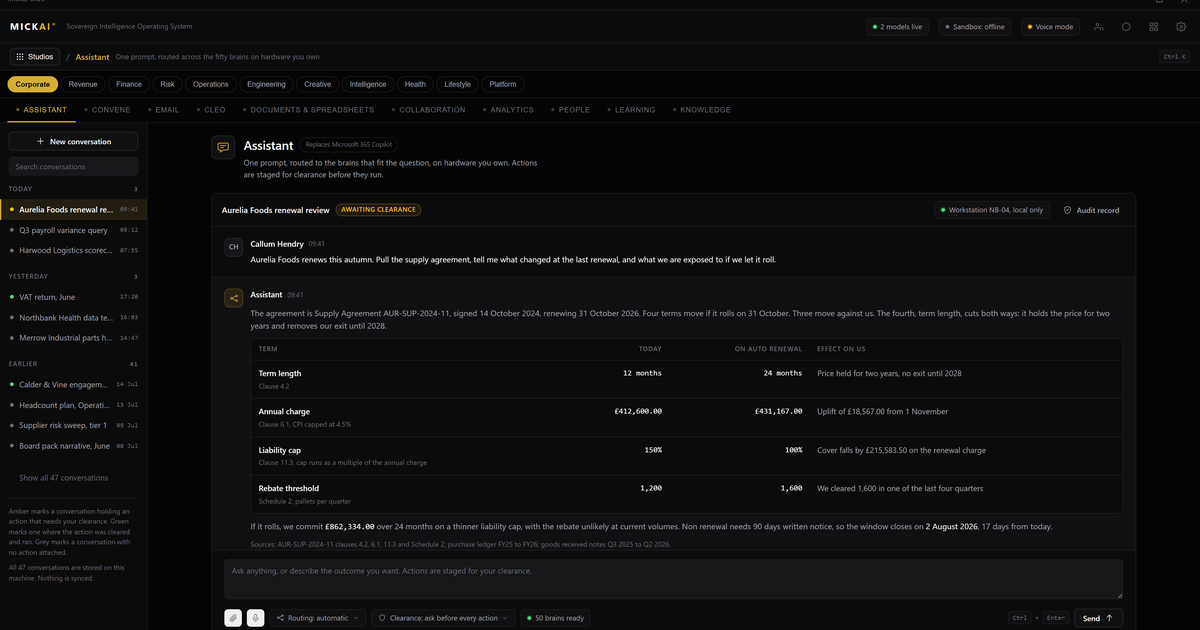
The intelligence layer is the reasoning that runs underneath every studio on MICKAI. It is one assistant that reads across your email, meetings, CRM, documents and the rest, answers questions in plain language, and takes actions on your behalf, all on hardware you own and with nothing sent to a third party. It is the thing that turns 87 separate studios into one system that thinks about your business.
Most companies buy their intelligence one app at a time. The email tool has its writing helper. The CRM has its own assistant. The meetings product has a note-taker. Each one is clever inside its own walls and blind to everything outside them, and each one sends what it sees back to a different vendor. We built the opposite: a single reasoning layer that sits below all the studios and can see across them, on your machines, offline.
What the intelligence layer does
The intelligence layer is the assistant, and the assistant is everywhere. Open any studio and it is the same reasoning, the same memory of your business, the same voice. Ask it a question and it answers from your own data. Ask it to do something and it does it.
It reads. "What did we agree with this account in March." "Summarise where the project stands." "Who has not replied to the contract." It pulls the answer from wherever it lives, across email, the CRM, the document store and team management, and shows how it got there.
It acts. Draft the reply and put it in the right thread. Build the quarterly report and schedule it. Update the record after a call. Book the meeting and invite the people who need to be there. These are not separate features bolted onto separate apps. They are one assistant reaching into whichever studio holds the work.
And it carries a task across studios. A request that starts in the meetings platform can end with a record updated in the CRM and a message drafted in the email system, because the reasoning underneath is one layer, not three tools passing notes.
Why it can see across the studios
An assistant is only as useful as the data it can reach. This is where running everything on one operating system changes what is possible.
On a typical stack, your email is one vendor, your CRM another, your meetings a third, your files a fourth. Each holds a slice of the truth and guards it behind its own login and its own export. An assistant living inside one of them cannot reason about the others without a pile of connectors, each of which is another copy of your data leaving through another door.
On MICKAI the studios are not separate products. They are studios on one operating system, sharing one data layer that the company owns. The intelligence layer reads across that layer directly. It does not need a connector to the CRM because the CRM is not a foreign system, it is a studio on the same machine over the same data. That is why the assistant already understands the shape of your business the first time you ask it something. It is not integrating with your tools. It is part of the operating system your tools run on.
Where the reasoning happens
Here is the part that matters most, and the part almost no one else offers. The reasoning runs on your hardware, inside your building, offline.
When you ask a mainstream assistant a question, your question and the context around it travel to the vendor's cloud, get processed on their machines, and come back. Your most sensitive material, the correspondence, the numbers, the strategy, is read somewhere you do not control. Private deployment where the vendor cannot see your data is the baseline we begin from. We go past it.
The intelligence layer is air-gapped by default. The model runs locally. Retrieval happens locally. The action is taken locally. Nothing reaches out to a vendor cloud, because there is no vendor cloud in the loop. There is no telemetry describing what you asked. There is no copy of your prompt sitting in someone else's logs. The reasoning about your business happens on machines that are not talking to anyone.
We do not discuss the underlying model, and for the buyer that is the right arrangement. You are not licensing a model and wiring it into a stack. You are buying a system where the reasoning is already there, already local, already connected to your studios. The model is our concern. The behaviour is what you get: local, offline, over your own data.
Every action on the record
An assistant that can act needs to be accountable, especially in a regulated firm. Ours is.
Every action the intelligence layer takes is written to the Open Audit Record on your own system. Not a vague access log that says a user touched a system at a time, but a record at the level of the action: what was asked, what data was read, what was done, and by whom. When the assistant drafts a reply, updates a record or builds a report, that is written down where you can see it.
For a regulated small or mid-sized firm this is the difference between hoping you can reconstruct what happened and being able to show it. When an auditor asks how a decision was reached or who saw a piece of data, you have the record, on your own hardware, and no one else has a copy. An assistant that acts is only safe to run if you can see exactly what it did. That is why the audit record is built into the layer rather than sold as an add-on.
What it replaces
Look at what a company usually pays for intelligence across its stack. There is the assistant bundled into the productivity suite, sold per user per month. There is the copilot in the CRM, another per-seat charge. There is the meeting note-taker, another subscription. Each is priced separately, each rises with headcount, and each only reasons inside its own app.
The published prices are per user per month and they compound. A productivity assistant with a published list price of 30 US dollars per user per month, for a firm of 50 people, is 50 times 30 times 12, which is 18,000 US dollars a year for that one add-on alone. Put a CRM copilot on top at a similar per-seat figure and you are paying twice for two assistants that cannot see each other's data. Scale to 200 users and each of those lines multiplies again. These figures use the vendors' own published list prices and a flat headcount assumption stated here so you can check them against your own seat count and tier.
We do not publish our pricing, and this is not a price comparison of us against them. The point is structural. When the intelligence layer is part of an operating system you run on hardware you own, you are not renting one assistant per app and paying again every time you add a person. It is one reasoning layer across every studio, and it does not meter your own staff back to you.
One layer, one operating system
The intelligence layer is not a product you buy alongside the studios. It is the thing that makes them one system. MICKAI is the sovereign operating system a company runs on, spanning 63 studios, and the assistant is the single reasoning surface across all of them. Clients onboard onto an initial focused set of studios, and the same assistant works everywhere they go, on machines they own, offline, with the record kept on their own hardware.
Your business already produces the knowledge. The intelligence layer is what reads it, reasons over it and acts on it, without ever letting it leave the building.
FAQ
What is the intelligence layer? It is the reasoning that sits underneath every studio on the operating system. The same assistant reads across your email, meetings, CRM, documents and the rest, answers questions in plain language and takes actions on your behalf, all on hardware you own.
Does the intelligence layer send our data to a third party? No. It runs on hardware you own and is air-gapped by default. Every question, every retrieval and every action happens on your own machines. Nothing is sent to a vendor to be processed, and there is no telemetry describing what you asked.
Which AI model does it use? We do not discuss the underlying model. What matters for the buyer is the behaviour: the reasoning runs locally, on your hardware, offline, over your own data, and every action it takes is written to the Open Audit Record. The model is our concern, not something you have to integrate.
How is this different from a private deployment of a cloud assistant? A private deployment where the vendor cannot see your data is the baseline we start from. We go past it. The intelligence layer is air-gapped by default, spans the whole software stack rather than a single app, and records what it does at the level of the action rather than a vague access log.
Can it act, or only answer? It can act. Draft the reply, build the report, update the record, schedule the meeting. Because it reaches across the studios on one operating system, it can carry a task from one to another. Every action is logged and attributable in the Open Audit Record.
Is this one layer across all the studios? Yes. The platform spans 63 studios on one sovereign operating system, and the intelligence layer is the single reasoning surface across all of them. Clients onboard onto an initial focused set and the same assistant works everywhere they go.
Frequently asked questions
What is the intelligence layer?
It is the reasoning that sits underneath every studio on the operating system. The same assistant reads across your email, meetings, CRM, documents and the rest, answers questions in plain language and takes actions on your behalf, all on hardware you own.
Does the intelligence layer send our data to a third party?
No. It runs on hardware you own and is air-gapped by default. Every question, every retrieval and every action happens on your own machines. Nothing is sent to a vendor to be processed, and there is no telemetry describing what you asked.
Which AI model does it use?
We do not discuss the underlying model. What matters for the buyer is the behaviour: the reasoning runs locally, on your hardware, offline, over your own data, and every action it takes is written to the Open Audit Record. The model is our concern, not something you have to integrate.
How is this different from a private deployment of a cloud assistant?
A private deployment where the vendor cannot see your data is the baseline we start from. We go past it. The intelligence layer is air-gapped by default, spans the whole software stack rather than a single app, and records what it does at the level of the action rather than a vague access log.
Can it act, or only answer?
It can act. Draft the reply, build the report, update the record, schedule the meeting. Because it reaches across the studios on one operating system, it can carry a task from one to another. Every action is logged and attributable in the Open Audit Record.
Is this one layer across all the studios?
Yes. The platform spans 63 studios on one sovereign operating system, and the intelligence layer is the single reasoning surface across all of them. Clients onboard onto an initial focused set and the same assistant works everywhere they go.