The HR studio: people data under your control
Run recruitment, records and people processes on your own hardware, with one assistant, and keep sensitive personal data in the building.
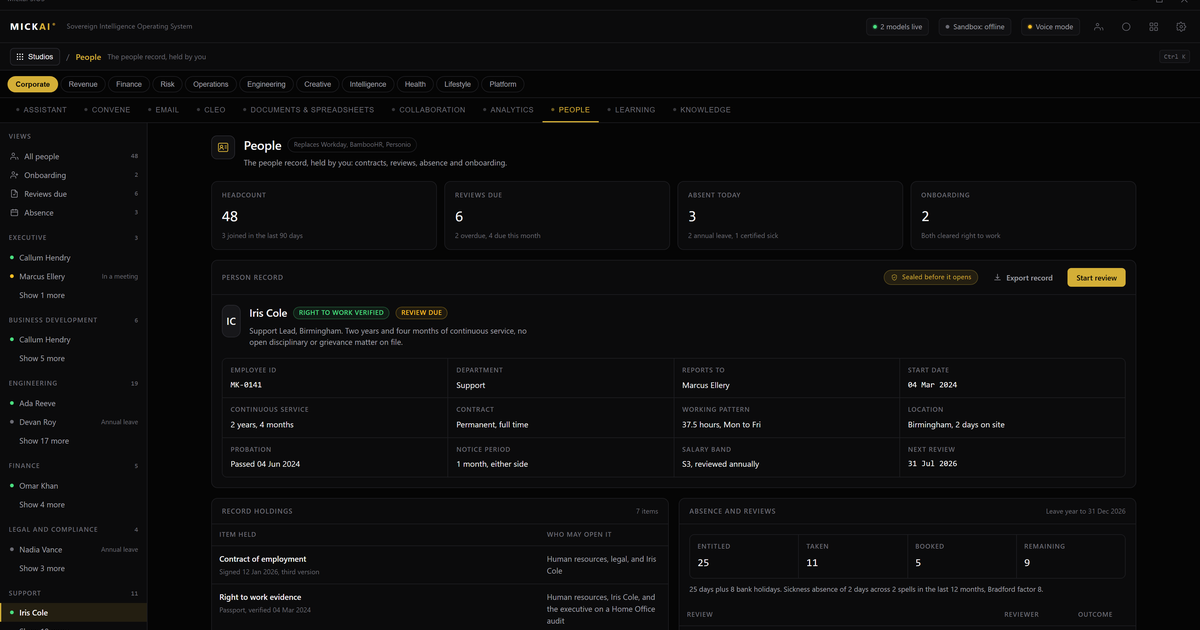
Your HR studio runs recruitment, employee records and people processes on hardware your company owns, with one assistant across the whole system, and the sensitive personal data never leaves the building. That is the difference. Instead of renting an HR cloud where your staff's salaries, health notes and disciplinary records sit on a vendor's servers, you run the same functions on your own machines, under your own jurisdiction, with a full record of every access.
What the HR studio does
The HR studio covers the ordinary work of a people team. It holds employee records: contracts, roles, pay bands, start and leave dates, next of kin, right to work. It runs recruitment: job openings, applications, CVs, interview notes, offer letters. It handles the recurring processes: onboarding checklists, probation reviews, holiday and absence, appraisals, and the inputs your payroll run needs.
None of that is new work for a business. What changes is where it happens. In the HR studio it happens on your operating system, on your hardware, with your assistant. The CVs a candidate sends, the reference a manager writes, the note about a grievance: all of it stays on machines you control.
One operating system, not another app
The HR studio is not a standalone product you buy and bolt on. It is one studio on the MICKAI sovereign operating system, the same system your other studios run on. That matters in practice.
Your people data sits alongside the rest of your company's data, on the same platform, so the joins that normally require an integration project are already there. A new starter created in HR is a person the rest of the operating system knows about. When they leave, the offboarding runs across the system rather than in one isolated tool that someone forgets to update.
There is one assistant across every studio. In the HR studio it drafts a job description, screens applications against the criteria you set, prepares an offer letter, summarises a stack of interview notes, or answers a manager's question about remaining holiday. It is the same assistant your finance or operations team uses, so people learn one way of working, not a dozen. And it runs locally. It does not send a candidate's CV or an employee's medical note to an outside model to get an answer.
Why control and jurisdiction matter for HR data
HR data is the most sensitive data most companies hold. Salaries. Bank details for payroll. Home addresses. Health information behind sick leave. Disciplinary and grievance records. Performance notes that could follow someone for years. This is special category personal data under UK data protection law, and mishandling it is both a legal exposure and a breach of trust with your own staff.
When that data lives in a rented HR cloud, you are trusting a vendor's servers, a vendor's location, and a vendor's staff with the most private records about your people. You are also trusting whatever jurisdiction those servers sit in, which may not be the one your employees signed their contracts under. If the vendor is compromised, your people are compromised. If the vendor is served a legal order abroad, your data is in scope.
Keeping HR data in the building removes those layers. The data is on your hardware, in one location, under one jurisdiction you can name. Access is governed by your rules, and the vendor cannot see the data at all. Private deployment where the vendor is blind to your data is where we start. The HR studio goes further: air-gapped by default, so the sensitive records are not reachable from the open internet unless you decide otherwise.
The Open Audit Record: who touched what
Data protection is not only about where data sits. It is about being able to show who accessed it, when, and why. The HR studio writes every action to the Open Audit Record. Not just logins, but actions: a record opened, a field changed, a document exported, a search run across candidates, an assistant task on a personal file.
For a people team, this is the difference between hoping you can reconstruct events and being able to evidence them. A subject access request becomes a query rather than an archaeology project. An internal question about who saw a disciplinary file has an answer. If a regulator asks how personal data is handled, you have an action-level trail rather than a policy document and a shrug. That audit depth is a large part of what sets this apart from private cloud alone, where you may know the data stayed private but cannot always prove who did what to it.
The cost of renting versus owning
Companies pay per user, per month, for HR software, and the bill grows with headcount. Published list prices make the pattern clear across the software a company rents. Microsoft 365 Business Standard is listed at 12.50 US dollars per user per month. Slack's Pro plan is listed at 8.75 US dollars per user per month on annual billing. Salesforce's Enterprise CRM is listed at 165 US dollars per user per month. HR platforms sit in the same rented model, charged the same way.
Take a conservative worked example on the general pattern. A 200 person company paying a blended 12 US dollars per user per month across a rented productivity and HR stack pays 200 times 12 times 12, which is 28,800 US dollars a year, every year, rising with each hire and each price increase. That figure buys access, not ownership. Stop paying and the software, and your ability to reach your own records inside it, stops with it. The assumption here is 200 users at a published-list blended rate of 12 US dollars per user per month; adjust the count and rate to your own numbers.
Owning the studios inverts that. The software runs on hardware you have bought, and the people data is an asset you hold rather than a subscription you rent. We do not publish MICKAI pricing here; the point is the model. A rented seat is a recurring cost with no residual value. An owned operating system is infrastructure your company keeps.
Built for the regulated small and mid-sized firm
The heavyweight vendors are built for the largest enterprises, with the compliance teams and budgets to match. The regulated small and mid-sized firm is often left to rent tools designed for someone else and carry the data risk anyway. That firm is who the HR studio is built for: a business that holds genuinely sensitive people data, has real regulatory duties, and wants control without running a hyperscale operation.
We hold no certifications, and we do not claim any. The posture is structural, not a badge: your data on your hardware, air-gapped by default, one assistant that reasons locally, and a complete audit record you can inspect yourself. You start from a private deployment the vendor cannot read, and you get the layers beyond it.
The HR studio is one of 63 studios on the operating system. Companies onboard onto an initial focused set rather than everything at once, and the studios carrying the most sensitive data are a common place to begin. You keep your people's records where they belong: in the building, under your control.
FAQ
Where does our HR data live with the MICKAI HR studio? On hardware your company owns, inside your building or your own data centre. Records, applications and payroll inputs stay on your machines. Nothing is copied to a vendor cloud, and the vendor cannot read your data.
Is the HR studio a separate app we have to integrate? No. It is one studio on the MICKAI sovereign operating system, sharing the same data and the same assistant as the rest of your studios. You are running a stack, not stitching together a new SaaS tool.
Can the assistant see everyone's salary and health records? Only where your access rules allow it. The assistant runs locally and respects the same role permissions as your people team. Every action it takes on a record is written to the Open Audit Record.
How does this help with UK GDPR and data protection duties? You keep personal data in a location you control, under one jurisdiction, with a complete action-level audit trail. That makes access, retention and subject requests easier to evidence. It supports your obligations; it does not replace your own legal advice.
Do you hold certifications like ISO 27001 or SOC 2? No. We hold none and claim none. The security posture comes from the architecture: your data on your hardware, air-gapped by default, with a full audit record you can inspect.
Can we start with just HR? Yes. The platform spans 63 studios, and companies onboard onto an initial focused set. Many begin with the studios that carry the most sensitive data, then add more as they go.
Frequently asked questions
Where does our HR data live with the MICKAI HR studio?
On hardware your company owns, inside your building or your own data centre. Records, applications and payroll inputs stay on your machines. Nothing is copied to a vendor cloud, and the vendor cannot read your data.
Is the HR studio a separate app we have to integrate?
No. It is one studio on the MICKAI sovereign operating system, sharing the same data and the same assistant as the rest of your studios. You are running a stack, not stitching together a new SaaS tool.
Can the assistant see everyone's salary and health records?
Only where your access rules allow it. The assistant runs locally and respects the same role permissions as your people team. Every action it takes on a record is written to the Open Audit Record.
How does this help with UK GDPR and data protection duties?
You keep personal data in a location you control, under one jurisdiction, with a complete action-level audit trail. That makes access, retention and subject requests easier to evidence. It supports your obligations; it does not replace your own legal advice.
Do you hold certifications like ISO 27001 or SOC 2?
No. We hold none and claim none. The security posture comes from the architecture: your data on your hardware, air-gapped by default, with a full audit record you can inspect.
Can we start with just HR?
Yes. The platform spans 63 studios, and companies onboard onto an initial focused set. Many begin with the studios that carry the most sensitive data, then add more as they go.