The finance studio: accounts and reporting on infrastructure you own
Run bookkeeping, reporting and analysis on hardware you own. Financial data never leaves the building, every action logged in the Open Audit Record.
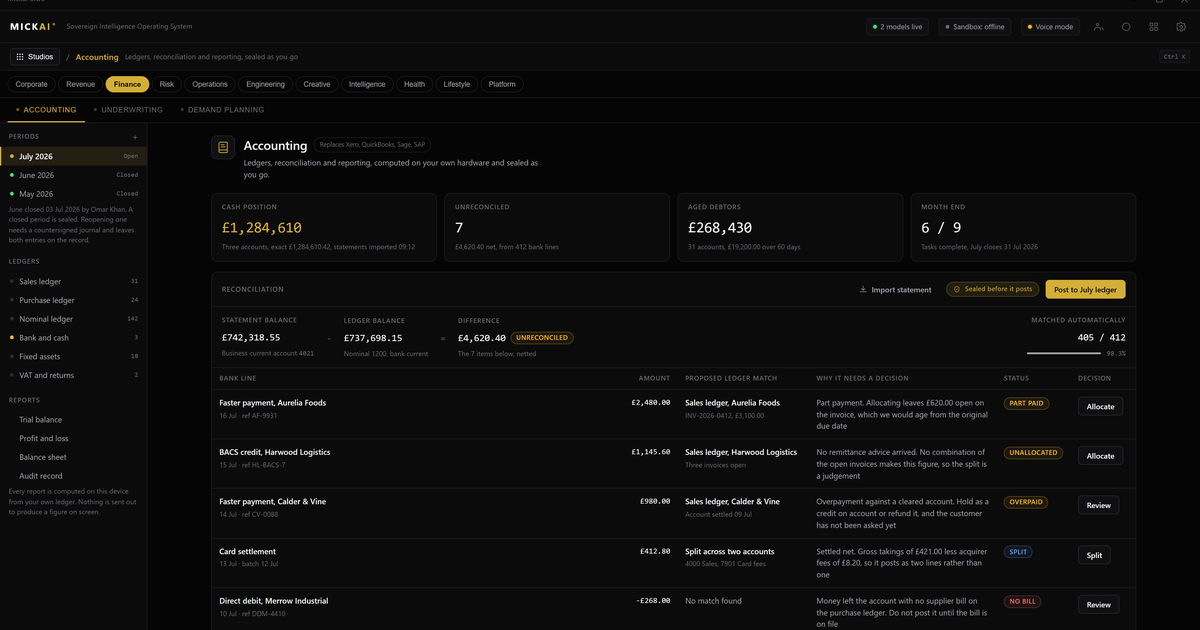
Your accounts, reporting and financial analysis run on hardware you own, inside your own building. The finance studio does the bookkeeping, the reconciliation and the management reports, and your figures never leave the premises. Every action is written to the Open Audit Record, so you can prove exactly what happened to your numbers and who did it.
That is the whole idea. Financial data is the most sensitive data most companies hold. It should not sit on someone else's servers where the vendor can read it and where a subpoena, a breach or a policy change is out of your hands. The finance studio keeps it in the building and gives you a full record of every touch.
What the finance studio does
The finance studio is one of the studios on the MICKAI sovereign operating system. It is not a separate app you bolt on. It runs on the same operating system as the rest of your studios, shares your own data, and is driven by the same assistant that works across all of them.
In practical terms it handles:
- Bookkeeping and the general ledger: postings, journals, chart of accounts, period ends.
- Bank and account reconciliation against your statements.
- Management reporting: profit and loss, balance sheet, cash position, department and project views.
- Analysis: variance against budget, trend lines, ratios, ad hoc questions about the numbers.
- Export packs for your accountant, your board and your auditor.
All of it reads and writes to storage you control. There is no accounting cloud in the middle.
The assistant works with your figures without sending them anywhere
The assistant runs locally on the same hardware as the finance studio. That changes what you can safely ask it.
You can point it at the ledger and ask it to reconcile the current account against last month's bank statement, and it works through the figures on the machine. You can ask it to draft the management pack for the board, explain why marketing overspent against budget, or flag any supplier invoice that looks out of pattern. Because it never sends your numbers to an outside service, none of this leaks. The figures stay where they are.
This is the difference between an assistant that is helpful and an assistant you can actually use on real financial data. Sensitive figures do not have to be redacted or held back. The assistant sees them because it lives on your hardware, not on a vendor's.
Every action is in the Open Audit Record
Private deployment, where the vendor cannot see your data, is the baseline we start from. The finance studio goes past it.
Every action is written to the Open Audit Record: who ran it, when, against which data, and what changed. A posting, a reconciliation, a report the assistant drafted, an export, all of it. This is action-level audit, not just an access log. When an auditor asks how a figure was arrived at, you export the record for the period and show the chain.
For a finance function this is the part that matters most. You are not just trusting that the software behaved. You have a record of what it did, and you own that record.
Air-gapped by default
The finance studio is air-gapped by default. It does not need an internet connection to do its work, because the software and your data are both on your hardware. You choose what, if anything, connects out, for example a feed to your bank or a filing endpoint, and everything else stays sealed.
For a regulated firm this removes a whole category of risk. There is no standing pipe from your ledger to an outside server that could be misconfigured, breached or repurposed. The default is closed.
A worked cost comparison
The usual way to run finance software is to rent it per user per month, forever. It is worth putting real numbers against that so the comparison is honest.
Take a common bundle: a productivity and email suite plus the tools a finance team sits inside all day. Microsoft publishes a list price for Microsoft 365 Business Standard of 12.50 US dollars per user per month on an annual commitment. That is a public, reported figure.
Assume a 40 person company where everyone needs that suite. The method is simple: users times published price times 12 months.
40 users x 12.50 US dollars x 12 months = 6,000 US dollars per year, on that one product line, every year, rising with headcount and with price changes you do not control.
That is before you add a dedicated accounting subscription, a business intelligence seat for reporting, or the per user cost of the chat and meetings tools the finance team also uses. Each of those is another per user per month line that recurs for as long as you use it. We are using the published Microsoft 365 Business Standard list price as a reported public fact and a conservative single line; your real total across all rented tools is higher.
The finance studio changes the shape of the spend. You own the hardware and you own the software stack that runs on it. We do not publish our pricing, so this piece does not state ours. The point is the model: owning the stack instead of renting seats that never stop billing, on data you would rather keep in the building anyway.
Where the finance studio fits with the rest
Because the finance studio shares the operating system with your other studios, the numbers do not sit in a silo. The same assistant that reconciles your ledger can pull the figures into a board pack in your documents studio, answer a question in your team's collaboration space, or feed a report to your CRM view of a customer's account. One operating system, one assistant, your own data moving between studios you own.
The platform spans 63 studios in total. Clients start on an initial focused set, and finance is a natural anchor because it is where the sensitive data and the audit pressure concentrate. You onboard onto what you need first and add studios over time.
Who this is for
The finance studio is aimed at regulated small and mid-sized firms. These are the companies that carry real compliance weight but are too small to build and run their own systems team, and too important to their sector to be relaxed about where their financial data lives. The heavyweight vendors tend to leave this group renting seats and hoping the cloud holds. We give them the whole stack, on their own hardware, with the audit record to prove it.
FAQ
Where is our financial data stored? On the company's own hardware, inside the building. The finance studio reads and writes to your own storage. Nothing is sent to an external accounting cloud, and the assistant that helps you runs locally on the same machine.
Can the finance studio replace our accounting software? It covers bookkeeping, ledgers, reconciliation, management reporting and analysis on infrastructure you own. Many firms run it alongside their filing and payroll tools during onboarding and consolidate over time.
How do we prove what happened to an auditor? Every action in the finance studio is written to the Open Audit Record: who ran it, when, on what data, and what changed. You export the record for a period and hand it over.
Does the assistant see our numbers? The assistant runs on your hardware, so it works with your figures without sending them anywhere. It drafts reports, explains variances and reconciles accounts locally, and its actions are logged like any other.
Is this only for large companies? No. The finance studio is aimed at regulated small and mid-sized firms that need control over financial data but do not want to build their own systems team.
How does the cost compare with renting software? You own the hardware and the software stack instead of paying per user per month forever. We do not publish our pricing, but the worked example above shows how to build a conservative comparison against published incumbent list prices.
Frequently asked questions
Where is our financial data stored?
On the company's own hardware, inside the building. The finance studio reads and writes to your own storage. Nothing is sent to an external accounting cloud, and the assistant that helps you runs locally on the same machine.
Can the finance studio replace our accounting software?
It covers bookkeeping, ledgers, reconciliation, management reporting and analysis on infrastructure you own. Many firms run it alongside their filing and payroll tools during onboarding and consolidate over time.
How do we prove what happened to an auditor?
Every action in the finance studio is written to the Open Audit Record: who ran it, when, on what data, and what changed. You export the record for a period and hand it over.
Does the assistant see our numbers?
The assistant runs on your hardware, so it works with your figures without sending them anywhere. It drafts reports, explains variances and reconciles accounts locally, and its actions are logged like any other.
Is this only for large companies?
No. The finance studio is aimed at regulated small and mid-sized firms that need control over financial data but do not want to build their own systems team.
How does the cost compare with renting software?
You own the hardware and the software stack instead of paying per user per month forever. We do not publish our pricing, but the article shows how to build a conservative comparison against published incumbent list prices.