The CIO Sovereign AI Roadmap
A staged journey from cloud dependency to an owned, governed intelligence estate, mapped through the homecoming of Odysseus.
Every chief information officer knows the feeling. The public cloud gave us speed, elasticity and a decade of genuine progress, and then, almost overnight, the same architecture that felt like freedom started to feel like a leash. Sensitive data leaves the building to be reasoned over. Model behaviour changes without notice. A regulator asks a simple question, who approved this action and can you prove it, and the honest answer is that nobody can.
A sovereign intelligence estate is the answer, but you do not reach it in a single leap. It is a staged journey, much like the one Odysseus took home: long, deliberate, full of moments where the easy course was a trap. This is the roadmap we walk with CIOs who want intelligence they own, govern and can defend, without declaring war on the cloud partners who serve them well.
The map before the voyage
Odysseus did not sail blind. He listened to those who knew the waters, and he named the hazards before he met them. A sovereign roadmap begins the same way, with an honest inventory of where intelligence already touches the business and where the risk actually lives.
We start by classifying workloads against the boundary that matters to you. Some data can move freely and belongs in the public cloud, where our allies at OpenAI, Microsoft, Amazon Web Services, Google and Oracle do superb work at a layer we never contest. Some data must never cross the perimeter because of the General Data Protection Regulation (GDPR), the European Union Artificial Intelligence Act (EU AI Act), the Digital Operational Resilience Act (DORA), or sector rules such as the Health Insurance Portability and Accountability Act (HIPAA) and the International Traffic in Arms Regulations (ITAR). The roadmap is not cloud versus sovereign. It is the discipline to know which is which, and to draw the line on your own terms.
Escaping the lotus of convenience
The first real test is cultural. Convenience is the lotus flower that made the crew of Odysseus forget the way home. Teams have grown used to piping anything into a hosted endpoint because it is faster this quarter, and every such habit quietly widens the blast radius of a breach.
Stage one of the estate is a governed inference layer that runs on hardware you own, air-gapped or on-premise, with zero data egress. Mickai is a Sovereign Intelligence Operating System, a SIOS, and this is where it earns the name. Sensitive prompts and documents are reasoned over inside your perimeter by revocable brains, sovereign models you can switch on, switch off and audit. Nothing leaves. The convenience does not disappear, it simply relocates to the safe side of the boundary, so the business feels no friction while the risk collapses.
Binding yourself to the mast
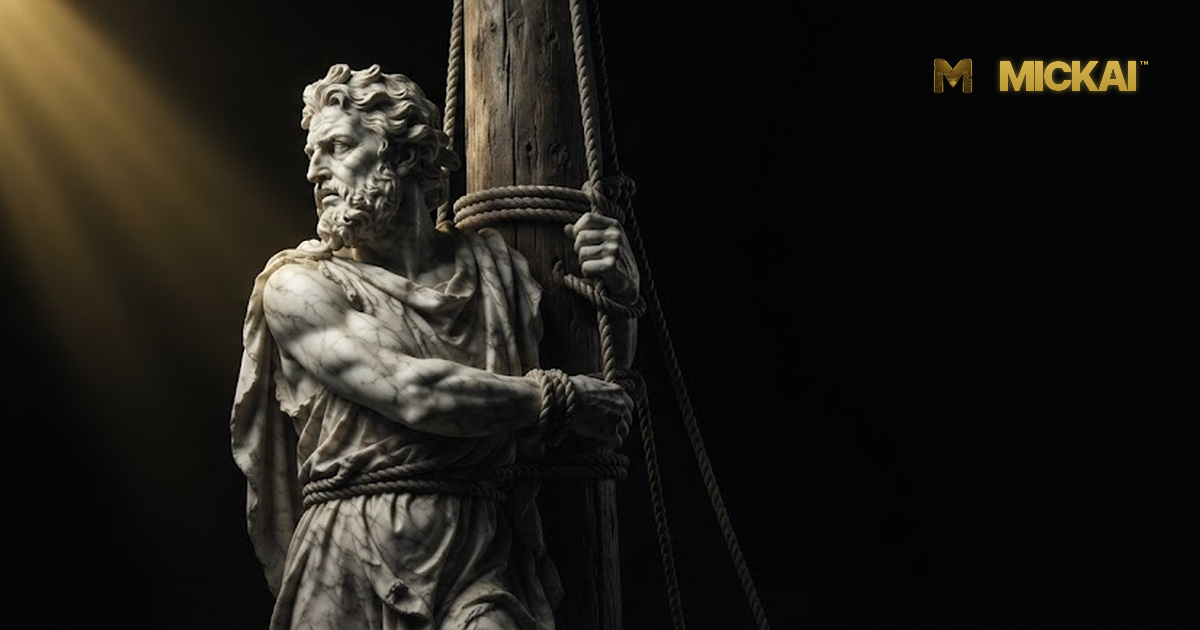
Odysseus wanted to hear the Sirens without being destroyed by them, so he had himself bound to the mast: full capability, hard constraint. That is exactly the posture a regulated intelligence estate needs. You want autonomous action, and you want it impossible for that action to run unchecked.
In our architecture, every action is bound before it can move. The Operation Attestation Record, our OAR, signs each operation before it executes, not after, so there is no such thing as an unattested act. High-stakes operations require multi-brain plus voice-biometric approval, meaning no single model and no single voice can move alone. The estate is not slower for this. It is simply incapable of the reckless act, the way the bound captain could listen to the song and still steer true.
The ledger that cannot be rewritten
When Odysseus finally reached home, the proof of who he was mattered as much as the return itself. A sovereign estate lives or dies on the same thing, proof. Not a promise that governance happened, but evidence a regulator, an auditor or a court will accept without argument.
Stage three lays down a tamper-evident, cryptographically-signed audit ledger. Every attestation is chained with SHA-3-512 hashing so the record cannot be quietly rewritten, and every signature uses post-quantum cryptography, specifically the Federal Information Processing Standard 204 (FIPS 204) ML-DSA-65 scheme, so it will still stand when today's encryption no longer does. Crucially, the whole chain verifies offline. You do not phone a vendor to prove your own compliance. Under the EU AI Act, DORA, the Sarbanes-Oxley Act (SOX) and the second Markets in Financial Instruments Directive (MiFID II), that offline, self-owned proof is the difference between a clean audit and an open finding.
Reclaiming the estate
The suitors had occupied the hall of Odysseus in his absence, consuming his household as if it were their own. Many CIOs inherit an equivalent, a sprawl of shadow integrations and opaque dependencies that behave as if the intelligence estate belongs to them rather than to the enterprise.
Stage four consolidates. Scattered pilots become governed brains inside one operating system. Ad hoc scripts become studios with defined owners, defined permissions and a single attested ledger behind them all. This is where the estate stops being a collection of experiments and becomes an asset on the books, one you can value, insure and answer for. The capability here is protected by 104 filed United Kingdom patent applications, 2,340 claims owned by Mickai LTD, each framed around a specific power of the system rather than an abstract idea, so the estate you reclaim is genuinely yours to defend.
Governing the estate for the long peace
Homecoming was not the end of the story of Odysseus, it was the start of the harder work of ruling well. A sovereign estate demands the same ongoing stewardship, and the final stage of the roadmap is a governance posture you can sustain for years, not a project you close.
We align the estate to the frameworks your board already answers to: the International Organization for Standardization 42001 (ISO 42001) standard for artificial intelligence management systems, the National Institute of Standards and Technology Artificial Intelligence Risk Management Framework (NIST AI RMF), the Network and Information Systems Directive 2 (NIS2), and the Basel capital standards where they bite. Brains stay revocable, so a model that drifts can be pulled without dismantling the estate. Approvals stay cryptographic, so authority is always provable. The public cloud remains your ally for everything that belongs there. What changes, permanently, is that the regulated core now runs on ground you hold.
The bottom line
Sovereignty is not a wall against the cloud, and it is never a single purchase. It is a voyage in stages: map the boundary, escape reflexive convenience, bind autonomy to hard constraint, lay down proof that verifies offline, reclaim the sprawl into one owned estate, then govern it for the long term. Odysseus reached home because he refused every shortcut that would have cost him the whole purpose of the journey.
For the CIO, the purpose is intelligence you own, govern and can defend under any audit, on hardware you control, with a partner ecosystem intact. Mickai is built and it is live, and the roadmap to reach it is walkable now. The only real question left is when you set sail.