The Asgard Gap: Defence Decision Support Needs Assurance, Not Another Supplier
Procurement keeps buying capability. The harder question is whether a decision made under pressure can be proven, replayed and defended after the fact.
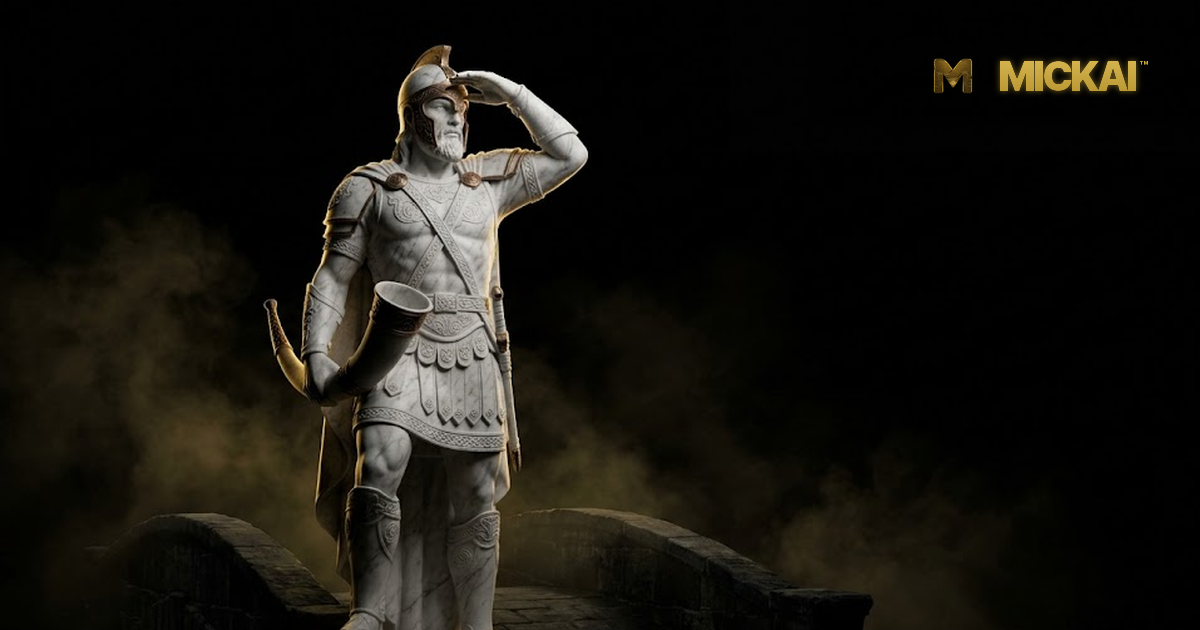
The gap nobody procures for
Defence ministries have no shortage of decision-support suppliers. Every fusion platform, every common operating picture, every targeting aid arrives with the same promise: faster sense-making under pressure. What almost none of them sell is the thing a commander actually answers for afterwards. Not the recommendation, the account of it. The ability to say, weeks or years later, exactly what the system advised, on what evidence, which human approved it, and that none of that record was altered in between.
Call it the Asgard gap. In the myth, Asgard is defended not by stronger walls but by Heimdall, the watchman who sees and remembers everything that crosses the bridge. Modern command software has built impressive walls and forgotten to build the watchman. The result is a procurement market crowded with capability and starved of assurance.
Why another supplier does not close it
The instinct in a capability gap is to buy more capability. It rarely helps here, because the gap is not in what the tools recommend. It is in what survives the recommendation. Add a smarter model and you have a smarter opinion with the same evidentiary half-life: a screenshot, a log line, a memory that degrades the moment it is questioned in a review, an inquiry or a court.
Assurance is a different property from accuracy. An accurate system that cannot prove its own reasoning is, under scrutiny, indistinguishable from a confident guess. Defence learned this lesson the hard way in every after-action review where the data had moved on, the model had been retrained, and the chain of who-knew-what could not be reconstructed. Buying a better oracle does not fix a missing memory.
The honest requirement is therefore awkward for the supplier market. It is not a feature you bolt onto a platform. It has to be the substrate the platform runs on, present at the moment of decision, not reconstructed afterwards from whatever logs happened to be retained.
Assurance as the substrate
Mickai approaches this as a Sovereign Intelligence Operating System, a SIOS that runs fifty specialised brains (twenty-five domain, twenty-five operational) on the operator's own hardware, fully offline-capable. The point is not that it hosts another model. The point is what happens around every consequential action it takes.
Each such action is sealed into the Open Audit Record and signed with FIPS 204 ML-DSA-65, the published NIST post-quantum signature standard. Mickai did not invent that standard, it adopts it, which is exactly the point: assurance you can defend rests on cryptography the rest of the world has already scrutinised, not on a proprietary trick. The record captures the recommendation, the evidence it stood on, and the human who approved it, in a form that cannot be quietly edited later without breaking the signature.
Because the brains run on the operator's own silicon, none of this depends on a vendor cloud staying reachable, a licence staying current, or a foreign data centre staying friendly. The watchman lives inside the wall, not in someone else's building.
Permanence without surrender
A signed record proves a thing was not altered. It does not, on its own, prove when it existed. For that, Mickai anchors a hash commitment of the record to Bitcoin through Pantheon, its own sovereign Layer 1 with the native token PAN and a fixed supply of five billion. Anchoring writes a fingerprint, not the file. It moves no Bitcoin and is not a Bitcoin Layer 2. Anchoring is not spending.
The distinction matters in defence more than almost anywhere. The operator keeps the evidence on sovereign hardware, under sovereign control, and borrows only the permanence of the most attacked timestamping surface on earth to prove the record predates the dispute. Nothing sensitive leaves the perimeter. Only the proof that something existed, unchanged, at a moment in time.
What this changes for the buyer
Reframing the requirement from capability to assurance changes what good procurement looks like. The question stops being which platform recommends best and becomes which platform can prove, after the worst day, what it recommended and why. That is a question Mickai is built to answer in evidence rather than assertion: 104 filed UK patent applications, 2,340 claims, owned by Mickai LTD, with Micky Irons (Mickarle Wagstaff-Irons) the named inventor. The portfolio is the receipt for the architecture, not the headline.
Trust Agent sits at the perimeter; Sentinel is a Mickai capability inside it. Together they make the same promise the rest of the system does. A decision support tool that cannot be held to account is not support, it is exposure. Closing the Asgard gap means buying the watchman, not another wall.