Surveillance Is the Default. Sovereignty Is a Decision.
Pervasive collection is the business model of modern technology, artificial intelligence makes that data far more valuable and far more dangerous, and the only real alternative is intelligence you run yourself.
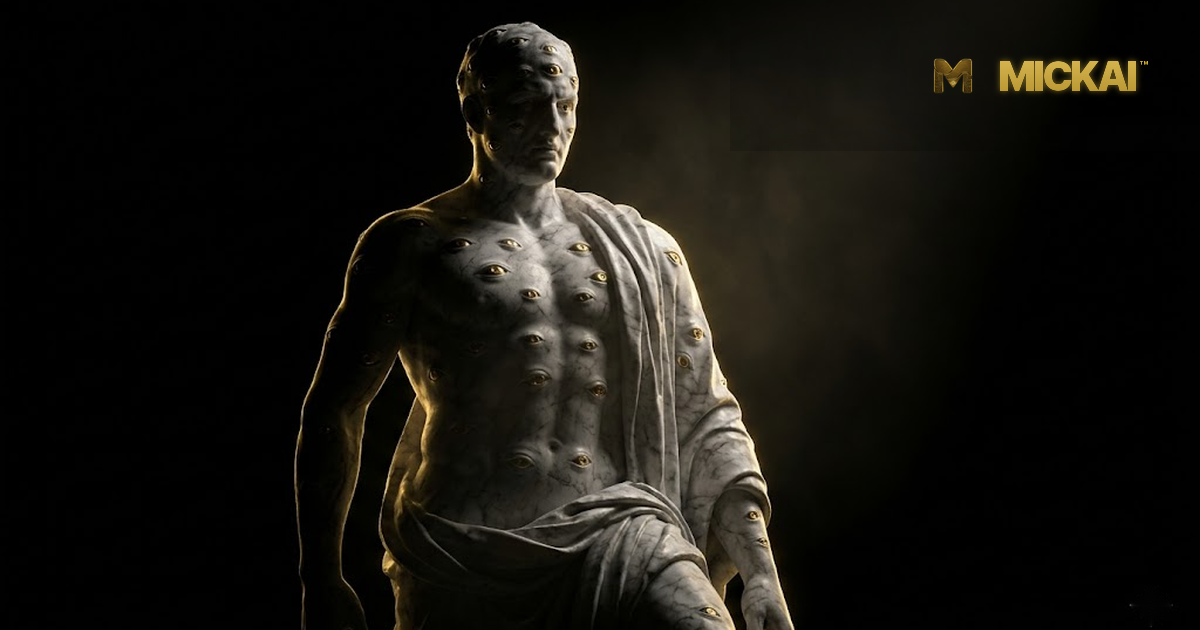
You are being measured right now, and you did not agree to it in any way you would recognise as agreement. The phone in your pocket is broadcasting where you are. The applications you opened this morning are selling that signal onward. Somewhere a model is learning the shape of your life from the exhaust of your day. None of this is a failure of the system. It is the system working exactly as designed.
I want to make an argument that is uncomfortable and also plainly true. Surveillance is not an abuse of modern technology. Surveillance is the business model. Collection is the default state, the path of least resistance, the thing that happens when nobody decides otherwise. Sovereignty, by contrast, is a decision. It has to be designed, built and defended. I built Mickai because I wanted that decision to exist as a real thing you can run, not a slogan you can read.
The default is collection, and it always pays
Start with the money, because incentives explain almost everything. The global market for brokered data was valued at roughly 294 billion United States dollars in 2025 and is forecast to clear 315 billion in 2026. That is not a fringe. It is an industry larger than the gross domestic product of most countries, built on the simple act of writing down what people do and selling it to whoever will pay.
The product is you, rendered as a stream of events. Where your phone slept last night. Which clinic you sat outside. Which rally you walked through. In January 2025 the United States Federal Trade Commission finalised orders against the data broker Gravy Analytics and its subsidiary Venntel for selling precise geolocation that could place a person at a place of worship, a domestic abuse shelter, a medical facility or a political gathering. The same month it banned Mobilewalla from selling sensitive location data harvested straight out of real time advertising auctions. These were landmark actions. They were also a description of standard practice, not an exception to it.
Collected data does not stay where you left it
Defenders of collection lean on a quiet promise. The data is safe. It is aggregated. It is handled responsibly. Hold that promise next to what happened to Gravy Analytics. In January 2025 an intruder used a single compromised credential to reach the company's cloud storage and walked out with a trove later measured in the region of seventeen terabytes, tens of millions of location points pulled from thousands of ordinary applications. Games. Dating apps. A period tracker. The leaked records placed devices at the White House, at military bases, at the Vatican.
This is the durable principle, and it is older than any of these companies. Data that is collected will eventually leak, be sold, be subpoenaed or be repurposed. Not always, but reliably enough that you should treat it as a law. The only record that cannot be stolen from a central store is the record that was never placed in one. Every byte gathered today is a liability tomorrow, held by someone whose incentives are not aligned with yours and whose security is not under your control.
Artificial intelligence raises the stakes on every byte
Here is what changed, and why I am writing this in 2026 rather than a decade ago. For most of the surveillance era, collected data was clumsy. It sat in tables. Turning it into insight took effort. Artificial intelligence removed that friction. A behavioural model does not need your name. It infers your pregnancy, your politics, your mental health and your next purchase from the pattern of your movement and the texture of your conversation.
The collectors understand this completely. From December 2025 the largest social platform began using interactions with its own artificial intelligence assistant, the offhand questions about parenting, weekend plans and major life decisions, to target advertising across its networks, switched on across nearly every region. In April 2025 it had already updated its privacy policy to make voice and artificial intelligence data collection the default, with no real way to opt out. Its smart glasses, of which roughly seven million sold in 2025, normalise an always on camera and microphone, and human contractors were later found to be reviewing the footage. Artificial intelligence is the engine that makes the collected data worth far more, and far more dangerous. The same behavioural exhaust that once filled a database now trains a system that knows you better than your friends do.
Sovereignty is the deliberate alternative
None of this is inevitable. It is a set of choices, and choices can be made differently. The alternative is not to opt out of intelligence. It is to change who holds it. Sovereignty means the intelligence runs on hardware the operator owns, the data never leaves that hardware, and every action the system takes is written into a record the operator controls. The default flips. Nothing is collected to a third party because there is no third party in the loop.
That is what Mickai is. Not an application, a Sovereign Intelligence Operating System, built and in production. Fifty specialised models, twenty five for domain work and twenty five for operations, run on a silicon substrate we call Poseidon, on the operator's own machine. The model serves the person sitting in front of it and answers to nobody else. There is no advertising auction at the other end of the cable because there is no cable. The behavioural exhaust that the entire brokered data economy is built to harvest is simply never produced, because it has nowhere to go.
A record you own, verifiable without trusting me
Sovereignty without accountability is just a different black box, so the record matters as much as the runtime. In Mickai every action is signed before it executes, then written to an append only, hash chained ledger we call the Open Audit Record. The signatures are post quantum, using the standardised ML-DSA-65 scheme under Federal Information Processing Standard 204, so the proof does not rot when the cryptography of today is broken. You can verify the whole chain offline, in a verifier that runs in your own browser, with no network call and no trust placed in me as the vendor. The audit root anchors to our sovereign Layer 1 blockchain, Pantheon, and from there to Bitcoin. The point of all of it fits in one sentence. You do not have to believe my claims. You can check them.
I have put my work behind this position. Mickai LTD, registered in the United Kingdom as company 17166618, holds 104 filed United Kingdom patent applications covering roughly two thousand two hundred and thirty four claims, with me named as inventor. They describe a substrate built on the opposite assumption to the one the industry runs on. Not collect by default and apologise after the breach, but compute locally, retain nothing externally and prove every step. Surveillance is what happens when no one decides. Sovereignty is the decision. I have made mine, and I built the thing that lets you make yours.