What Replacing a SaaS Stack With Studios on One Operating System Looks Like
One owned operating system runs the studios that replace your SaaS stack, sharing a single data store, identity model and verifiable audit ledger.
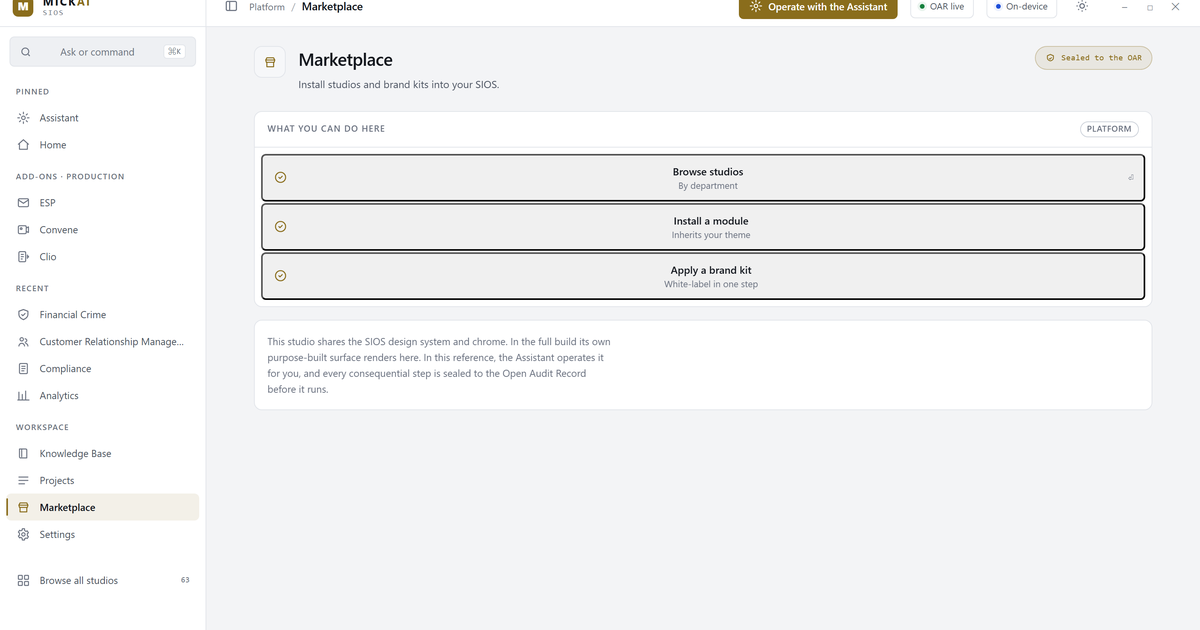
Replacing a stack of separate SaaS subscriptions with studios on one operating system means the work each cloud subscription used to do, email and messaging, meetings, document and contract review, customer records, finance, project tracking and analysis, runs as separate studios inside a single system you own. It holds together because the studios share one data layer, one identity model and one audit ledger, so information never leaves your hardware to reach a vendor cloud. What was a dozen logins, a dozen contracts and a dozen egress paths becomes one operating system under your control.
The question matters in 2026 because the cost of the SaaS model is no longer only the invoice. Every subscription is a copy of your data held on someone else's infrastructure, reachable under the US CLOUD Act, and a separate attack surface to defend. Regulated buyers under DORA, NIS2 and GDPR are being asked to prove where their data sits and who can touch it, and a sprawl of cloud tools makes that proof harder every year.
What is a studio, and how does it replace a SaaS subscription?
A studio is a self-contained workspace for one kind of work: a meetings studio, a document studio, a customer studio, a finance studio. Each studio does what a comparable SaaS subscription does, but it runs locally as part of Mickai, our Sovereign Intelligence Operating System. Mickai runs offline on operator-owned hardware with every action cryptographically sealed. A studio is not a browser tab pointed at a vendor cloud. It is native software running on your machines, drawing on sovereign models that stay inside the perimeter, and a single local assistant drives every studio so the work moves between them without a new login.
Which business applications does one operating system actually cover?
The point of consolidation is coverage, so here is the concrete ground a single owned operating system covers:
- Team messaging and channels, in place of a hosted chat subscription
- Video meetings and transcripts, in place of a conferencing subscription
- Document drafting and review, including sensitive contract and legal review
- Customer records and pipeline, in place of a hosted CRM
- Finance, invoicing and reporting workspaces
- Project and task tracking
- Data analysis and reporting over your own records
- Content and communications drafting
Each of these is a studio, not a separate account with a separate vendor. The value is not the count of tools removed. It is that many data copies and many contracts collapse into one store you own.
How is the data different when it never leaves your hardware?
In a SaaS stack, each subscription holds its own copy of your data in its own cloud. Consolidating onto one operating system collapses those copies into a single store on hardware you control. Mickai uses a zero-egress inbound perimeter: data and models come in, the work happens inside, and nothing is sent out to a third-party cloud in order to function. Identity is hardware-attested and bound to the audit chain, so every action is tied to a specific verified machine and operator. Offline verifiability means the system can prove what it did without calling home.
What can an auditor check that a SaaS stack cannot show?
A SaaS stack answers questions about your data with a vendor's dashboards and a vendor's word. An owned operating system answers with a ledger you hold. Every action across every studio is written to a single audit ledger, sealed with post-quantum digital signatures under FIPS 204 (ML-DSA), the primary signature standard, with FIPS 205 (SLH-DSA) as the stateless-hash alternative. An auditor can verify the ledger offline, confirm that no entry was altered, and trace any action to the machine and operator that performed it. The named test is simple: ask to verify the signature chain without contacting any external service. A scattered SaaS stack cannot pass it, because the record lives on someone else's servers.
“Consolidation onto an owned operating system is not about fewer invoices, it is about holding one verifiable record of everything the business does instead of trusting a dozen vendors to hold it for you.”
Which rules make consolidation onto owned infrastructure necessary?
Several regimes now push in the same direction. DORA, in force since January 2025, holds financial entities accountable for the resilience of their information systems and their third-party dependencies. NIS2 extends security and reporting duties across essential and important entities. GDPR still governs where personal data sits and who can reach it, and the US CLOUD Act means data on a US provider's infrastructure can be compelled regardless of where it is stored. On the EU AI Act, the high-risk Annex III obligations once due on 2 August 2026 have been deferred by the Digital Omnibus to 2 December 2027, with embedded Annex I high-risk duties moving to 2 August 2028 and the Article 50 transparency rules largely unchanged. We read that as a build window, not a reprieve. ISO/IEC 42001 gives a management-system standard for governing AI, and one ledger makes that governance checkable rather than asserted.
What do buyers give up, and what do they keep?
Consolidation is a trade, so it should be stated plainly. Buyers give up the convenience of a public cloud service that someone else patches and scales, and they take on running the hardware. Public cloud AI services are outside the perimeter for the most sensitive work, precisely because the data would have to leave it. What buyers keep is control: one set of records, one identity model, one audit trail, and no dependence on a vendor's uptime or data policy. Cross-model consensus inside the system lets several sovereign models check each other before an answer is trusted, which a single-vendor subscription cannot offer. The architecture behind this sits within 104 filed UK patent applications, approximately 2,340 claims, owned by Mickai LTD, filed and patent pending.
Frequently asked questions
Is a studio just a rebranded app?
No. A studio is a workspace inside Mickai, our Sovereign Intelligence Operating System, not a separate account with a separate vendor. It runs on operator-owned hardware, shares one data store and one audit ledger with the other studios, and functions offline. That is the opposite of a browser tab pointed at a cloud service.
How many SaaS subscriptions can one operating system replace?
The coverage spans the common categories: messaging, meetings, documents, customer records, finance, project tracking and analysis. The value is not the count of tools removed but the collapse of many data copies and many contracts into one store you own and one ledger you can verify. Coverage grows as more studios are added inside the same system.
What happens to our audit trail when everything moves onto one system?
It improves. Every action across every studio writes to a single audit ledger, sealed with post-quantum signatures under FIPS 204 and FIPS 205. An auditor can verify the chain offline and trace any action to a specific machine and operator, which a scattered SaaS stack cannot do because its records sit on different vendors' servers.
Does the EU AI Act deadline force this now?
The high-risk Annex III obligations were due on 2 August 2026, but the Digital Omnibus deferred them to 2 December 2027, with embedded high-risk duties following on 2 August 2028. We treat that as a build window, not a reprieve. DORA, NIS2, GDPR and the US CLOUD Act already make the case for owning your data today.
Can we still use public cloud AI services alongside this?
For general, non-sensitive work, buyers may choose to. For regulated or confidential work, the point of an owned operating system is that the data never leaves the perimeter, so public cloud AI services are deliberately outside it. Mickai runs sovereign models locally, so the sensitive work never has to leave your hardware.