Can sovereign software match your brand and accessibility rules with a setting, not a rebuild?
In a sovereign operating system, brand and accessibility are a single theme setting applied across every surface at once, not a rebuild.
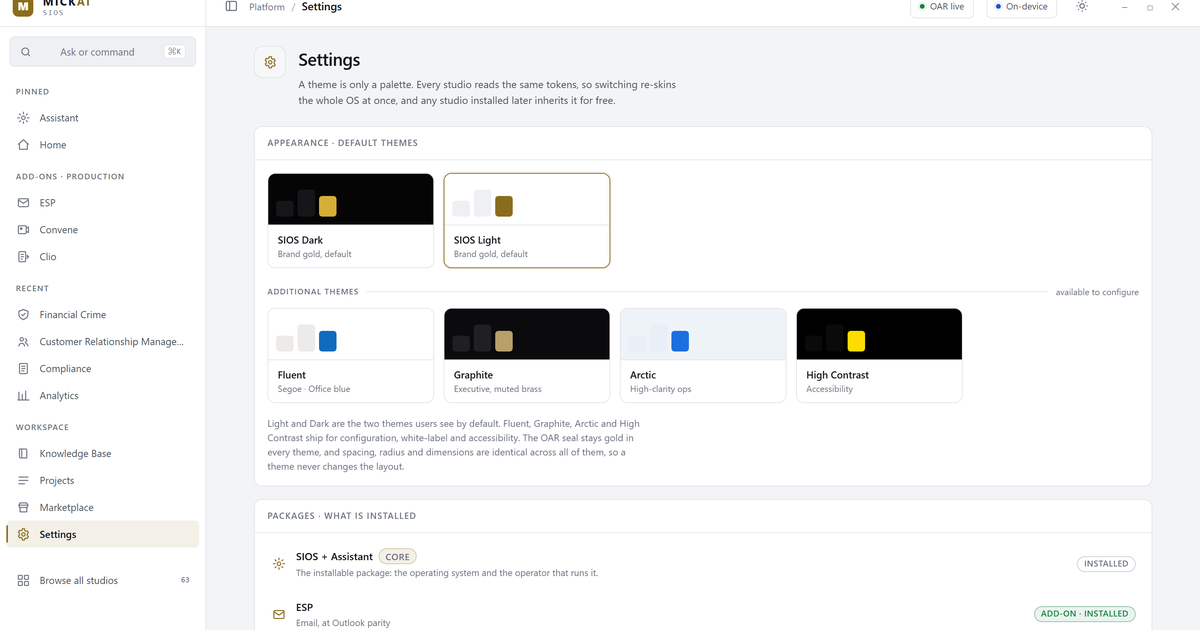
Yes. In a Sovereign Intelligence Operating System, brand and accessibility are a theme applied in one step, not a rebuild. Every surface reads its colour, logo, typography, spacing, contrast and motion from a single set of semantic design tokens, so changing the theme redraws the whole system at once. Nothing about appearance is hard-coded, which is why a setting, and not a development project, controls how it looks and how it meets your accessibility rules.
This matters because in 2026 appearance is a compliance surface, not decoration. Buyers must satisfy WCAG 2.2 accessibility duties, brand governance and procurement rules at the same time, often across many tenants and departments. When white-label is a bespoke project, every brand variant is new code that needs fresh review, fresh testing and a fresh audit trail. When it is a theme, the review is done once and the variation is configuration.
“When appearance is a set of tokens rather than code, brand and accessibility become a configuration an auditor can read, not a project a vendor must rebuild.”
How does theming as a setting actually work?
Every visual decision is expressed as a semantic token, not a fixed value. A button does not store a gold colour: it stores a reference to the action token, and the theme decides what that token resolves to. Logos, typefaces, corner radius, focus rings and animation timing are bound the same way. A theme file sets the values once, and the operating system reads them everywhere. There is no per-screen styling to chase, because no screen holds its own appearance.
What is the difference between a theme and a white-label project?
A white-label project forks the interface and maintains a second copy. A theme changes variables inside one copy. The distinction is operational. A fork drifts: a fix in one brand must be re-applied to every other. A theme cannot drift, because there is only one system and the brands are values inside it. This is why a brand, a sub-brand and a partner skin can co-exist without multiplying the code an auditor has to trust.
Can it enforce our accessibility rules, not just our colours?
Yes, because accessibility is expressed in the same tokens. Contrast, text scale, focus visibility, reduced motion and a dedicated high-contrast theme are token settings, not afterthoughts. The build can gate on them: a theme whose text fails the WCAG 2.2 AA contrast ratio of 4.5 to 1 is rejected before it ships. Accessibility stops being a manual audit at the end and becomes a rule the theme must pass to exist.
What can an auditor check when the theme changes?
Every theme change is an event in the sealed audit ledger. The record shows what changed, when, and which hardware-attested identity made the change, bound to the audit chain so it cannot be repudiated. The ledger is signed with post-quantum digital signatures, FIPS 204 (ML-DSA) as the primary standard alongside FIPS 205 (SLH-DSA), so the record stays verifiable for years. An auditor checks one signed history, not scattered stylesheets. This token and theming architecture sits within the 104 filed UK patent applications and approximately 2,340 claims owned by Mickai LTD, filed and patent pending.
Which rules make configurable theming necessary?
Several regimes push in the same direction. WCAG 2.2 and public-sector procurement make accessibility a hard requirement. GDPR and ISO/IEC 42001 expect governed, documented change. DORA, in force since January 2025, and NIS2, which covers essential and important entities, expect operational resilience and clear control over systems. On the EU AI Act, the high-risk Annex III obligations once due on 2 August 2026 were deferred by the Digital Omnibus to 2 December 2027, with embedded Annex I high-risk moving to 2 August 2028 and Article 50 transparency duties largely unchanged. We read that as a build window, not a reprieve.
How does this hold up offline and zero-egress?
Theming never leaves the estate. A SIOS runs offline on operator-owned hardware behind a zero-egress inbound perimeter, so a theme change is a local configuration, not a cloud round-trip. This is the line regulated buyers cannot cross with public cloud AI services, where configuration and data can traverse third-party infrastructure subject to foreign jurisdiction such as the US CLOUD Act. Here, brand and accessibility settings, and the audit of them, stay inside the same sealed boundary as the work.
What test can we run before we buy?
Run the one-file test. Ask for one theme file to be changed, then confirm three things: every surface updates from that single change, a theme that fails contrast is refused by the build, and the change appears as one signed entry in the audit ledger. If all three hold, appearance is genuinely a setting. If any of them requires editing screens by hand, it is still a rebuild wearing the word theme.
Frequently asked questions
Is white-label theming really one setting or a hidden rebuild?
In a token-based system it is one setting. Every surface reads from semantic tokens, so a single theme file changes colour, logo, typography, contrast and motion everywhere at once. It is only a rebuild when appearance is hard-coded into individual screens, which forces manual edits. The test is simple: change one file and see whether the whole system updates.
Can we run our brand and a partner brand at the same time?
Yes. Because brands are values inside one system rather than separate forks, a primary brand, a sub-brand and a partner skin can co-exist as different themes. Each tenant sees its own appearance while the underlying operating system stays single and consistent. No brand variant needs its own copy of the code.
Does theming cover accessibility or only visual style?
It covers both. Contrast ratios, text scaling, focus visibility, reduced motion and a high-contrast theme are token settings, so accessibility travels with the theme. The build can refuse a theme that fails WCAG 2.2 AA contrast, which makes the rule enforceable rather than aspirational.
Can an auditor prove who changed the brand and when?
Yes. Every theme change is recorded in a sealed audit ledger as a single event, showing what changed, when, and which hardware-attested identity made it. The ledger is signed with post-quantum signatures, with FIPS 204 as the primary standard, so the history stays verifiable and cannot be quietly altered.
Does changing the theme send anything to the cloud?
No. A SIOS runs offline on operator-owned hardware behind a zero-egress inbound perimeter, so a theme change is a local configuration. Nothing about your brand or accessibility settings is sent to an external service. This is the difference from public cloud services, where configuration and data leave your estate.