What is a Sovereign Intelligence Operating System, and why run enterprise AI on hardware you own?
A Sovereign Intelligence Operating System runs enterprise AI on hardware you own, offline, with every action sealed into a record you verify yourself.
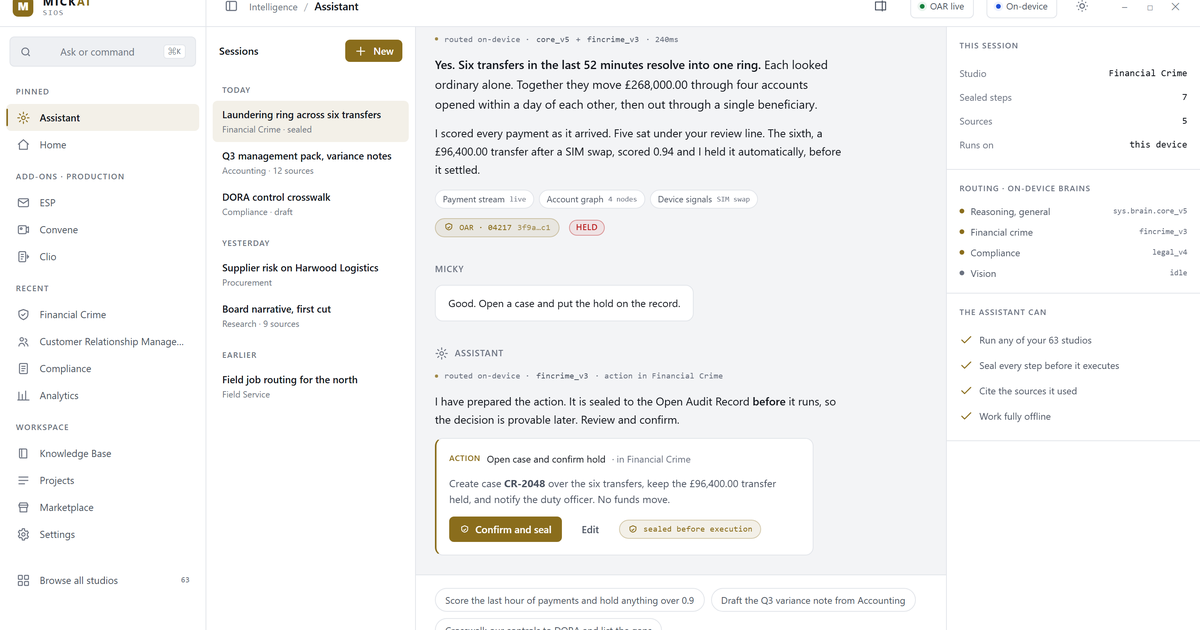
A Sovereign Intelligence Operating System, or SIOS, is enterprise artificial intelligence that runs entirely on hardware the operator owns, with no dependence on a public cloud and every action cryptographically sealed into an audit ledger the operator can verify offline. Mickai is a SIOS. It matters because the alternative, sending your data to a public AI service, means your most sensitive information leaves your control and is governed by someone else's terms and someone else's jurisdiction. Owning the hardware is what makes sovereignty real rather than rhetorical: if the model, the data and the logs never leave your building, no outside party can read them, throttle them or be compelled to hand them over.
This question has moved from theory to procurement in 2026. Regulated buyers in defence, finance, healthcare and critical infrastructure now have to prove where their data sits, who can reach it and how each automated decision was made. Public AI services cannot answer those questions on the buyer's behalf, which is why the sovereign approach has stopped being a policy slogan and become a technical specification.
What is a Sovereign Intelligence Operating System?
A SIOS is the full stack of enterprise AI installed inside the operator's own perimeter: the models, the data, the reasoning and the record. Mickai runs offline on operator-owned hardware. Nothing is rented from a public cloud and nothing phones home. The sovereign models are held locally, so the intelligence keeps working when the building is disconnected from the internet. We call it an operating system, not something smaller, because it governs how every agent and workflow inside the organisation is allowed to act, and it seals what they did.
Why does owning the hardware matter?
Ownership decides who can compel access. When your AI runs on someone else's servers, the data is subject to their jurisdiction and their legal obligations. Under the US CLOUD Act, a US provider can be required to produce data it holds, wherever in the world that data physically sits. Owning the hardware removes that exposure, because there is no third-party operator to serve with an order. It also removes the softer risks: being rate-limited, having a model version changed underneath you, or having a service withdrawn. Sovereignty is not a feeling of control. It is the physical fact that the compute, the weights and the logs sit on machines you hold the keys to.
How does a SIOS work?
A SIOS is defined by four mechanisms a public service cannot offer:
- A zero-egress inbound perimeter. Data and prompts come in. Nothing goes out. There is no outbound path to a vendor, so there is nothing to intercept or exfiltrate.
- Hardware-attested identity. Every user, agent and node proves itself through the hardware, and that identity is bound directly to the audit chain, so no action can be logged under a borrowed or forged name.
- A post-quantum signed audit ledger. Every action is sealed into an append-only ledger signed with FIPS 204 (ML-DSA), the primary post-quantum digital signature standard, with FIPS 205 (SLH-DSA) available as a second scheme. The signatures stay verifiable against tomorrow's cryptographic threats, not only today's.
- Cross-model consensus. High-stakes outputs are checked by more than one sovereign model, so a single model's error or hallucination does not pass unchallenged.
“Sovereignty is not where your AI is marketed from: it is whether the model, the data and the audit trail can be produced and independently verified without anyone outside your walls being involved.”
What can an auditor actually check?
The test of a sovereign system is whether an auditor can verify it without trusting the vendor. With Mickai, they can. Offline verifiability means an auditor takes the signed ledger and confirms, on an air-gapped machine, that each record is authentic and unaltered, using the public verification keys alone. They do not need to call us. They do not need a network connection. The named test is simple: hand the auditor the ledger and the verification key, disconnect the machine, and ask them to prove the chain. If a single record had been changed, added or removed, the signature check fails. That is the difference between a log you are asked to believe and a record you can prove.
What does a SIOS replace?
A SIOS replaces the public AI subscription for any work that touches regulated, confidential or classified data. In practice, the tasks organisations currently send to ChatGPT, Claude or Gemini, drafting, analysis, summarisation, code, research and decision support, are brought back inside the perimeter and run on sovereign models instead. It also consolidates the sprawl of point solutions, each with its own data-sharing terms, into one governed environment. The public services remain well suited for open, non-sensitive work. The SIOS exists for everything a regulated buyer cannot lawfully or safely put into them.
Which rules make this necessary?
Several regimes now push in the same direction, and the timing shifted in 2026:
- The EU AI Act. The high-risk obligations under Annex III, originally due on 2 August 2026, were deferred by the Digital Omnibus to 2 December 2027, with embedded high-risk systems under Annex I moving to 2 August 2028 and the Article 50 transparency duties largely unchanged. We read the delay as a build window, not a reprieve.
- DORA, in force since January 2025, requires financial entities to control and evidence their operational resilience, including third-party and ICT risk.
- NIS2 extends binding security duties across essential and important entities in critical sectors.
- GDPR still governs where personal data may be processed and transferred.
- ISO/IEC 42001 gives a certifiable standard for managing an AI system responsibly.
A sovereign architecture is the most direct way to answer the underlying question every one of them asks: can you show, exactly, where the data went and what the system did?
Frequently asked questions
Is a Sovereign Intelligence Operating System just AI running on premise?
Not quite. On premise describes location only. A SIOS adds the governance and the proof: a zero-egress perimeter, hardware-attested identity, and a post-quantum signed audit ledger an auditor can verify offline. Running a model on your own server without those controls gives you privacy but not provable sovereignty.
Can a SIOS work completely offline?
Yes. Mickai holds its sovereign models locally and runs with no internet connection. Air-gapped operation is a design goal, not a degraded mode. That is what makes it usable in defence and critical infrastructure settings where an outbound connection is prohibited.
Why can't regulated organisations just use ChatGPT, Claude or Gemini?
Those are public cloud services. Data sent to them leaves the organisation's control and its jurisdiction, which regulated buyers in defence, finance and healthcare often cannot permit. They also cannot give an auditor an independently verifiable record of every action. A SIOS keeps the data inside the perimeter and produces that record.
How are the audit logs protected against future attacks?
The ledger is sealed with post-quantum digital signatures, FIPS 204 (ML-DSA) as the primary standard and FIPS 205 (SLH-DSA) as a second. These are designed to withstand attacks from quantum computers, so a record signed today stays verifiable and tamper-evident for years to come.
Who owns the technology behind Mickai?
The intellectual property behind Mickai is 104 filed UK patent applications, approximately 2,340 claims, owned by Mickai LTD; never granted or patented. All remain patent pending. The architecture, the sovereign models and the sealed audit design are held and operated by the buyer on their own hardware.