Should a trade union let member data anywhere near cloud AI?
No, because membership itself is special category data and the confidentiality promise to members should be structural, not contractual.
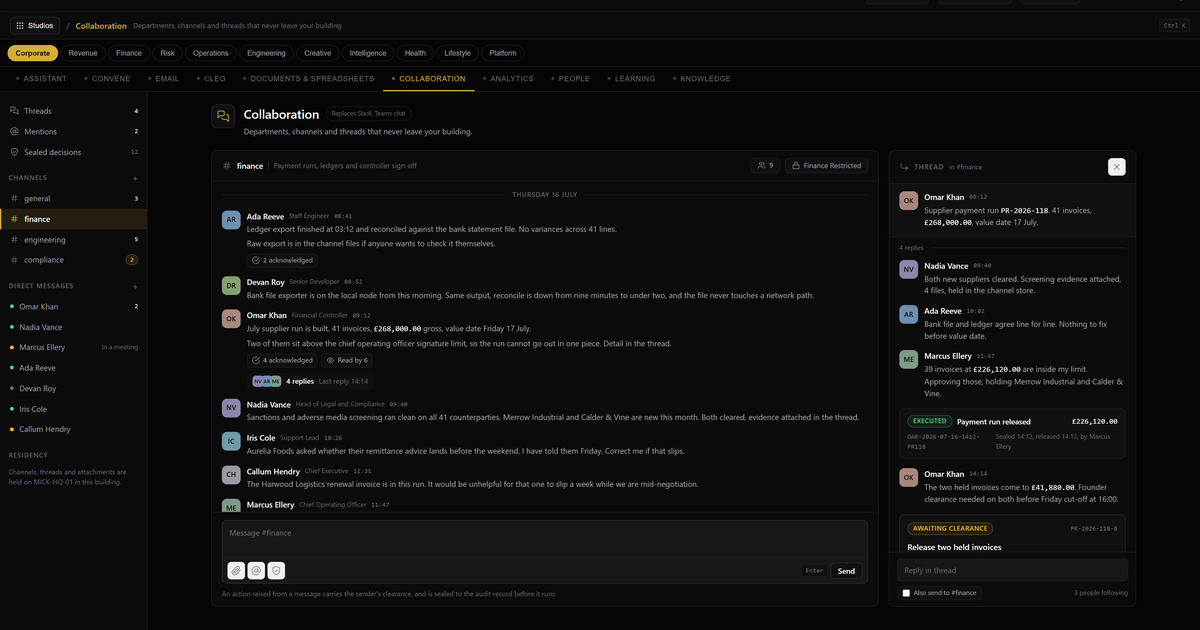
No. Trade union membership is itself special category data under UK GDPR Article 9, so a union's entire membership database sits in the highest protection class before a single case file is opened. That does not put AI off limits for unions. It means the processing belongs on infrastructure the union itself controls, with role-limited access and a sealed record of every action, because the confidentiality promise to members should be structural rather than a clause in a vendor's terms.
The question matters in 2026 because unions carry heavy casework and correspondence loads with small staff teams, and AI drafting is a genuine gain they should not have to forgo. The issue is not whether unions use AI. It is whether member data ever leaves the union's hands in the process.
Why is membership data itself in the highest protection class?
Because the statute says so explicitly. UK GDPR Article 9 lists trade union membership alongside health data, religious belief and political opinion as special category data. The protected fact is membership itself, not merely what a case file says, so even a plain list of names and branches is in the highest class before any grievance, disciplinary or injury claim is added. There is no such thing as a low-sensitivity union dataset that includes members.
What actually sits in a union's files?
The most consequential material members ever share. Casework files hold grievances, disciplinaries, health and injury claims and employment disputes, told from the member's side and often naming colleagues and managers. Organising data reveals who is active, who is recruiting and where campaigns are building. All of it is given on a single understanding: the union keeps it. A member who thought the employer might ever see it would not have spoken.
What is the structural problem with cloud AI for a union?
Dependence, not accusation. A union routinely acts against employers, and some of the organisations unions face across the table operate or supply the cloud infrastructure on which consumer AI services run. There is no suggestion that any provider misuses customer data; the point is architectural. Confidentiality that depends on the controls, contracts and personnel of infrastructure the union does not operate is a policy, and the union's promise to members deserves more than a policy. When the processing runs on union-owned hardware, the question of who else could touch the data does not need an answer, because there is no one else.
What does the blacklisting history teach?
That leaked union data ruins working lives, and slowly. The construction blacklisting scandal, exposed in 2009 when the Consulting Association's files came to light, showed union activity records being used against workers over many years, and the Blacklists Regulations 2010 exist because of it. The lesson for AI adoption is direct: a union's data describes real people whose livelihoods depend on confidentiality, and the history of that data being aggregated and misused is not hypothetical. Any new processing of member data should be judged with that history in view.
What can a union safely use AI for?
The drafting and synthesis around representation:
- Summarising casework files so a rep walks into a hearing prepared.
- Drafting correspondence, submissions and member communications.
- Digesting employer proposals and consultation documents at speed.
- Routine organising administration, from minutes to branch reports.
The scope stays honest: judgements about a member's case, negotiating positions and industrial strategy stay with officers and reps. AI shortens the paperwork, not the representation.
What should members be able to verify?
That the promise holds in the architecture, not just the rulebook. On Mickai, a Sovereign Intelligence Operating System, processing runs entirely on hardware the union owns, access is limited by role so a branch rep sees only their own cases, and every AI action is sealed to an audit ledger signed under FIPS 204, the primary post-quantum digital signature standard. The record verifies offline, which means the union can demonstrate to its members, and if necessary to a tribunal or regulator, exactly what was processed and by whom, without asking anyone to take its word.
“A union's promise to its members is confidentiality, and only infrastructure the union controls can make that promise structural.”
How the full architecture holds that promise together is set out at /sovereign-ai, and the film at /film shows the interface in operation.
Frequently asked questions
Can our union use ChatGPT to draft casework letters?
Not with member-identifying content. Anything naming a member is special category data by default, and putting it into external AI services such as ChatGPT, Claude, Gemini or Microsoft 365 Copilot means it leaves the union's control. Drafting help is legitimate and valuable; it belongs on infrastructure the union runs itself.
Is a membership list really special category data if it is just names?
Yes. UK GDPR Article 9 protects the fact of trade union membership itself, so a bare list of members is in the same protection class as health data. The sensitivity does not come from what the file says about a person; it comes from what inclusion in the file reveals.
What does the blacklisting scandal have to do with AI?
It is the clearest record of what aggregated union data does in the wrong hands. The Consulting Association files, exposed in 2009, affected workers for years and led to the Blacklists Regulations 2010. AI adoption multiplies the places member data could flow, which is why unions should adopt it only inside a boundary they control.
Can a rep use AI on a member's grievance file?
Inside the union's own boundary, yes: summarising the file, building a chronology and drafting submissions are exactly where AI helps. Access should be limited to the rep handling the case, the member's data should never leave union infrastructure, and the sealed record should show what was done.
How would a union show members its AI is trustworthy?
By showing the record rather than the policy. A sealed, verifiable ledger of every AI action, held on union-owned hardware and checkable offline, lets a union answer a member's question about their own data with evidence. That standard, oversight a member can verify, is the one unions already apply to ballots and accounts.