Sovereign AI for recruitment agencies
Run recruitment, CRM, email and documents on one sovereign OS you own. Candidate data stays in the building. One assistant screens and matches.
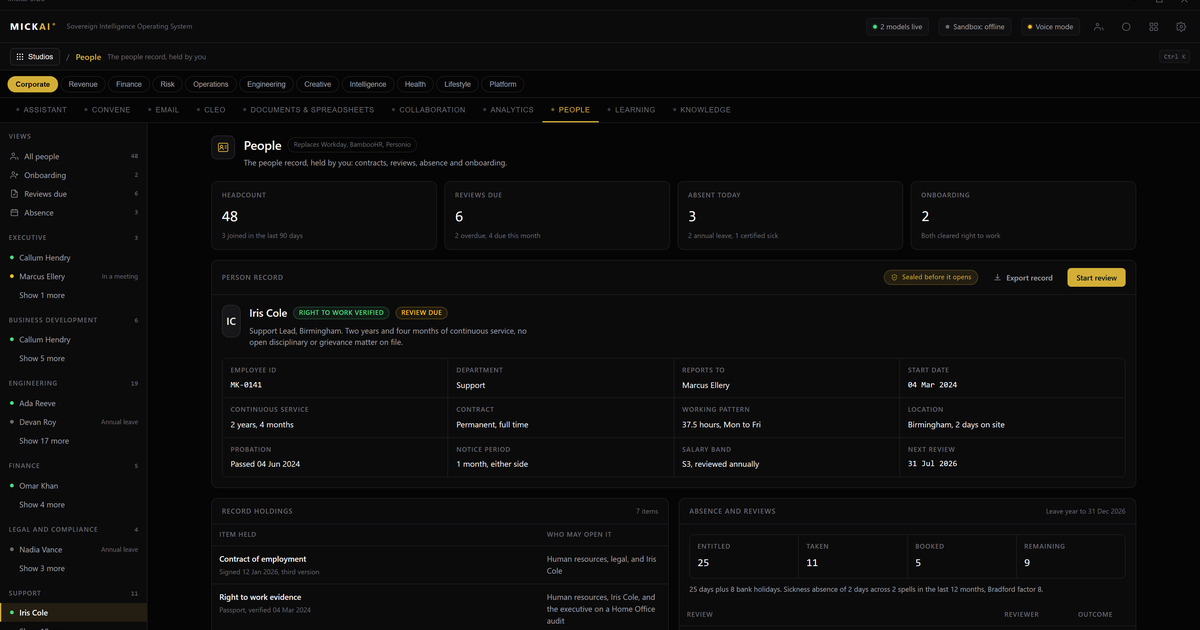
Recruitment agencies run on other people's software and other people's servers. We give you the whole stack on hardware you own: the recruitment desk, the CRM, the email system, the documents platform and one assistant across all of it, with candidate data that never leaves the building. You stop renting Salesforce, Bullhorn, Microsoft and the rest, and you keep the one asset the business is actually built on, which is the data.
The problem with renting your agency's core
A staffing agency is a data business. Candidate CVs, client contact records, placement history, rate cards, interview notes, right-to-work documents. Today most of that sits in tools you rent by the seat: an applicant tracking system, a CRM, an email suite, a meetings tool, a document store. Each one holds a copy of your candidates. Each one charges per consultant per month. None of them talk to each other without more software in the middle.
Two costs follow. The obvious one is the monthly bill, which grows every time you add a desk. The quieter one is control. Your candidate database, the thing a competitor would pay for, lives on servers you do not own, governed by terms you did not write, in a place you cannot point to when a candidate asks where their data is.
Sovereign AI reverses that. The studios an agency needs run on one operating system, on your hardware, sharing one store of your own data.
The studios an agency actually runs
You do not get an app. You get a set of studios on one sovereign operating system, and they share the same candidate and client data underneath.
The recruitment desk. Vacancies, candidate pipelines, submissions, interviews, placements. A consultant works a role from brief to offer in one place, and the pipeline is the same data the assistant reads to find matches.
The CRM. Clients, contacts, jobs, activity and rate cards. Because it sits on the same operating system as the recruitment desk, a placement updates the client record without an export or an integration.
The email system. Consultant inboxes, candidate and client correspondence, templates and sequences. Mail is tied to the record it belongs to, so the thread with a candidate lives against that candidate, not in a separate silo.
The documents platform. CVs, contracts, right-to-work evidence, terms of business. Parsed once, stored once, available to every studio that needs them.
The meetings platform. Interviews and client calls, with notes that write back to the candidate or client record.
One operating system, one store, one login. Not five subscriptions bolted together.
Candidate data stays in the building
This is the part that changes the risk profile of the whole agency. The system is air-gapped by default and runs on hardware you own. Candidate CVs, right-to-work documents, interview notes and client contracts sit on your machine, in your office, under your control.
When a candidate exercises a data subject access request, you can answer from one store instead of hunting across five vendors. When a client audits how you handle their data, you can show them the building it lives in. When you decide to change how you work, you are not asking a vendor for an export of your own database.
Private deployment on someone else's cloud is the baseline the market already offers. We go past it. The value is that the data is physically yours, the system runs with no outbound connection, and every action the AI takes is recorded.
One assistant that screens and matches
Across every studio sits one assistant. It reads the same data the studios hold, which is what makes it useful rather than decorative.
Give it a live vacancy and it ranks your existing candidates against the brief, drafts a shortlist with the reasoning attached, and surfaces the ones a keyword search would miss. Point it at a new CV and it parses the document, fills the candidate record, and tells you which open roles it fits. Ask it to prepare a client update and it pulls the pipeline from the recruitment desk and drafts the email in your system.
It works the whole desk because it can see the whole desk. The recruitment studio, the CRM, the documents and the email are one operating system, so the assistant is not integrating across vendors, it is reading one store.
A consultant stays in charge. The assistant drafts, ranks and prepares. A person approves, edits or rejects before anything reaches a candidate or a client. And every step is logged.
The Open Audit Record
Screening and matching touch people's personal data, so the question a regulator or a client asks is simple: what did the AI do, and with whose data. The Open Audit Record answers it at the level of the action, not the login.
Every time the assistant reads a candidate record, produces a shortlist, or drafts a message, the system writes down what happened: which record, what was produced, who approved it. It is a factual account of AI activity against personal data, ready for a GDPR request, a client audit or an internal review. Access logs tell you someone opened a file. The Open Audit Record tells you what was done with it.
What you stop renting
Here is the method for the money, using published list prices as reported public facts. We state the assumption and let you put your own numbers in; we quote no MICKAI price.
Take an agency of 40 people. Consultants typically carry a CRM or ATS seat, a business productivity suite and a communications tool. As reported public list prices, per user per month: Microsoft 365 Business Standard is listed at 12.50 US dollars, and Salesforce Sales Cloud Enterprise is listed at 165 US dollars per user per month. A staffing-specific ATS is often quoted in a similar band to the CRM.
The worked example is users times price times 12. For the productivity suite: 40 users times 12.50 dollars times 12 months is 6,000 dollars a year. For the CRM at Enterprise list: 40 times 165 times 12 is 79,200 dollars a year. Add a per-seat ATS in the same band as the CRM and the CRM-plus-ATS line alone runs into six figures annually. Communications and meetings tools stack on top.
Those are list prices, before the discounts larger buyers negotiate, and the point is the shape, not the exact figure. The bill scales with every desk you add, forever, and at the end of it you own none of the software and none of the servers. Owning the stack turns a permanent per-seat rent into hardware and a system you keep.
The focus here is the regulated small and mid-sized firm, because that is where the per-seat rent bites hardest and where owning the data matters most.
Built on a sovereign operating system
None of this is a single clever app. There are 63 studios on one sovereign operating system, sharing your own data, run on hardware you own. The underlying intelligence layer reads across the studios so the assistant can screen, match and draft against the live desk, and it does so locally, with no model to send your candidates out to.
The work sits on a patent estate of 104 filed UK patent applications carrying 2,340 claims. Those are filed, not granted, and they cover how the operating system, the audit record and the studios fit together. The system reaches the market through a distribution partner.
For a recruitment agency the offer is plain. Keep the desk, the CRM, the email, the documents and the assistant. Keep the candidate data in the building. Own the stack instead of renting it, and hold a factual record of everything the AI did with the people in your database.
Frequently asked questions
Where does candidate data live? On hardware you own, inside your building. Every studio reads and writes the same store, so a CV parsed once is available to the CRM, the email system and the assistant without leaving your walls.
Do we still need Salesforce, Bullhorn or a separate ATS? No. Recruitment, CRM, email, meetings and documents are studios on one operating system. You stop paying per seat for each and stop stitching them together.
Can it run without an internet connection? Yes. The system is air-gapped by default. The assistant and the studios run locally, so screening and matching continue with no outbound connection.
How does the assistant screen and match candidates? It reads the same data the studios hold, ranks candidates against a live vacancy, drafts the shortlist and logs every step in the Open Audit Record. A consultant approves or edits before anything goes out.
What proves what the AI did with someone's data? The Open Audit Record captures actions at the point they happen: which record was read, what the assistant produced, who approved it. It is a factual log for a GDPR request or a client audit.
Is this only for large agencies? No. The focus is the regulated small and mid-sized firm. Owning the stack removes per-seat rent, which is where smaller agencies feel the cost most.
Frequently asked questions
Where does candidate data live?
On hardware you own, inside your building. Every studio reads and writes the same store, so a CV parsed once is available to the CRM, the email system and the assistant without leaving your walls.
Do we still need Salesforce, Bullhorn or a separate ATS?
No. Recruitment, CRM, email, meetings and documents are studios on one operating system. You stop paying per seat for each and stop stitching them together.
Can it run without an internet connection?
Yes. The system is air-gapped by default. The assistant and the studios run locally, so screening and matching continue with no outbound connection.
How does the assistant screen and match candidates?
It reads the same data the studios hold, ranks candidates against a live vacancy, drafts the shortlist and logs every step in the Open Audit Record. A consultant approves or edits before anything goes out.
What proves what the AI did with someone's data?
The Open Audit Record captures actions at the point they happen: which record was read, what the assistant produced, who approved it. It is a factual log for a GDPR request or a client audit.
Is this only for large agencies?
No. The focus is the regulated small and mid-sized firm. Owning the stack removes per-seat rent, which is where smaller agencies feel the cost most.