Sovereign AI for medical and dental practices
The studios a medical or dental practice runs on its own hardware. Records, scheduling, documents and email, with patient data kept in the building.
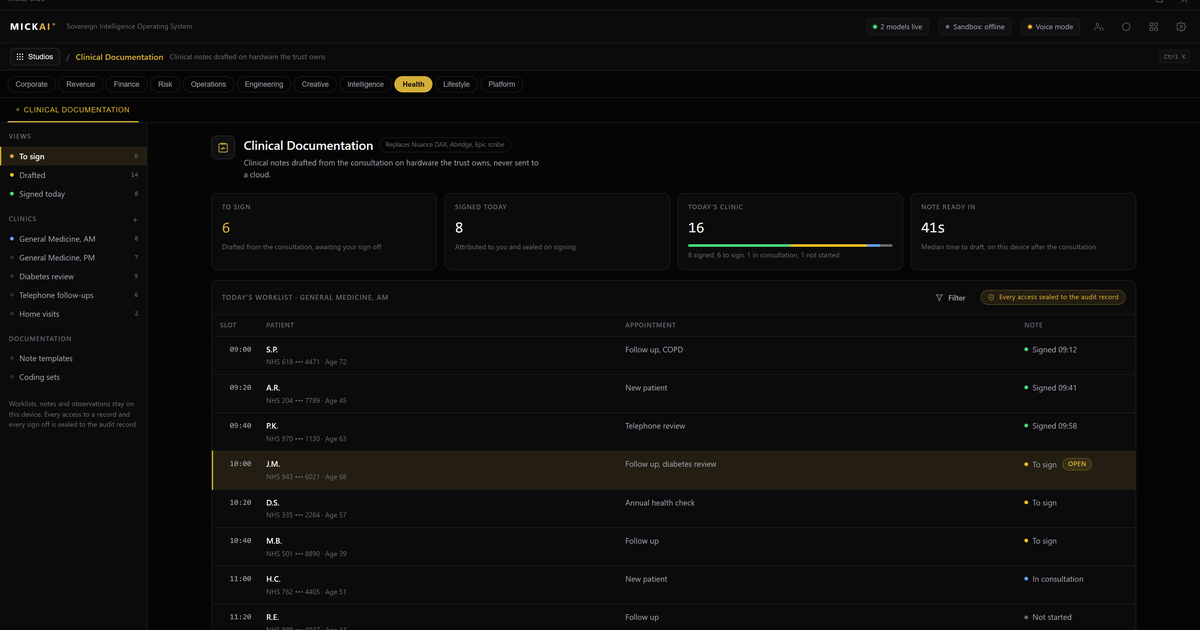
A medical or dental practice can run its records access, scheduling, documents and email on hardware it owns, with patient data kept inside the building. The studios sit on one sovereign operating system, share the practice's own data, and answer to a single assistant. Nothing has to leave the premises for the software to work.
That is the whole idea. Most practices today rent their day-to-day software from several large vendors, pay per user per month, and accept that patient-adjacent data moves through systems they do not control. We keep the practical benefit and remove the dependence.
What a practice actually gets
The tools a practice uses every day are ordinary software: email, a calendar, documents and storage, meetings and chat, and the contact tools used to reach patients. We run equivalents as studios on the MICKAI sovereign operating system.
- Our email system and shared calendar, for staff mail and appointment coordination.
- Our documents and storage, for referral letters, consent forms, treatment plans and the paperwork a practice generates all day.
- Our scheduling, for the appointment book and recalls.
- Our meetings and chat platforms, for the practice team and for remote consultations where you already do them.
- Our CRM, for patient contact history, reminders and follow-up, kept as the practice's own record.
- One assistant across all of it, so a member of staff can ask a plain question and get an answer drawn from the practice's own data.
These are not separate apps stitched together. They are studios on one operating system, reading and writing to the practice's own store. That is what makes the assistant useful: it can see across records, schedule and documents because they live in the same place, under the same control.
Where the data lives
The point that matters most in a clinical setting is residency. When you run these studios, patient data sits on hardware you own, inside your practice. The software does not need a third-party cloud to function. It can run air-gapped, with no route out to the public internet at all.
This is not a promise about a data centre in the right country. It is the machine in your building. Access to the record is access someone has to be standing in your practice, or on your own network, to obtain. For a small or mid-sized practice that has never had that level of control, it changes the risk picture.
What we do not claim
We are careful here on purpose. We do not make clinical decisions, we do not diagnose, and we do not offer treatment advice. We are not a medical device and we hold no clinical certification. The clinician's judgement and the regulated clinical systems a practice already relies on stay exactly where they are.
We also hold no security certifications, and we do not claim any as held or in progress. What we describe is what the architecture does: your data in your building, an action-level audit record, and air-gapped operation by default. Your own compliance sign-off remains yours and your advisers'. We give you a system that is easier to reason about, not a badge to hide behind.
The money side
The clearest saving is the software you stop renting. The everyday productivity stack is sold per user per month, and a practice pays it for every member of staff, every month, forever.
Take a published figure as a public fact. Microsoft's UK list price for Microsoft 365 Business Standard is £10.30 per user per month. That covers email, calendar, the Office apps and storage. It does not, on its own, cover the meetings, chat and CRM tooling many practices also pay for.
Here is a conservative worked example, on that one line item alone. The assumption is a practice with 20 staff, each on Business Standard at the £10.30 UK list price:
20 users times £10.30 times 12 months = £2,472 per year.
Add the tools that usually sit alongside it and the annual bill climbs well past that. A practice paying separately for a meetings and chat suite, and for a CRM or patient-contact platform, is often running three or four per-seat subscriptions at once. Each follows the same shape: seats times price times twelve, every year, rising as the vendor's list price rises and as you add staff.
The method is the honest part. Count your seats, take each vendor's published per-user price, multiply by twelve, and add the lines together. That is your rented software bill. When those functions run as studios on hardware you own, that recurring per-seat bill is what you are no longer paying. We do not publish a MICKAI price here. We are showing you the incumbent cost you can measure today.
One operating system, one assistant
The reason this holds together is that everything is one system rather than a shelf of products. The email, the documents, the schedule and the patient record are studios on the same operating system, sharing the practice's own data. So the assistant is not a chatbot bolted onto the side. It can draft a recall letter from the appointment book, find the consent form attached to a patient's record, or pull the week's schedule, because all of it is in one place under one set of controls.
Every action the assistant and the studios take is written to an Open Audit Record at the level of the action itself, not just a login line. In a setting where you may one day need to show who did what and when, that record is part of the product, not an add-on.
We do not name the intelligence layer's underlying model, and it does not matter to the practice. What matters is what it does for the studios: it reads the practice's own data, on the practice's own hardware, and helps staff move faster through ordinary work without that data leaving the building.
How practices start
No one rips everything out on a Monday. Most practices begin with the pieces that are safe and obvious: email and shared calendar, documents and storage, and the appointment book on their own hardware. Clinical systems stay in place. Then studios are added as rented seats are retired, at the practice's pace. The assistant works across whatever is switched on, so the system gets more useful as more of it comes home.
The wider picture
We are a British company with 104 filed UK patent applications covering 2,340 claims. Filed, not granted. The 63 studios on the operating system span far more than a medical practice needs, which is the point: a practice turns on the handful it uses and ignores the rest, and the same sovereign foundation is there if it grows.
Private deployment from a large provider is the baseline we start from, not the story we tell. Our value is what sits beyond it: the action-level audit record, air-gapped operation by default, the whole software stack rather than a single model to integrate, and a deliberate focus on the regulated small and mid-sized firm. A medical or dental practice is exactly that firm. It handles sensitive data, it is accountable for it, and it has rarely been given software it can genuinely own.
That is what we offer. The tools your practice runs every day, on hardware you own, with patient data in the building, and one assistant across all of it.
Frequently asked questions
Where does patient data live when we run MICKAI?
On hardware you own, inside your practice. The studios read and write to your own store. Nothing is sent to a third-party cloud to make the software work, and the system can run air-gapped.
Is this a clinical system or a medical device?
No. We do not make clinical decisions, offer diagnosis, or claim any medical certification. We run the practice around the clinician: records access, scheduling, documents, email and a shared assistant. Your clinical judgement and your regulated clinical systems stay yours.
What does it replace?
The everyday software a practice rents: email and calendar, documents and storage, meetings and chat, and the CRM-style tools used for patient contact. You run equivalents as studios on one operating system instead of paying per user per month to several vendors.
How is this different from private cloud from a big provider?
Private deployment is our baseline, not our headline. Beyond it we add an action-level Open Audit Record, air-gapped operation by default, and the whole software stack rather than a single model you have to integrate. Our focus is the regulated small and mid-sized firm.
Do we need to name every studio and rip everything out at once?
No. Most practices start with email, documents and scheduling on their own hardware, keep clinical systems in place, and add studios as they retire rented seats. One assistant works across whatever you have switched on.
Are you certified to a security standard?
We hold no certifications and we do not claim any as in progress. We describe what the architecture does: your data in your building, an audit record of actions, and air-gapped operation. Your own compliance sign-off stays with you and your advisers.