Sovereign AI for manufacturers
Inventory, orders, procurement, finance and documents as studios on one sovereign OS, on hardware you own, data kept in the building.
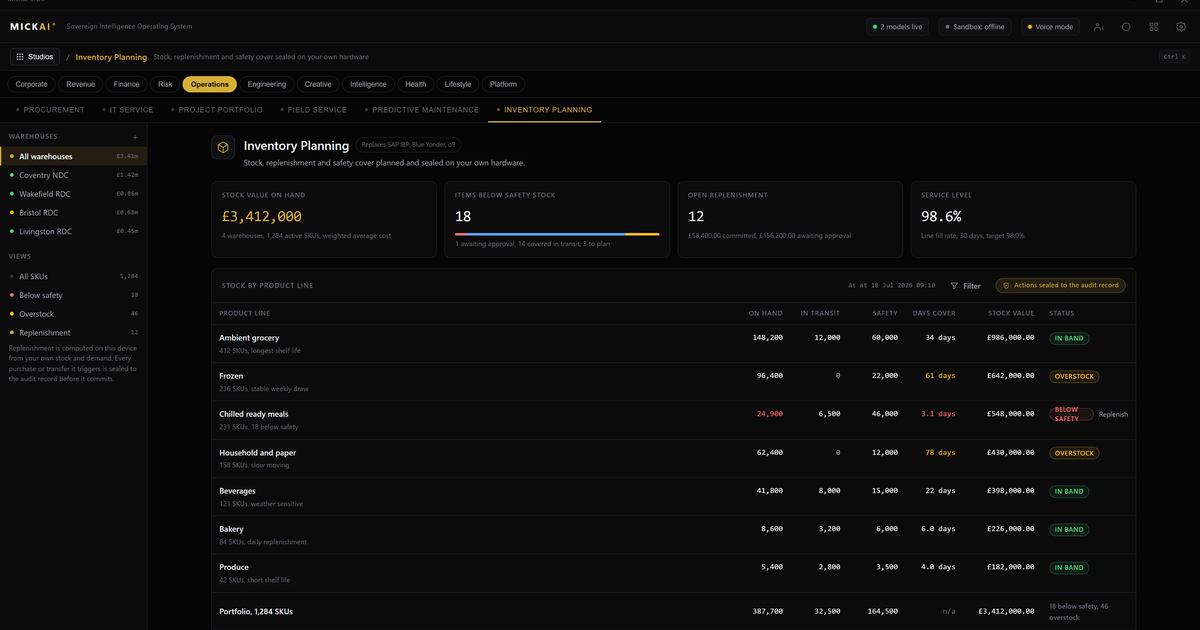
A manufacturer can run its inventory, orders, procurement, finance and documents as studios on one operating system, on hardware it owns, with the operational data kept inside the building and isolated from the network where it needs to be. That is what we build. It ends the arrangement where the records that run your plant live in other companies' clouds and never quite agree with each other.
The data that runs a plant should not be rented
A factory generates the records that matter most to it and then, in the usual setup, hands them out. Stock levels sit in one vendor's cloud. Orders sit in another. Purchasing lives in a third. Drawings and specifications are in a document tool from a fourth. Finance is a fifth subscription. Each is a monthly seat fee, and between them sits the work no one costs: the exports, the nightly syncs, the reconciliation when two systems disagree about how many of a part you actually have.
We build these as studios on the MICKAI sovereign operating system. The inventory, the bills of materials, the work orders, the purchase orders, the supplier terms, the drawings and the ledger all sit on hardware you own. The software runs there. Nothing has to leave the site for the plant to run.
The studios a manufacturer gets
Five studios cover the spine of a manufacturing operation, and they are one system, not five products.
Inventory and stock. Parts, raw materials, work in progress and finished goods, with locations, lot and serial tracking, reorder points and live counts. The stock figure is one record, not a number that three tools each hold a different version of.
Orders. Sales orders in, work orders on the floor, fulfilment out. A customer order becomes a build becomes a despatch as the same records moving through the studios, not a re-keying exercise at each step.
Procurement. Suppliers, quotes, purchase orders, goods receipts and lead times. When stock drops below its reorder point, the purchase order draws on the same supplier records the buyer already maintains.
Finance. The general ledger, sales and purchase ledgers, invoicing, costing and management reporting, joined to the orders and procurement that create the figures. Job costs are read from the real materials and labour, not estimated in a separate spreadsheet.
Documents. Drawings, specifications, work instructions, certificates and quality records, versioned and searchable, tied to the parts and orders they belong to. A revision to a drawing is visible to the people building against it.
Each is a studio on one operating system, sharing one data layer. That is the difference from a stack of subscriptions.
Operational data in the building, isolated where needed
Manufacturers have a boundary that most software ignores: the shop floor and the office are not the same trust zone, and neither is the same as the internet. Our operating system respects that.
The inventory and production studios can run on a network segment with no path to the outside. The machines that hold your stock records and your work orders do not need to reach a vendor's cloud to function, because the software that runs them is on your hardware. Air-gapped by default is not a mode you switch on for a demo. It is how a studio can run.
Where a studio does need outside contact, a supplier portal, a customs filing, a bank feed, that connection is yours to define and it sits on the connected side of the boundary you drew. The crossing is a controlled action, and it is logged. You are not trusting a vendor's assurance about where your production data goes. You are deciding, on your own network, and keeping the proof.
One assistant across the plant
One assistant works across the studios, on your data, on your hardware. Because the studios share one data layer, it reasons over the whole plant at once.
Ask it to raise a purchase order when a part drops below its reorder point, and it does, with the right supplier, quantity and terms. Ask why a job ran over on margin, and it reads the costing against the materials and labour actually booked. Ask it to draft a work instruction from a drawing revision, and it produces one tied to the part. Ask for every document that references a part number before an engineering change, and it finds them across the document studio.
It does not send your production records to someone else's model to do this. The intelligence layer runs inside your deployment and serves the studios directly. What it does for the studios is the point, not what sits underneath it. And every action it takes is written down.
The Open Audit Record
Manufacturing is a record-keeping business as much as a making business. When a customer, an auditor or a regulator asks how a part was built, what revision it was built to, who changed the stock figure or when a supplier's certificate was received, you need an answer that is a record and not a reconstruction.
Our platform keeps an action-level Open Audit Record. Not just that a figure changed, but who or what changed it, when, from what to what, and in which studio. A planner adjusting stock, the assistant raising a purchase order, a batch closing a work order, all of it recorded at the level of the action. For a regulated small or mid-sized manufacturer, this is the difference between an activity log inside a vendor's system and a provable record inside a system you own.
The cost, done honestly
We do not publish a MICKAI price, and we set it in a briefing against your deployment. What we will do is give you the method to weigh the rented stack you run today, so the comparison is yours to compute rather than a figure we chose.
Take each tool the plant rents. For inventory, orders, procurement, finance and documents, most manufacturers are paying per user per month across several vendors. Business productivity and collaboration seats sit alongside them. Microsoft 365 and Google Workspace publish their per-user monthly plans openly. A customer platform such as Salesforce publishes per-user monthly tiers that run well into the tens of pounds and, on the upper plans, past a hundred. A messaging tool such as Slack publishes a per-user monthly price. The method is the same for each: take the current published list price per user per month, multiply by the number of users who need it, multiply by twelve.
A worked example, stated as an assumption and not a claim about your business: suppose fifty people need a collaboration and messaging seat at a combined published rate of 20 pounds per user per month. That is 50 times 20 times 12, which is 12,000 pounds a year, for two tools, before the ERP, the document system and the customer platform are added. Put the real plans you are on into the same arithmetic and you have your annual rent. It recurs every year, rises with headcount and with each vendor's price change, and converts to no ownership of the software or unconditional control of where your data sits.
Against that, the studios are one operating system on hardware you own or buy once. The comparison is not seat fee against seat fee. It is a recurring rent, forever, across several vendors, against owning the whole stack and your own data.
Who this is for
We build for the regulated small and mid-sized manufacturer: large enough to feel the seat fees and the sync tax across a stack of tools, and regulated enough to need proof of how a part, a figure or a certificate came to be. Private deployment is where others stop. We go past it, with an action-level record, an air-gapped default, the whole software stack rather than a model to wire up, and one assistant across the plant.
The stock is yours. The orders, the purchasing, the books and the drawings are yours. The hardware is yours, and the boundary between the floor and the outside is drawn by you. That is the offer.
Frequently asked questions
Where does our operational data live?
On hardware you own, inside your own building. Stock levels, bills of materials, purchase orders, supplier terms, drawings and finance records all sit on your own machines. Nothing has to leave the site for the studios to work, and any studio can run air-gapped by default.
Can we isolate the shop floor from the wider network?
Yes. The inventory and production studios can run on a segment with no path to the internet, while the studios that need outside contact stay on the connected side. You decide the boundary, and every crossing is a controlled, logged action rather than an assumption.
How is this different from private hosting of an ERP or MES?
Private deployment is the baseline we start from, not the finish line. Our value is beyond it: an action-level Open Audit Record of every change, an air-gapped default, the whole software stack rather than a model you integrate, and a focus on the regulated small and mid-sized manufacturer.
Do the studios share data or do we still reconcile between systems?
They share one data layer. A part, a work order and the invoice raised against it are the same records seen from inventory, production and finance. There is nothing to export and nothing to reconcile between disconnected tools, because the tools are one operating system.
What does the assistant do on a factory's data?
It works across the studios on your records. Raise a purchase order from a low-stock alert, explain a margin move on a job, draft a work instruction, find every drawing that references a part, or answer a question about a supplier's lead time. Every action it takes is written to the Open Audit Record.
Do you replace our people or our machines?
No. The studios hold the records and keep them clean, joined and auditable. Your planners, buyers and finance team work inside them. We give them one system across the plant instead of a stack of rented tools that do not talk to each other.