Sovereign AI for insurance brokers
The studios an insurance broker runs on one sovereign operating system, with policyholder data in the building and one assistant across quoting and renewals.
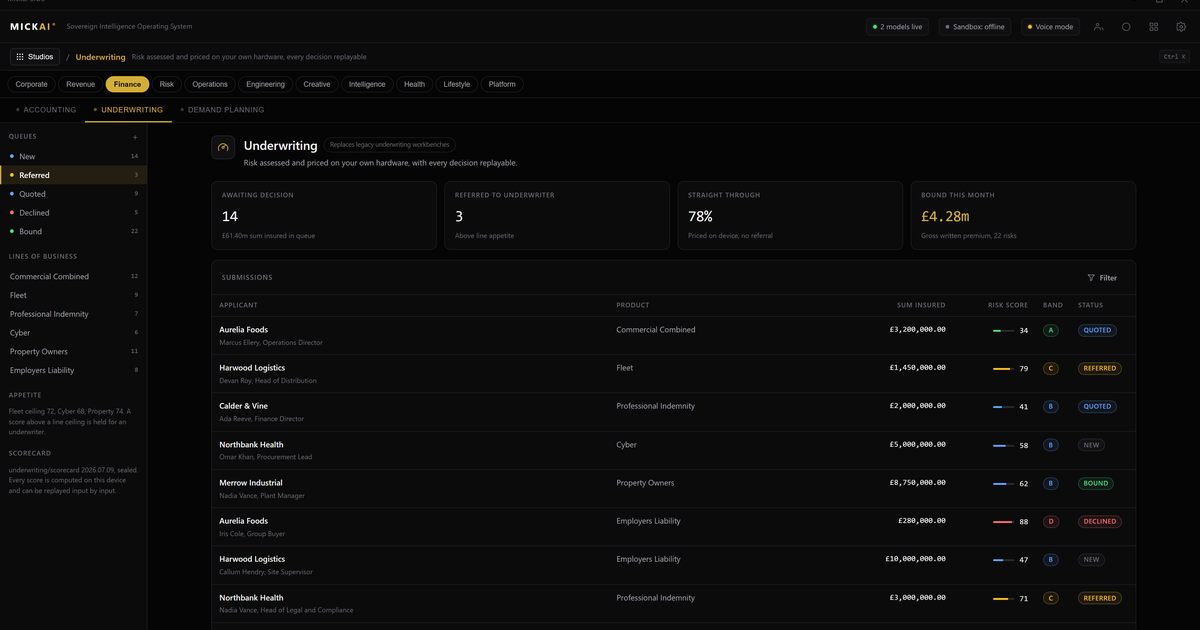
An insurance broker runs on a dozen rented tools: email, documents, chat, a CRM, a compliance folder somewhere. We replace that stack with studios on one sovereign operating system, running on hardware the broker owns, with policyholder data in the building and one assistant across all of it. You stop renting Microsoft, Google, Slack and Salesforce, and you stop shipping client records to other people's clouds to get any work done.
The stack a broker actually runs
Look at a working day. A broker takes an enquiry by email, pulls the client's history from the CRM, drafts a quote comparison in a document, chases the insurer over chat, books a review call, and files everything for the compliance record. Today each of those steps sits in a different subscription, owned by a different vendor, holding a different copy of the same client's data.
We give the broker the same jobs as studios on one operating system. Our email and calendar system. Our documents and shared drives. Our chat and our meetings platform. Our CRM. Our reporting and dashboards. They are not separate apps stitched together by integrations. They are studios on one operating system, reading and writing the firm's own single copy of its client data.
That single copy is the point. When the CRM, the documents and the email all sit on the same operating system, a client's record is one record. No sync, no export, no reconciling four versions of the truth across four vendor clouds. The data never leaves the building to move between the tools, because the tools share the same ground.
Policyholder data stays in the building
A broker holds some of the most sensitive personal data there is: names, addresses, dates of birth, health disclosures, financial history, claims. Under FCA rules and UK data protection law, the firm is accountable for every copy of it.
On the rented stack, that data is scattered across servers you do not control, in jurisdictions you did not choose, readable in principle by the platform operator. The honest answer to "who else can see our policyholders' records" is "we are not sure".
On our operating system the answer is simple. The data sits on hardware the broker owns. It runs air-gapped by default, so nothing is required to reach the public internet for the system to work. When a regulator or a client asks where the data lives and who can touch it, the broker points at a machine in the building and a permission list they control. Private deployment is the baseline any serious vendor should offer. Our value is what sits on top of it.
The assistant across quoting and renewals
Every studio shares one assistant, and it runs inside the same boundary as the data. It is not a chatbot bolted on the side. It reads the CRM, the past policies and the correspondence a given user is allowed to see, and it does the repetitive work of a broking desk.
On a new enquiry, it pulls the client's record, drafts a comparison across the quotes on file, and lays out the differences in cover and excess in plain terms. On renewals, it watches the book, flags policies coming due weeks ahead, drafts the client letter, and notes where cover or premium has moved since last year. On a claim, it assembles the history so the broker walks into the call already briefed.
The broker reviews and sends. The judgement stays human. What changes is that the preparation, the reading and the drafting happen in seconds, and they happen without a single client detail leaving the building to reach an outside model. The reasoning layer works on the firm's hardware. We do not describe which model sits underneath because it does not matter to the broker; what matters is that it serves the studios and never phones home.
Compliance you can show, not just claim
Regulated firms live or die on evidence. When the FCA asks how a recommendation was reached, or a client disputes what they were told, the broker needs a record.
Every action the assistant takes and every change across the studios is written to an Open Audit Record. Not a vague activity log, but action-level detail: what was read, what was drafted, what was sent, by whom, when. That is a class of evidence the rented stack does not give you, because on the rented stack the log belongs to the vendor and stops at their boundary.
We hold no certifications and we do not claim any. We are not going to tell you we are SOC 2 or ISO certified, because we are not. What we do is provide the technical ground a certification stands on: data that stays put, per-action logging, and a stack the firm controls end to end. Your compliance team runs the certification. We make the evidence trivial to produce.
The money you stop renting
The rented stack is a per-seat bill that grows every year and never buys you anything you own. It is worth doing the sum for your own firm.
Take the productivity and collaboration suite most brokers pay for. Published list prices for the common business tiers of the mainstream office suites run in the region of eleven to twenty-two pounds per user per month, before the CRM. A CRM seat on the well-known sales platforms is published at substantially more, with common professional and enterprise tiers listed from eighty pounds per user per month up into the low hundreds.
Work a conservative example. A twenty-five person brokerage, office suite at a conservative fifteen pounds per user per month, is 25 x 15 x 12, or four thousand five hundred pounds a year. Add a CRM at a conservative eighty pounds per user per month for, say, ten client-facing seats, and that is 10 x 80 x 12, or nine thousand six hundred pounds a year. That is fourteen thousand one hundred pounds a year, on two line items alone, renting tools you will never own, before chat, meetings, storage and the rest.
The assumption is stated and deliberately conservative; put your own seat counts and your own current invoices into the same arithmetic. The list prices are the incumbents' own published figures, per user per month, reported as public fact. We do not publish our own pricing here; that is a conversation for a briefing. The point of the sum is the shape of it: the rented stack is a permanent tax that rises with headcount and leaves you owning nothing.
Built for the regulated mid-sized firm
This is deliberately aimed at the small and mid-sized broker, the firm that carries full FCA obligations without a large IT department. Those firms are the worst served by the current market. They pay enterprise prices for consumer-grade data handling, and they carry the regulatory risk alone.
The platform is broad. There are 63 studios on the operating system, covering the office, the client desk, compliance and reporting, and the everyday collaboration a firm runs on. The engineering behind it is protected by 104 filed UK patent applications carrying 2,340 claims. Those are filed applications, not granted patents, and they sit behind the product rather than in front of it. What the broker buys is not a patent portfolio. It is a working operating system, on their own hardware, with their clients' data in the building and one assistant across the whole desk.
You keep your data. You keep your audit trail. You stop renting your own business back from other people's clouds.
Frequently asked questions
Where does policyholder data live?
On hardware the broker owns, inside the building or a private rack. Client records, quotes, policy documents and claims history stay on the firm's own machines. Nothing is required to leave for a third-party cloud, and the system runs air-gapped by default.
Which tools does this replace?
The everyday stack a broker rents: email and calendar, documents and shared drives, chat and meetings, the CRM, and the reporting layer. Each becomes a studio on one operating system, sharing the firm's own client data rather than syncing across separate vendor clouds.
Does the assistant see client data it should not?
The assistant runs inside the same boundary as the studios and follows the firm's own permissions. It reads what a given user is allowed to read. Every action it takes is written to an Open Audit Record you can inspect line by line.
Is this only for large brokers?
No. The focus is the regulated small and mid-sized firm that has to meet FCA obligations without a large IT team. One operating system, one assistant and one audit trail are easier to run than a dozen separate subscriptions.
What about certifications and audits?
We hold no certifications and claim none. What we provide is the technical ground an audit stands on: data that stays in the building, per-action logging, and a stack you control end to end. Your compliance team owns the certification process; we make the evidence easy to produce.
Can the assistant handle quoting and renewals?
It works across both. It reads the CRM and past policies, drafts quote comparisons, flags renewals coming due, and prepares the client correspondence. A broker reviews and sends. The reasoning stays on the firm's hardware, so client details never leave the building to get an answer.